Numerical 7: Rate Analysis of Uncoursed Rubble Masonry in CM - Specifications and Rate Analysis
TL;DR
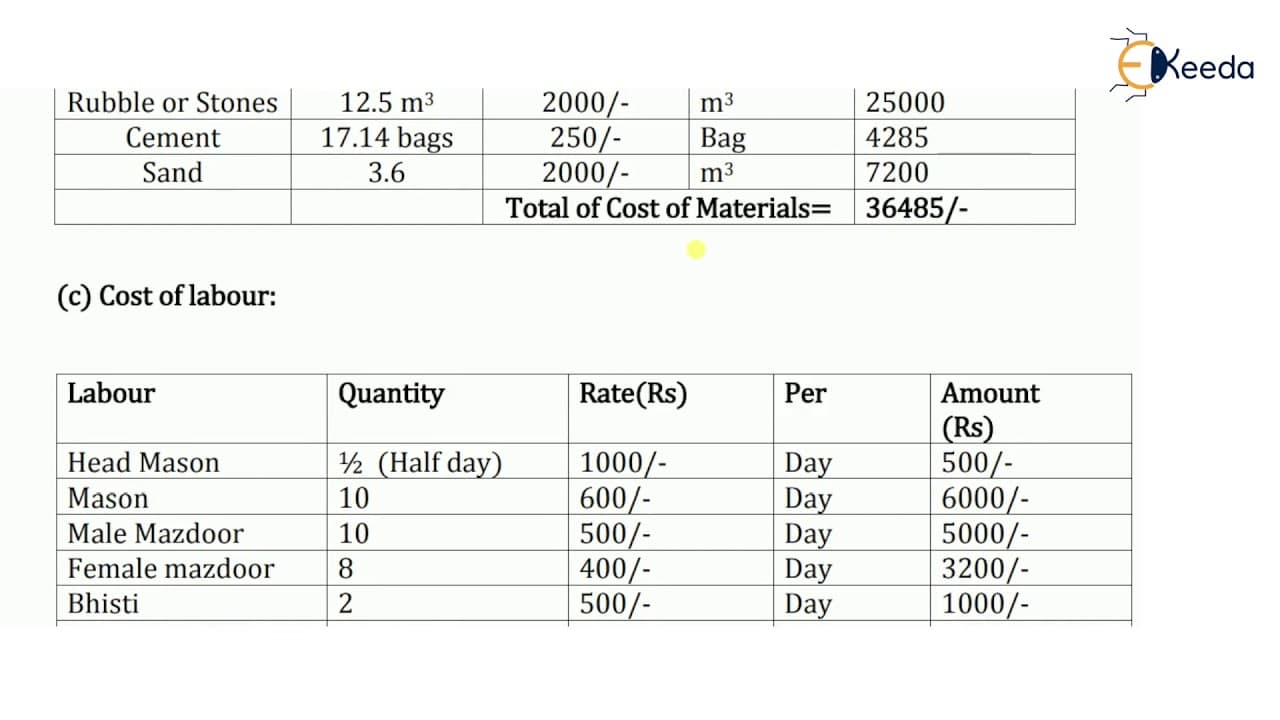
Detailed calculation for rate analysis of uncaused rubble masonry in cement mortar with a proportion of 1:6.
Transcript
hello everyone in this video we are going to see a numerical on rate analysis for unco storable masonry in cement mortar for a superstructure so let's see first the problem statement it says prepare a rate analysis for uncaused rubble masonry the type of masonry given here is uncaused rubble masonry in cement mortar and the proportion given is 1 is... Read More
Key Insights
- 🔇 Dry volume calculation is crucial for determining material requirements accurately.
- ☠️ Labor costs, including different types of workers, are vital components of rate analysis.
- 💦 Contractors' profit and water charges are essential additions to cover project overheads.
- 💦 Understanding standard quantities for work helps in practical estimation.
- ☠️ Market rates for materials can vary, making it important to consider local price variations.
- 📽️ Detailed cost breakdown helps in creating transparent and accurate project estimates.
- ☠️ Rate analysis provides a structured approach to pricing projects in the construction industry.
Install to Summarize YouTube Videos and Get Transcripts
Explore YouTube Video Summarizer or Get YouTube Transcript Extractor
Questions & Answers
Q: What is the significance of assuming a standard quantity of work for rate analysis calculations?
Assuming standard quantities like 10 meter cubes for work helps in estimating material requirements and labor costs accurately based on practical experience and industry norms.
Q: How is the volume of cement calculated for UCR masonry in the given proportion?
The volume of cement is computed by dividing the dry volume by the sum of proportions with the cement proportion in the 1:6 ratio for the specified masonry type.
Q: Why is there a need to consider contractor's profit and water charges in the rate analysis process?
Including contractor's profit and water charges ensures that the total project costs cover overheads, contingencies, and additional expenses beyond materials and labor for accurate pricing.
Q: How is the rate per meter cube for UCR masonry derived from the total cost of materials and labor for a 10-meter cube project?
The rate per meter cube is calculated by dividing the total cost for ten meter cubes by the quantity of work, resulting in a per-unit cost for estimating future projects.
Summary & Key Takeaways
-
Numerical rate analysis for uncaused rubble masonry in cement mortar with a 1:6 proportion.
-
Calculation of material quantities for cement, sand, and rubble stones based on dry volume.
-
Breakdown of costs including materials, labor, contractor's profit, and water charges for a 10-meter cube UCR masonry.
Read in Other Languages (beta)
Share This Summary 📚
Summarize YouTube Videos and Get Video Transcripts with 1-Click
Try YouTube Summary with ChatGPT & Claude or YouTube Transcript Generator
Explore More Summaries from Ekeeda 📚





Summarize YouTube Videos and Get Video Transcripts with 1-Click
Try YouTube Summary with ChatGPT & Claude or YouTube Transcript Generator