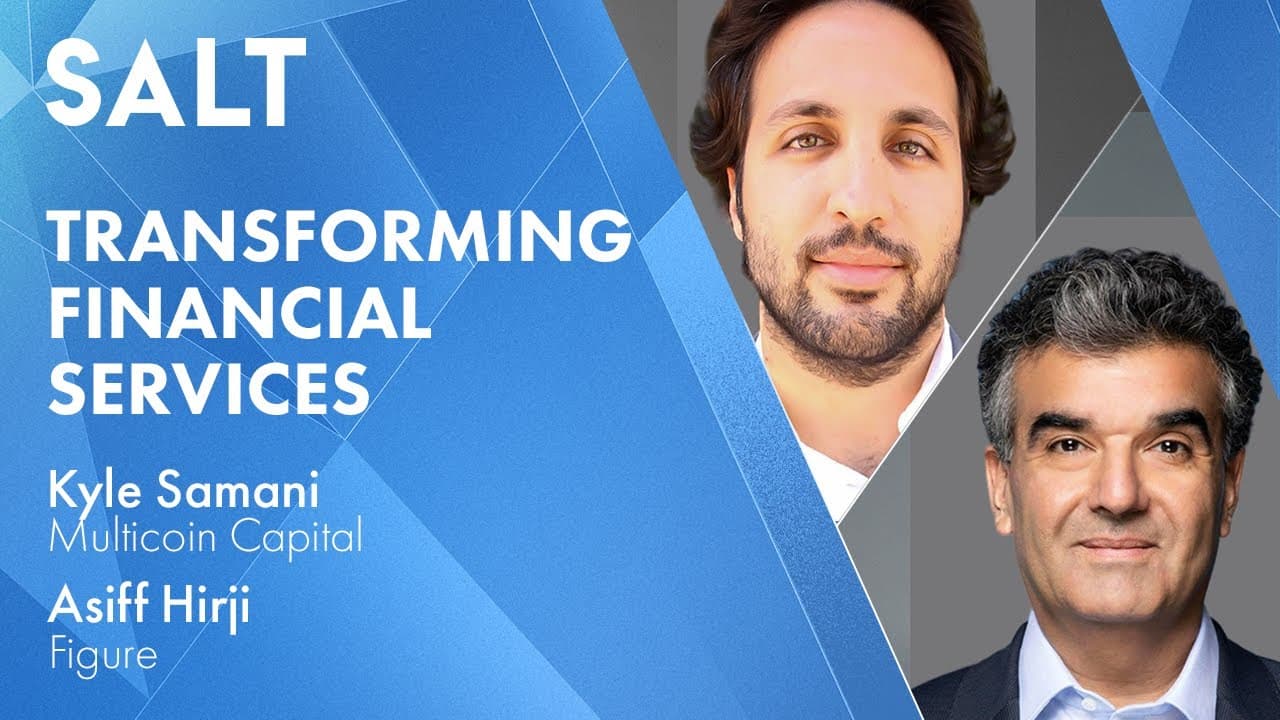
Asiff Hirji & Kyle Samani: Transforming Financial Services | SALT Talks #237
TL;DR
Asaf Jacobi and Kyle Simani discuss the potential of blockchain and crypto in revolutionizing financial services, offering lower costs, increased financial inclusion, and real-time settlement.
Transcript
hello everyone and welcome back to salt talks my name is john darcy i'm the managing director of salt which is a global thought leadership forum and networking platform at the intersection of finance technology and public policy salt talks are a digital interview series that we started in 2020 with leading investors creators and thinkers and our go... Read More
Key Insights
- 🇨🇷 Blockchain technology enables peer-to-peer bilateral settlement, reducing transaction costs and increasing financial inclusion.
- 🌐 Solana offers a scalable platform for global order books, empowering decentralized finance (DeFi) applications.
- 🤗 Social tokens and NFTs open new avenues for monetizing digital assets and engaging with communities.
- 😒 Figure showcases the use of blockchain in home equity lending, highlighting cost savings and real-time data transparency.
Install to Summarize YouTube Videos and Get Transcripts
Explore YouTube Video Summarizer or Get YouTube Transcript Extractor
Questions & Answers
Q: How does blockchain technology revolutionize financial transactions and reduce costs?
Blockchain allows for peer-to-peer bilateral risk-free settlement, eliminating the need for intermediaries and reducing transaction costs. This enables real-time, low-cost financial transactions and fosters financial inclusion.
Q: What are some other compelling use cases for blockchain technology?
Solana, a scalable blockchain platform, enables global permissionless order books and supports decentralized applications. Social tokens and NFTs offer new ways to engage and monetize communities, transforming the intersection of finance and creativity.
Q: How does Figure leverage blockchain in its home equity lending business?
Figure utilizes blockchain to streamline the home equity lending process, replacing intermediaries and reducing complexity. Real-time data transparency improves credit quality, lowers costs, and enables instant transaction settlement.
Q: Are there concerns about regulatory challenges for the crypto industry?
While there are regulatory risks, education and understanding are crucial. Increased awareness of the potential of crypto and blockchain in driving financial innovation and inclusion may lead to more favorable regulations in the long run.
Summary & Key Takeaways
-
Asaf Jacobi highlights the transformative power of blockchain and crypto in financial services, moving from centralized to decentralized systems. He emphasizes the ability to eliminate intermediaries and reduce transaction costs.
-
Kyle Simani shares his journey into the crypto space, recognizing the programmability and extensibility of Ethereum as a major catalyst. He discusses the potential of social tokens and NFTs as new forms of digital assets.
-
They discuss the significance of Solana as an efficient and scalable blockchain platform, enabling global permissionless order books and advancing the DeFi ecosystem.
-
Figure, led by Asaf Jacobi, illustrates the use case of blockchain in home equity lending, demonstrating cost savings, real-time data transparency, and superior credit quality.
-
They address regulatory concerns, acknowledging the need for better understanding and education on the potential of crypto and blockchain. While regulation poses risks, they remain optimistic about the future of the industry.
Read in Other Languages (beta)
Share This Summary 📚
Summarize YouTube Videos and Get Video Transcripts with 1-Click
Try YouTube Summary with ChatGPT & Claude or YouTube Transcript Generator
Explore More Summaries from SALT 📚






Summarize YouTube Videos and Get Video Transcripts with 1-Click
Try YouTube Summary with ChatGPT & Claude or YouTube Transcript Generator