How Do Food and Energy Affect Our Growth?
TL;DR
Food supplies essential building blocks and energy for our bodies, enabling growth from infancy to adulthood. Molecules in food, including fats, sugars, and proteins, are crucial for constructing new body structures and generating cellular energy for everyday functions.
Transcript
- [Instructor] Hey, quick question for you. You ever look at a person's baby pictures and wonder how people go from being small to, well, big? I mean, yes, I get it. People grow up, but here, I'm thinking more on the level of the atoms and molecules that make up the body because A, I'm a scientist and that's kind of what we do, and then also B, bec... Read More
Key Insights
- 🎚️ Growth on a molecular level is responsible for the changes we see in our bodies from infancy to adulthood.
- 😋 Food serves as both a source of molecular building blocks and fuel for our bodies.
- 😋 The molecules in our food are composed of carbon, hydrogen, oxygen, nitrogen, and sometimes other elements.
- 😋 Our cells can break down food molecules to obtain building blocks and generate energy.
- 🫒 The same principles apply to all living organisms, not just humans.
- 😋 The molecules in our food and body are interconnected, and our bodies rely on these molecules for growth and energy production.
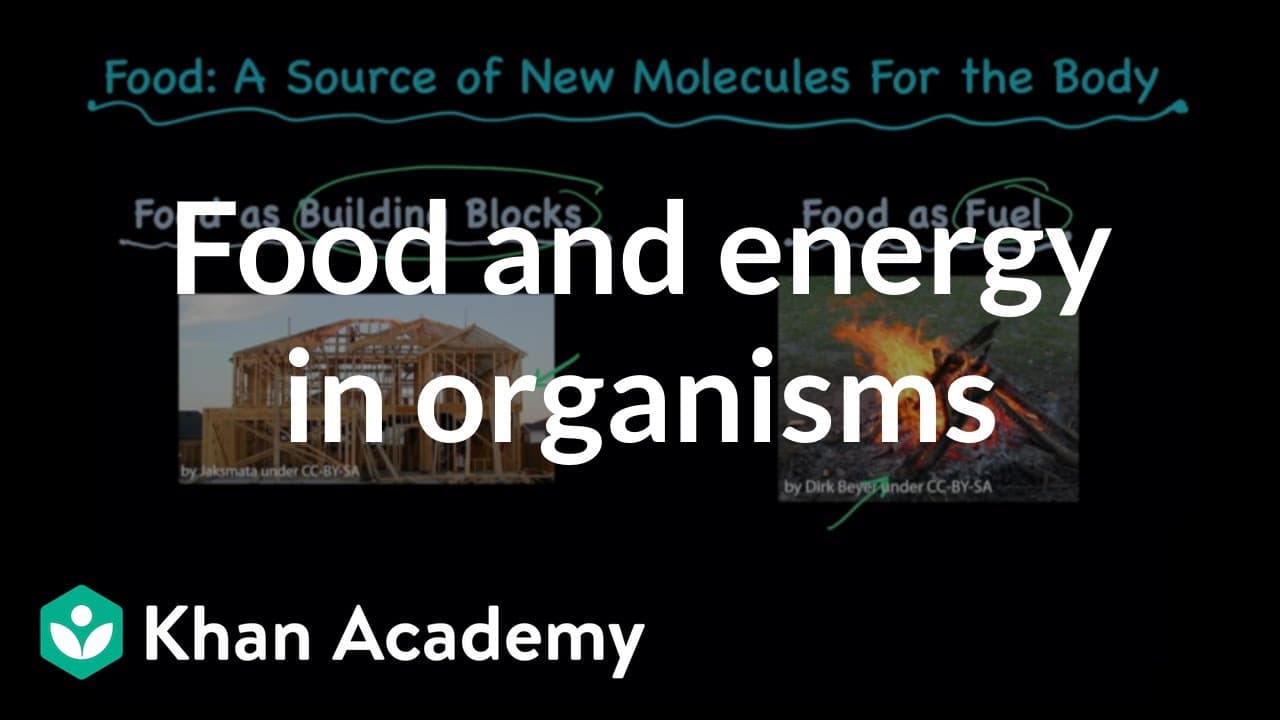
- 😋 Food can be compared to wood, as it can be used for building structures and as a source of fuel.
Install to Summarize YouTube Videos and Get Transcripts
Explore YouTube Video Summarizer or Get YouTube Transcript Extractor
Questions & Answers
Q: How do the molecules in our food contribute to our growth?
The molecules in our food act as both building blocks and fuel for our bodies. They are broken down by our cells to provide the necessary components for growth and energy production.
Q: What elements make up the majority of molecules in our food and body?
The majority of molecules in our food and body are composed of carbon and hydrogen, with oxygen and nitrogen also playing significant roles. Other elements, such as sulfur, may also be present in smaller amounts.
Q: How do our cells use food molecules to build new structures?
Our cells break down food molecules into smaller building blocks, which they can then use to construct new structures in our bodies. This process allows for growth and development.
Q: Can food molecules be used as fuel?
Yes, food molecules can also be used as fuel by our cells. Similar to how wood can be burned to produce energy, our cells can break down food molecules to generate cellular energy, which is then used to support various biological processes.
Summary & Key Takeaways
-
The changes we see in our bodies from infancy to adulthood are reflections of the many molecular changes occurring on a smaller scale.
-
The molecules in our food interact with the molecules in our bodies as building blocks and sources of fuel.
-
Food is composed of fats, sugars, and proteins, which are broken down into small building blocks that our cells use to construct new structures.
Read in Other Languages (beta)
Share This Summary 📚
Summarize YouTube Videos and Get Video Transcripts with 1-Click
Try YouTube Summary with ChatGPT & Claude or YouTube Transcript Generator
Explore More Summaries from Khan Academy 📚



Summarize YouTube Videos and Get Video Transcripts with 1-Click
Try YouTube Summary with ChatGPT & Claude or YouTube Transcript Generator