Silicon based life
TL;DR
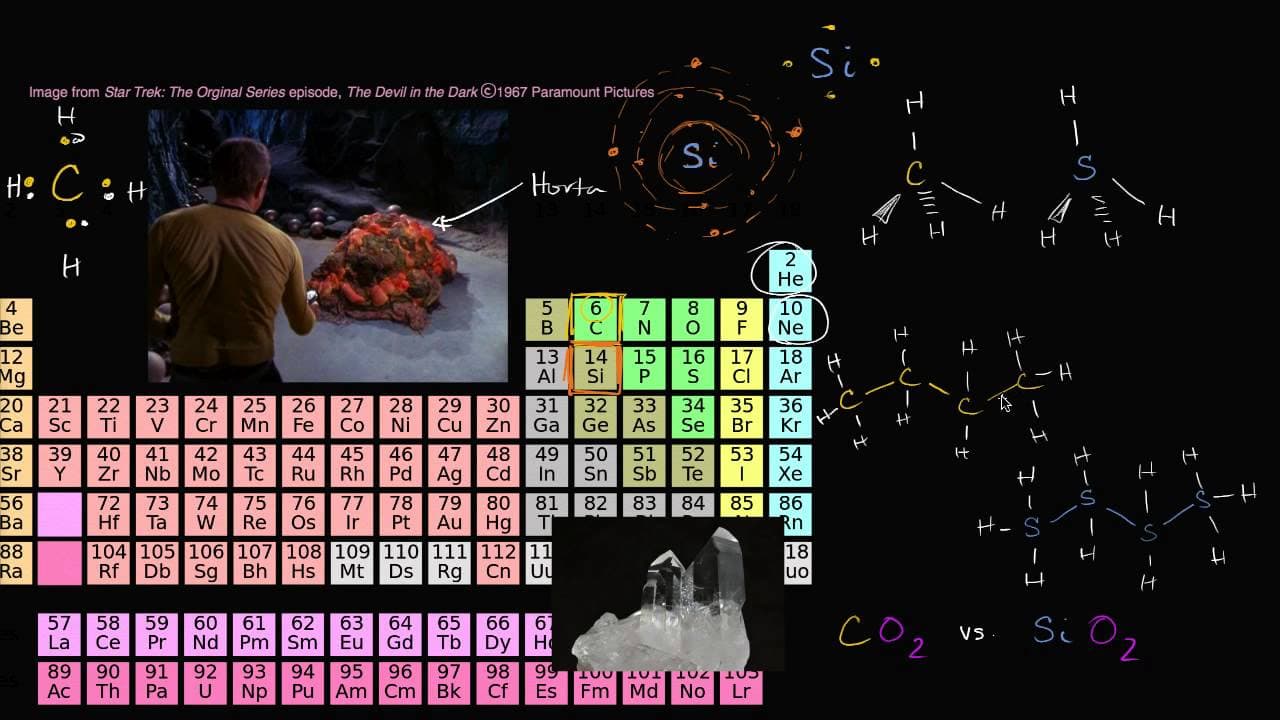
Carbon, with its ability to form four covalent bonds, is well-suited for life formation. Silicon, despite having similar properties, is less favorable due to weaker bonds and limited reactivity.
Transcript
we've talked a lot about why carbon is so awesome for life and a lot of it comes out of the fact that carbon tends to form four covalent bonds and that comes out of the fact that carbon has four valence electrons a neutral carbon would have six electrons same as its number of protons and then the six here tells us the number of protons neutral carb... Read More
Key Insights
- 👻 Carbon's four valence electrons allow it to form stable covalent bonds, enabling the creation of complex molecules.
- 💁 Silicon, having the same number of valence electrons as carbon, appears as a potential candidate for life formation.
- 🛟 However, silicon's weaker bonds and limited reactivity hinder its ability to support the necessary chemical processes for life.
- 🖤 Silicon oxide, the most common compound of silicon, is predominantly found in solid forms and lacks the versatility of carbon dioxide.
- 🛟 Carbon's unique properties and the prevalence of carbon-based compounds make it uniquely suitable for life as we know it.
- 💁 While it's important not to rule out alternative possibilities, the chemistry suggests that carbon is more favorable for life formation.
- 🛟 The example of the silicon-based life-form portrayed in Star Trek illustrates the speculation surrounding silicon's potential as a basis for life.
Install to Summarize YouTube Videos and Get Transcripts
Explore YouTube Video Summarizer or Get YouTube Transcript Extractor
Questions & Answers
Q: Why is carbon considered important for life formation?
Carbon's ability to readily form four covalent bonds allows it to form complex molecules and diverse chemical structures necessary for life processes.
Q: Can silicon be a viable alternative to carbon for life formation?
While silicon has similar properties to carbon, such as four valence electrons, its weaker bonds and limited reactivity make it less likely to support life as we know it.
Q: How does silicon differ from carbon in terms of bond strength?
Carbon-carbon bonds are strong enough to form long hydrocarbon chains, while silicon-silicon bonds are weaker and unable to support extensive chain formations.
Q: Why is silicon oxide not suitable for life formation?
Silicon oxide, unlike carbon dioxide, has strong bonds that limit its participation in chemical reactions and its solubility in various substances, making it less conducive to life processes.
Summary & Key Takeaways
-
Carbon's ability to form four covalent bonds, due to its four valence electrons, makes it ideal for bonding with other elements in various ways.
-
Silicon, which also has four valence electrons, can form four covalent bonds but lacks the strength and reactivity required for life formation.
-
Silicon oxide, the most common form of silicon, is mainly found in solid states like quartz or as a component in glass or sand.
Read in Other Languages (beta)
Share This Summary 📚
Summarize YouTube Videos and Get Video Transcripts with 1-Click
Try YouTube Summary with ChatGPT & Claude or YouTube Transcript Generator
Explore More Summaries from Khan Academy 📚



Summarize YouTube Videos and Get Video Transcripts with 1-Click
Try YouTube Summary with ChatGPT & Claude or YouTube Transcript Generator