Products
Features
YouTube Video Summarizer
Summarize YouTube videos
Web & PDF Highlighter
Highlight web pages & PDFs
Chat with PDF
Ask any PDF questions with AI
Ask AI Clone
Chat with your highlights & memories
Audio Transcriber
Transcribe audio files to text
Glasp Reader
Read and highlight articles
Kindle Highlight Export
Export your Kindle highlights
Idea Hatch
Hatch ideas from your highlights
Integrations
Obsidian Plugin
Notion Integration
Pocket Integration
Instapaper Integration
Medium Integration
Readwise Integration
Snipd Integration
Hypothesis Integration
Apps & Extensions
Chrome Extension
Safari Extension
Edge Add-ons
Firefox Add-ons
iOS App
Android App
Discover
Discover
Ideas
Discover new ideas and insights
Articles
Curated articles and insights
Books
Book recommendations by great minds
Posts
Essays and notes from readers
Quotes
Inspiring quotes collection
Videos
Curated videos and summaries
Explore Glasp
Glasp Newsletter
Weekly insights and updates
Glasp Talk
Interview series with great minds
Glasp Blog
Latest news and articles
Glasp Use Cases
Learn how others use Glasp
Build & Support
Glasp API
Access Glasp's API for developers
MCP Connector
Connect Glasp to Claude & ChatGPT
Community
Glasp Reddit Community
Students
Student discount and benefits
FAQs
Frequently Asked Questions
AboutPricing
DashboardLog inSign up

What Is a Mole in Chemistry and Why Is It Important?
1.7M views
•
April 22, 2014
by
Tyler DeWitt
YouTube video player
What Is a Mole in Chemistry and Why Is It Important?

TL;DR

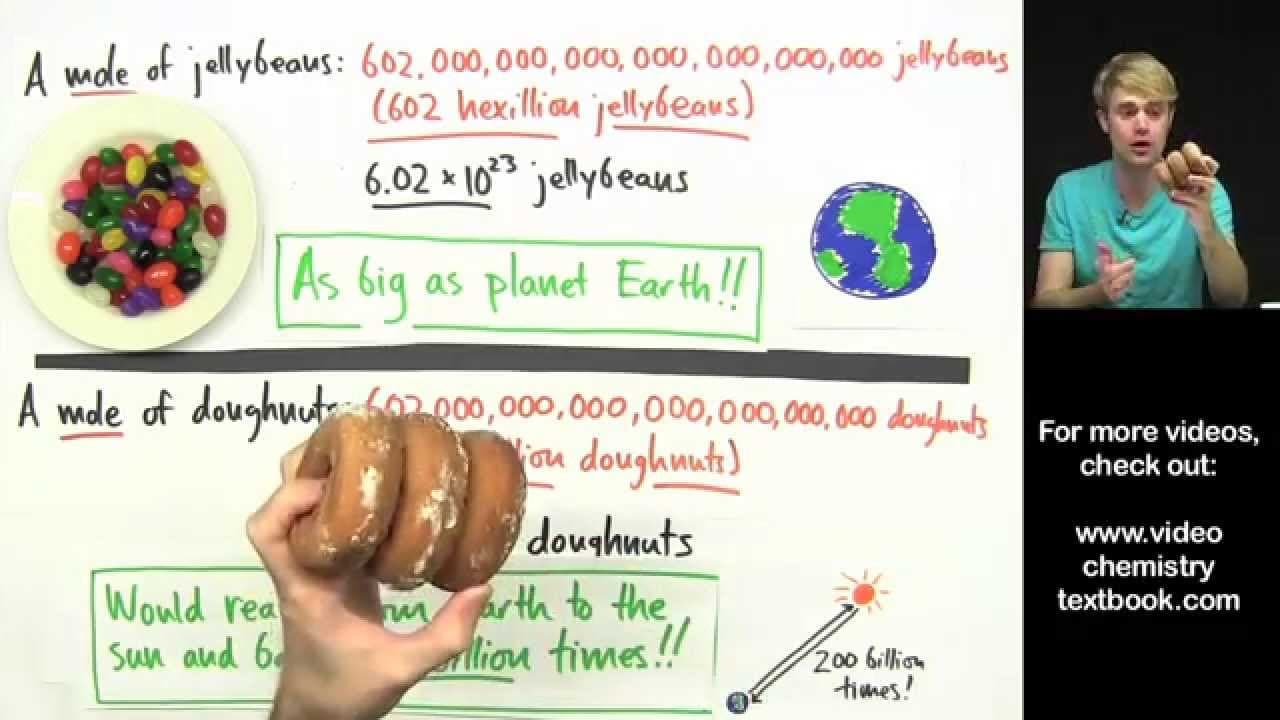
A mole in chemistry represents 602 hexillion entities, equated to Avogadro's number, or 6.02 x 10^23. It serves as a convenient way to quantify different substances, from jellybeans to atoms, highlighting that while a mole of jellybeans would be immense, a mole of atoms fits comfortably in small containers. Understanding moles is essential for grasping fundamental chemical concepts.

Transcript

in this video we're going to talk about the basics of moles we're going to learn about what they are and we're going to talk about some of these important numbers and terms now we're going to start from the very beginning on moles here so no matter how much you know or how much you don't know about moles this video will be a great place to start so... Read More

Key Insights

  • 🇦🇪 A mole is a unit representing 602 hexillion entities in chemistry.
  • ☺️ Avogadro's number, 6.02 x 10^23, is often used to abbreviate this large quantity.
  • #️⃣ Scientific notation simplifies the representation of the massive number of entities in a mole.
  • 🫀 A mole can be of anything, from jellybeans to atoms, depending on the context.
  • 🫀 The comparison between a mole of jellybeans and a mole of sulfur atoms highlights the vast difference in size.

Install to Summarize YouTube Videos and Get Transcripts

Explore YouTube Video Summarizer or Get YouTube Transcript Extractor

Questions & Answers

Q: What is a mole in the context of chemistry?

A mole is a unit used to quantify entities, containing 602 hexillion things, equivalent to 6.02 x 10^23.

Q: How is a mole different from a dozen?

A dozen represents 12 entities, while a mole is a vastly larger quantity of 602 hexillion entities.

Q: Why is scientific notation used for the number of entities in a mole?

Scientific notation, like 6.02 x 10^23, simplifies the representation of the massive number of entities in a mole for easier calculations.

Q: How does the size of a mole of jellybeans compare to a mole of atoms?

A mole of jellybeans would be as large as Earth, while a mole of atoms is much smaller and can fit in a small container due to the minuscule size of atoms.

Summary & Key Takeaways

  • A mole represents a specific number of entities, like a dozen does.

  • It contains 602 hexillion entities, abbreviated in scientific notation as 6.02 x 10^23.

  • Despite its massive size, a mole can be of anything from doughnuts to atoms.


Read in Other Languages (beta)

English

Share This Summary 📚

Summarize YouTube Videos and Get Video Transcripts with 1-Click

Download browser extensions on:

Try YouTube Summary with ChatGPT & Claude or YouTube Transcript Generator

Explore More Summaries from Tyler DeWitt 📚
Electroplating Part 2 thumbnail
Electroplating Part 2
Tyler DeWitt
What Are Endothermic and Exothermic Phase Changes? thumbnail
What Are Endothermic and Exothermic Phase Changes?
Tyler DeWitt
Charge of an Electron: Millikan's Oil Drop Experiment thumbnail
Charge of an Electron: Millikan's Oil Drop Experiment
Tyler DeWitt
How Can You Succeed on the AP Chemistry Exam Smarter? thumbnail
How Can You Succeed on the AP Chemistry Exam Smarter?
Tyler DeWitt
How to Calculate Oxidation Numbers Introduction thumbnail
How to Calculate Oxidation Numbers Introduction
Tyler DeWitt
AP® Chemistry Kinetics Questions Free Response thumbnail
AP® Chemistry Kinetics Questions Free Response
Tyler DeWitt

Summarize YouTube Videos and Get Video Transcripts with 1-Click

Download browser extensions on:

Try YouTube Summary with ChatGPT & Claude or YouTube Transcript Generator

Apps & Extensions

  • Chrome Extension
  • Safari Extension
  • Edge Add-ons
  • Firefox Add-ons
  • iOS App
  • Android App

Key Features

  • YouTube Video Summarizer
  • Web & PDF Summarizer
  • Web & PDF Highlighter
  • Chat with PDF
  • Ask AI Clone
  • Audio Transcriber
  • Glasp Reader
  • Kindle Highlight Export
  • Idea Hatch

Integrations

  • Obsidian Plugin
  • Notion Integration
  • Pocket Integration
  • Instapaper Integration
  • Medium Integration
  • Readwise Integration
  • Snipd Integration
  • Hypothesis Integration

More Features

  • APIs
  • MCP Connector
  • Blog & Post
  • Embed Links
  • Image Highlight
  • Personality Test
  • Quote Shots

Company

  • About us
  • Blog
  • Community
  • FAQs
  • Job Board
  • Newsletter
  • Pricing
Terms

•

Privacy

•

Guidelines

© 2026 Glasp Inc. All rights reserved.