What Is Impedance in RC Circuits and How to Calculate It?
TL;DR
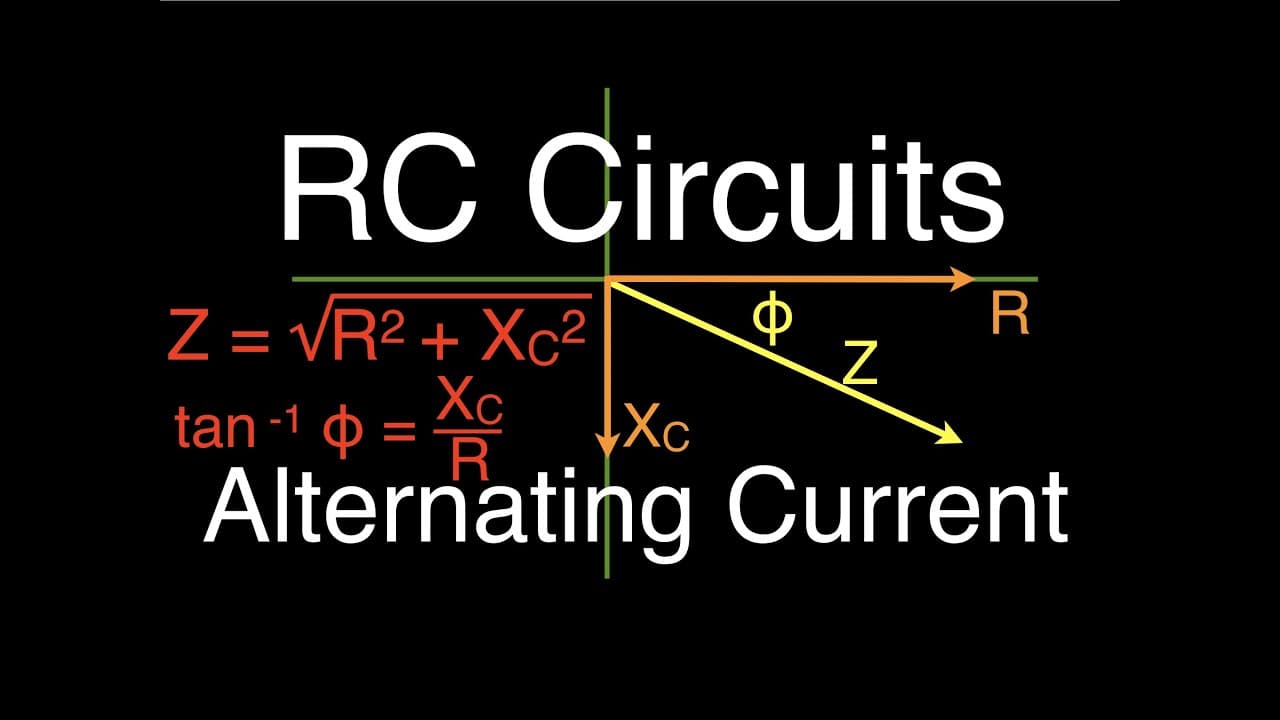
Impedance in RC circuits is the total opposition to current flow, calculated by combining resistance and capacitive reactance. It is represented by the formula Z = √(R² + Xc²), where Z is impedance, R is resistance, and Xc is capacitive reactance. Understanding impedance is essential for analyzing the current and voltage relationships within these circuits.
Transcript
okay today's video as you see is entitled AEC capacitive reactance part two and in this video I'm going to go over conceptually voltage and pins and phasor diagrams for our C circuit in the following videos I will go over some work calculation examples but for this video this is the circuit diagram that when you're talking about an our C circuit we... Read More
Key Insights
- ⚡ Voltage phasor diagrams illustrate the relationships between source voltage, resistor voltage, and capacitor voltage in AEC circuits.
- 🥺 Phase angles indicate the lead or lag of current compared to voltage in AEC circuits.
- 💐 Impedance is the total opposition to electron flow in AEC circuits, determined by adding resistive and reactive components.
- ⚡ Calculating source voltage, current, and impedance in AEC circuits involves using equations and graphical representations.
- 🔺 Understanding the behavior of AEC circuits requires knowledge of resistance, reactance, impedance, and phase angles.
- 🥺 Voltage lags current in capacitive circuits, leading to specific phase angles and impedance calculations.
- 🆘 Impedance calculations in AEC circuits help in optimizing circuit performance and efficiency.
Install to Summarize YouTube Videos and Get Transcripts
Explore YouTube Video Summarizer or Get YouTube Transcript Extractor
Questions & Answers
Q: What is the significance of phase angles in AEC circuits?
Phase angles indicate the relationship between voltage and current, with angles between 0 and 90 degrees showing how current leads voltage in capacitive circuits.
Q: How is impedance calculated in AEC circuits?
Impedance in AEC circuits is the total opposition to electron flow, calculated by adding resistive and reactive components using the Pythagorean theorem.
Q: Why is impedance important in AEC circuits?
Impedance determines how much resistance and reactance a circuit offers to the flow of electrons, impacting the overall performance and behavior of the circuit.
Q: How do voltage phasor diagrams aid in understanding AEC circuits?
Voltage phasor diagrams visually represent the relationships between source voltage, resistor voltage, and capacitor voltage, making it easier to analyze and calculate values in AEC circuits.
Summary & Key Takeaways
-
Video breaks down voltage phasor diagrams for AEC circuits, emphasizing phase angles and current relationships.
-
Explains impedance as the total opposition in AEC circuits due to resistance and reactance.
-
Provides equations and graphical representations for calculating source voltage, current, and impedance in AEC circuits.
Read in Other Languages (beta)
Share This Summary 📚
Summarize YouTube Videos and Get Video Transcripts with 1-Click
Try YouTube Summary with ChatGPT & Claude or YouTube Transcript Generator
Explore More Summaries from Step by Step Science 📚






Summarize YouTube Videos and Get Video Transcripts with 1-Click
Try YouTube Summary with ChatGPT & Claude or YouTube Transcript Generator