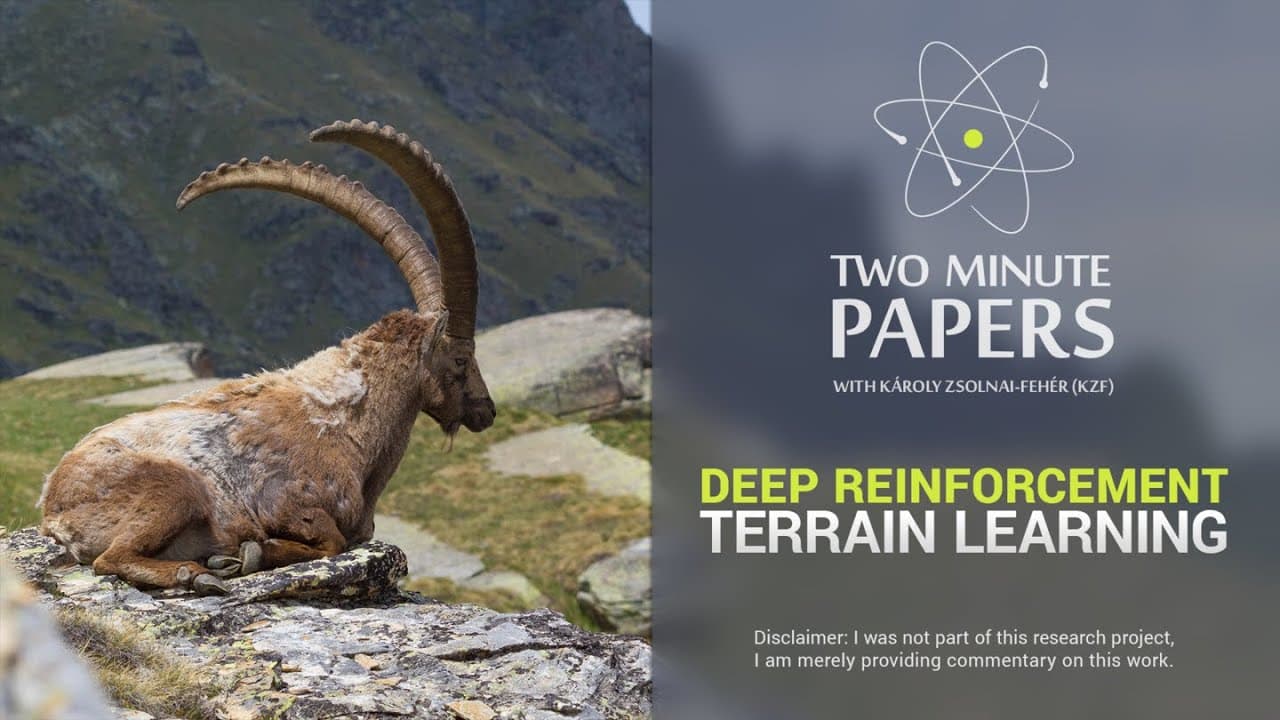
Deep Reinforcement Terrain Learning | Two Minute Papers #67
TL;DR
Creatures learn to walk and adapt movements to overcome obstacles using deep reinforcement learning in a 2D environment.
Transcript
Dear Fellow Scholars, this is Two Minute Papers with Károly Zsolnai-Fehér. This is a followup work to a technique we have talked about earlier. We have seen how different creatures learned to walk, and their movement patterns happened to be robust to slight variations in the terrain. In this work, we imagine these creatures as a collection of joint... Read More
Key Insights
- 🚶 Creatures learn to walk and adapt movements through deep reinforcement learning.
- ❓ The technique focuses on character and terrain features to enhance movement capabilities.
- ♻️ Limitations include being restricted to a 2D environment, posing challenges for more advanced movements.
- 👨🔬 Future research may explore applying results to 3D environments for broader applications.
- 🙈 Unified physics systems and error metrics are seen as essential for evaluating locomotion techniques effectively.
- 👨🔬 Research highlights the potential for significant advancements in locomotion studies.
- 👨🔬 The importance of discussing limitations and long-term potential in research is emphasized.
Install to Summarize YouTube Videos and Get Transcripts
Explore YouTube Video Summarizer or Get YouTube Transcript Extractor
Questions & Answers
Q: How do creatures in this study learn to walk and adapt their movements?
Creatures in the study learn to walk and adapt by monitoring their surroundings, focusing on character and terrain features through deep reinforcement learning.
Q: What machinery is used to achieve these learning capabilities in creatures?
The technique utilizes a combination of deep neural networks and reinforcement learning algorithms to teach creatures how to modify their movements based on feedback.
Q: What are some limitations of the technique used in this study?
One limitation is that the technique is restricted to a 2D environment, meaning creatures can only walk on a plane rather than in a 3D world, which poses challenges for more complex movements.
Q: What are the implications of this research for the future of locomotion studies?
The research shows the potential for significant advancements in locomotion studies, highlighting the need for a unified physics system and error metrics for evaluating different techniques accurately.
Summary & Key Takeaways
-
Creatures with joint and link structures learn to walk and adapt movements in response to terrain variations.
-
Deep reinforcement learning is used to teach creatures to modify their center of mass and movement patterns.
-
Limitations include 2D restrictions but show potential for future advancements in locomotion research.
Read in Other Languages (beta)
Share This Summary 📚
Summarize YouTube Videos and Get Video Transcripts with 1-Click
Try YouTube Summary with ChatGPT & Claude or YouTube Transcript Generator
Explore More Summaries from Two Minute Papers 📚




Summarize YouTube Videos and Get Video Transcripts with 1-Click
Try YouTube Summary with ChatGPT & Claude or YouTube Transcript Generator