Twist Drill - Tool Engineering - Production Process II
TL;DR
Twist drills are used for creating holes in workpieces efficiently, but may require subsequent operations for a finer finish.
Transcript
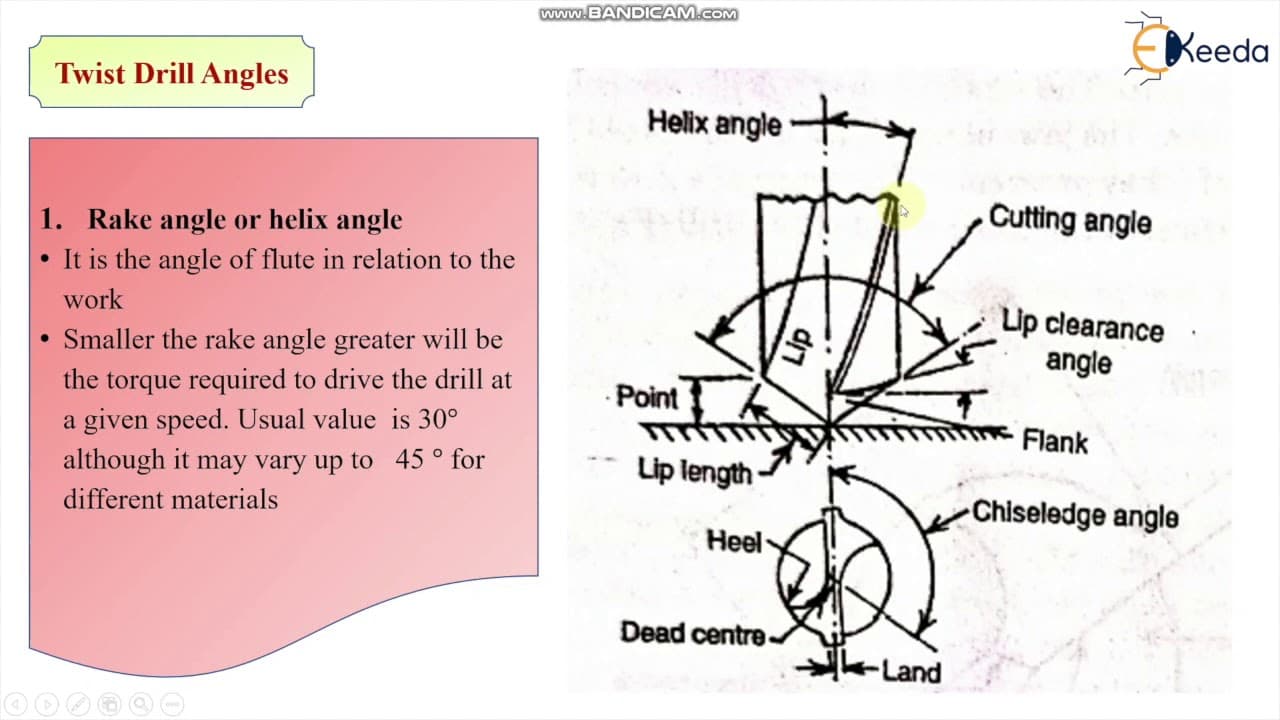
now students let us go for the next to that is the twist feel we have done the things about the single point cutting tool so it can have out the twist ring okay so the drill you can see other in pictures these are the twisters and it's showing is diameter here this is the 10mm J this is 80 mm J this is 6 mm drill like that these are the diameters o... Read More
Key Insights
- 🕳️ Twist drills efficiently remove metal to create holes in workpieces.
- 🏣 Subsequent operations like boring may be needed for a finer finish post-drilling.
- 🦻 The flutes of twist drills aid in rake angle provision and chip removal.
- ⚾ Drill specifications categorize them based on the material they are designed for.
- 💇 Cutting speed, feed, and depth of cut are critical factors in drill operation efficiency.
- 🔺 Various angles like rake angle and lip clearance angle affect drill performance.
- 🔀 Twist drills are available in different types for specific material applications.
Install to Summarize YouTube Videos and Get Transcripts
Explore YouTube Video Summarizer or Get YouTube Transcript Extractor
Questions & Answers
Q: What is the main purpose of twist drills?
Twist drills are primarily used to efficiently remove metal and create holes in workpieces, maximizing productivity in machining processes.
Q: Why might subsequent operations like boring be necessary after using a twist drill?
While twist drills are effective at removing metal quickly, the finishing quality may not be optimal, necessitating additional operations like boring to achieve a smoother surface.
Q: How are the flutes of a twist drill beneficial during the drilling process?
The flutes of a twist drill provide a rake angle, form cutting edges, create a coolant passage, and facilitate chip removal, enhancing the efficiency of the drilling operation.
Q: What are the key components of a twist drill and their functions?
The body, shank, flutes, lips, and dead center are crucial parts of a twist drill, each contributing to its cutting capabilities and efficiency in removing material during drilling.
Summary & Key Takeaways
-
Twist drills are essential for producing holes in workpieces by removing metal quickly.
-
The finishing quality of drills may not be ideal, leading to additional operations like boring.
-
Twist drills have helical grooves forming flutes that aid in various functions during the drilling process.
Read in Other Languages (beta)
Share This Summary 📚
Summarize YouTube Videos and Get Video Transcripts with 1-Click
Try YouTube Summary with ChatGPT & Claude or YouTube Transcript Generator
Explore More Summaries from Ekeeda 📚






Summarize YouTube Videos and Get Video Transcripts with 1-Click
Try YouTube Summary with ChatGPT & Claude or YouTube Transcript Generator