Proofs of Properties Regarding the Expected Value of a Function of a Random Variable
TL;DR
The video discusses proving expected value properties using integrals and density functions.
Transcript
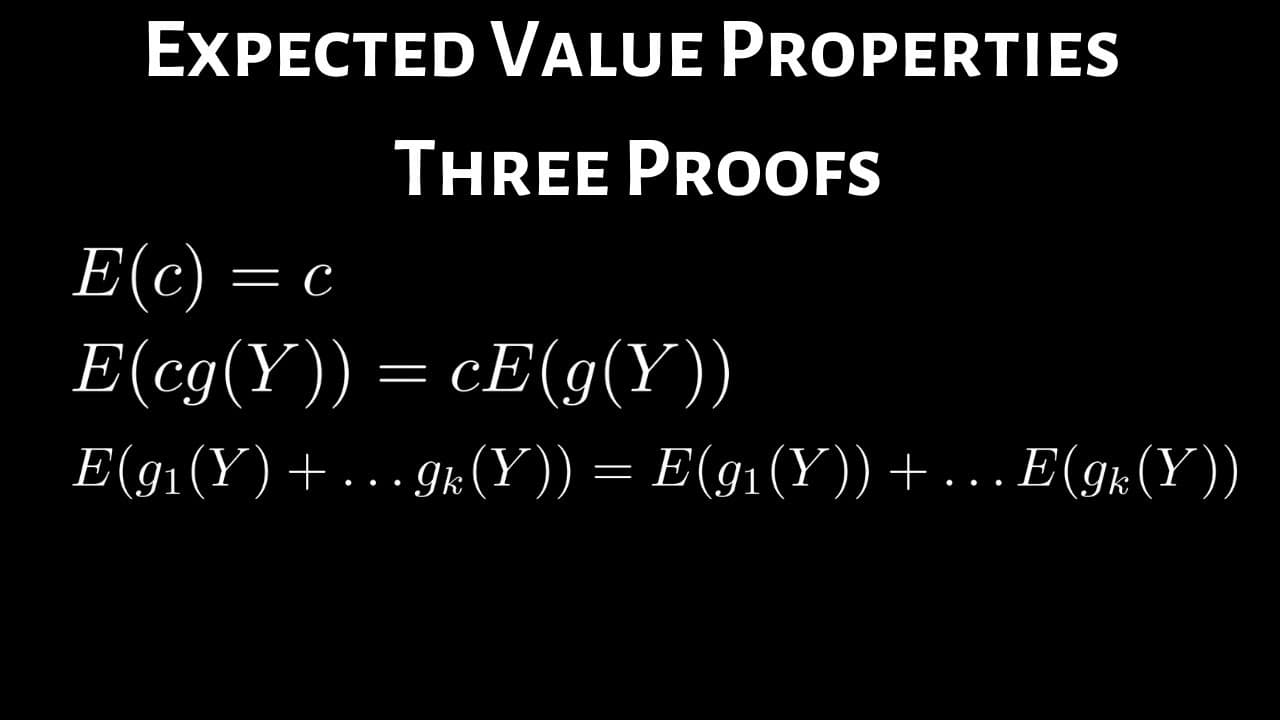
in this problem we have to prove all three of these things and to do that we're going to use a previous theorem if you have the expected value of a function of a random variable which we'll call y and you want the expected value of this this is equal to the improper integral from negative infinity to infinity of g of y times f of y i should should ... Read More
Key Insights
- 👍 Utilizing integrals and density functions are crucial in proving expected value properties.
- ❓ Linearity of integrals is a fundamental concept in determining expected values efficiently.
- 🟰 The expected value of a constant function is equal to the constant itself due to properties of integrals.
- 🧑🏭 Constant factors can be pulled out of integrals to simplify expected value calculations.
Install to Summarize YouTube Videos and Get Transcripts
Explore YouTube Video Summarizer or Get YouTube Transcript Extractor
Questions & Answers
Q: What is the expected value of a constant function in terms of integrals?
The expected value of a constant function is simply equal to the constant itself. This is proven by replacing the function in the integral formula and using the linearity of integrals.
Q: How do integrals help in proving the expected value of a constant times a function?
Integrals allow us to pull out constants and simplify the calculation to obtain the expected value of a constant times a function of a random variable.
Q: What is the proof for the expected value of the sum of functions of a random variable?
By distributing the density function throughout the sum of functions and using the linearity property of integrals, we can show that the expected value of the sum is equal to the sum of expected values.
Summary & Key Takeaways
-
The video demonstrates proofs for expected value properties using integrals and density functions.
-
Proofs are shown for expected value of a constant, a constant times a function, and a sum of functions of a random variable.
-
Linearity properties of integrals are crucial in proving these expected value properties.
Read in Other Languages (beta)
Share This Summary 📚
Summarize YouTube Videos and Get Video Transcripts with 1-Click
Try YouTube Summary with ChatGPT & Claude or YouTube Transcript Generator
Explore More Summaries from The Math Sorcerer 📚


Summarize YouTube Videos and Get Video Transcripts with 1-Click
Try YouTube Summary with ChatGPT & Claude or YouTube Transcript Generator