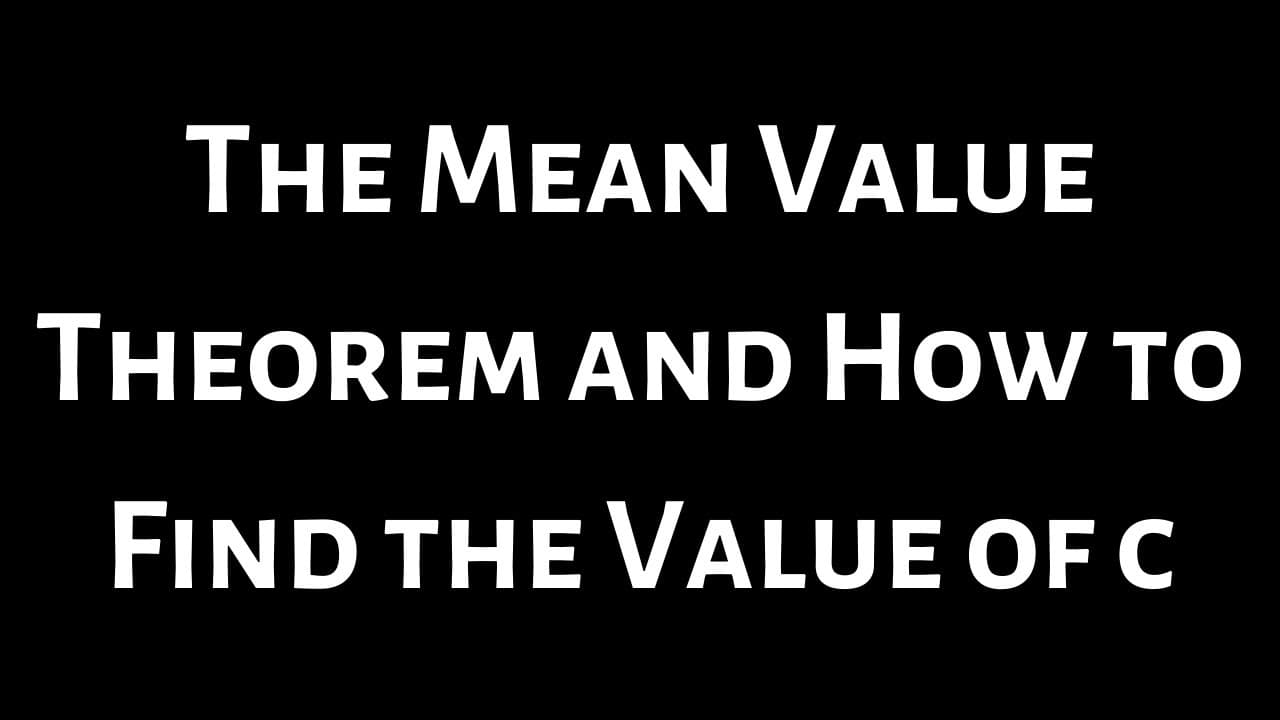
The Mean Value Theorem From Calculus Explanation and Example of Finding c
TL;DR
The Mean Value Theorem states that for a continuous and differentiable function on a closed interval, there exists a point where the tangent line is parallel to the secant line.
Transcript
everyone thanks for sitting my channel and this problem we're going to talk about one of the important theorems of calculus called the mean value theorem here there's a couple mean value theorems in calculus this is the mean value theorem this is the the first one the most important one maybe it's the first one you learn we can abbreviate with thre... Read More
Key Insights
- ❓ The Mean Value Theorem requires function continuity and differentiability on specified intervals.
- ☠️ It bridges the gap between average and instantaneous rates of change in calculus.
- 🚨 Rolle's Theorem emerges as a specific case within the broader Mean Value Theorem application.
- ❓ The Mean Value Theorem illustrates the correlation between tangents and secants in calculus.
- 😥 Finding the point where the derivative equals the secant slope is crucial in Mean Value Theorem applications.
- 🆘 Graphical representations help visualize the Mean Value Theorem concept effectively.
- 🫥 Application of the theorem involves identifying a point where the tangent line mirrors the slope of the secant.
Install to Summarize YouTube Videos and Get Transcripts
Explore YouTube Video Summarizer or Get YouTube Transcript Extractor
Questions & Answers
Q: What are the conditions for the Mean Value Theorem to hold?
The function must be continuous on the closed interval and differentiable on the open interval. These conditions ensure the existence of a point where the derivative equals the slope of the secant line.
Q: How does the Mean Value Theorem relate to Rolle's Theorem?
Rolle's Theorem is a special case of the Mean Value Theorem where the endpoints have equal y-values. The Mean Value Theorem extends this concept by focusing on the relationship between tangents and secants.
Q: What does it mean when the tangent line is parallel to the secant line?
It signifies that at a specific point in the interval, the instantaneous rate of change (derivative) is equal to the average rate of change (slope of the secant line).
Q: Can you provide an example of applying the Mean Value Theorem?
Yes, for a function f(x) = x^2 on the interval [0, 1], we find a point C where the derivative (2x) equals the slope of the secant line (1) showing how the theorem works in practice.
Summary & Key Takeaways
-
The Mean Value Theorem in calculus is essential and has conditions related to continuity and differentiability.
-
If a function meets the conditions, there exists a number in the interval where the derivative equals the slope of the secant line.
-
This theorem shows a relationship between average and instantaneous rates of change in a function.
Read in Other Languages (beta)
Share This Summary 📚
Summarize YouTube Videos and Get Video Transcripts with 1-Click
Try YouTube Summary with ChatGPT & Claude or YouTube Transcript Generator
Explore More Summaries from The Math Sorcerer 📚
Summarize YouTube Videos and Get Video Transcripts with 1-Click
Try YouTube Summary with ChatGPT & Claude or YouTube Transcript Generator