Free Radical Reactions
TL;DR
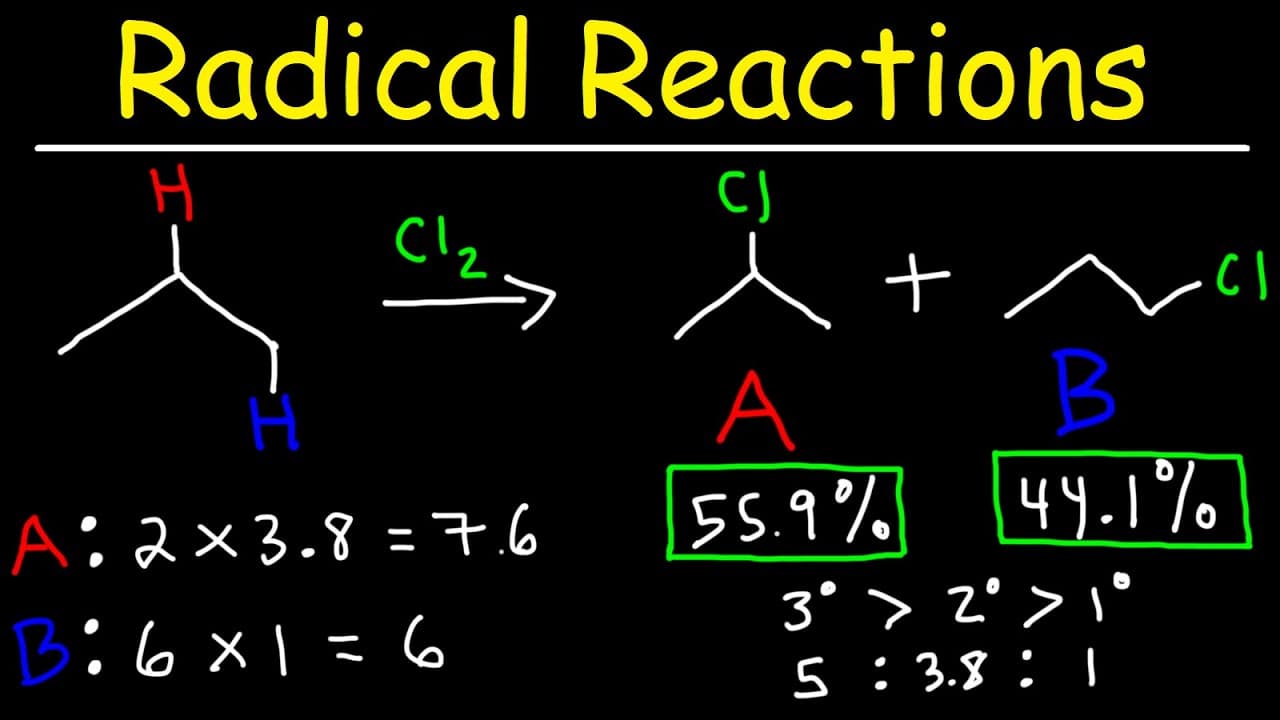
This video explains the concept of radicals, their formation through bond cleavage, and the different types of bond cleavage. It also discusses the three steps of a free radical reaction (initiation, propagation, and termination), and the selectivity of halogens in alkane substitution reactions.
Transcript
in this video we're going to talk about free radical reactions but first let's focus on radicals what are radicals and how are radicals formed a radical is basically any species or any atom with an unpaired number of electrons so any atom that has an odd number of electrons will have at least one unpaired electron and so that's going to be a radica... Read More
Key Insights
- 💁 Radicals are species with unpaired electrons and can be formed through bond cleavage.
- 😑 Heterolytic bond cleavage results in charged ions, while homolytic bond cleavage produces radicals.
- 🥶 Free radical reactions involve initiation, propagation, and termination steps.
- ❓ The selectivity of halogens in alkane substitution reactions is influenced by their reactivity and differences in activation energy.
- ❓ Chlorine is less selective and can replace both primary and secondary hydrogens, while bromine is more selective and prefers secondary hydrogens.
- ❓ The stability of the resulting radicals also influences the selectivity of halogens.
- ❓ Understanding the concepts of radicals and their reactions is important in organic chemistry.
Install to Summarize YouTube Videos and Get Transcripts
Explore YouTube Video Summarizer or Get YouTube Transcript Extractor
Questions & Answers
Q: What is a radical and how is it formed?
A radical is an atom or species with an unpaired electron. It is formed through bond cleavage, which can be either homolytic or heterolytic. In heterolytic cleavage, the electrons go towards the more electronegative atom.
Q: What is the difference between homolytic and heterolytic bond cleavage?
Homolytic bond cleavage occurs when two atoms of the same kind bond together and the electrons are distributed equally. Heterolytic bond cleavage occurs when two different atoms are bonded, and the electrons are pulled towards the more electronegative atom.
Q: What are the three steps of a free radical reaction?
The three steps are initiation, propagation, and termination. Initiation involves the generation of radicals from a neutral molecule. Propagation occurs when a radical reacts with a molecule to form a new radical and a new molecule. Termination happens when two radicals react to form a non-radical product.
Q: How does the selectivity of halogens in alkane substitution reactions differ?
Chlorine is less selective and can replace both primary and secondary hydrogens, while bromine is more selective and prefers to replace secondary hydrogens. The reactivity and selectivity of halogens are influenced by differences in activation energy and radical stability.
Summary & Key Takeaways
-
Radical species have unpaired electrons and can be formed through homolytic and heterolytic bond cleavage.
-
In heterolytic bond cleavage, the electrons go towards the more electronegative atom, resulting in ions with positive and negative charges.
-
Free radical reactions involve initiation, propagation, and termination steps, and can be observed in the chlorination of methane.
Read in Other Languages (beta)
Share This Summary 📚
Summarize YouTube Videos and Get Video Transcripts with 1-Click
Try YouTube Summary with ChatGPT & Claude or YouTube Transcript Generator
Explore More Summaries from The Organic Chemistry Tutor 📚




Summarize YouTube Videos and Get Video Transcripts with 1-Click
Try YouTube Summary with ChatGPT & Claude or YouTube Transcript Generator