What Is the Market Maker Trap in Head and Shoulders Patterns?
TL;DR
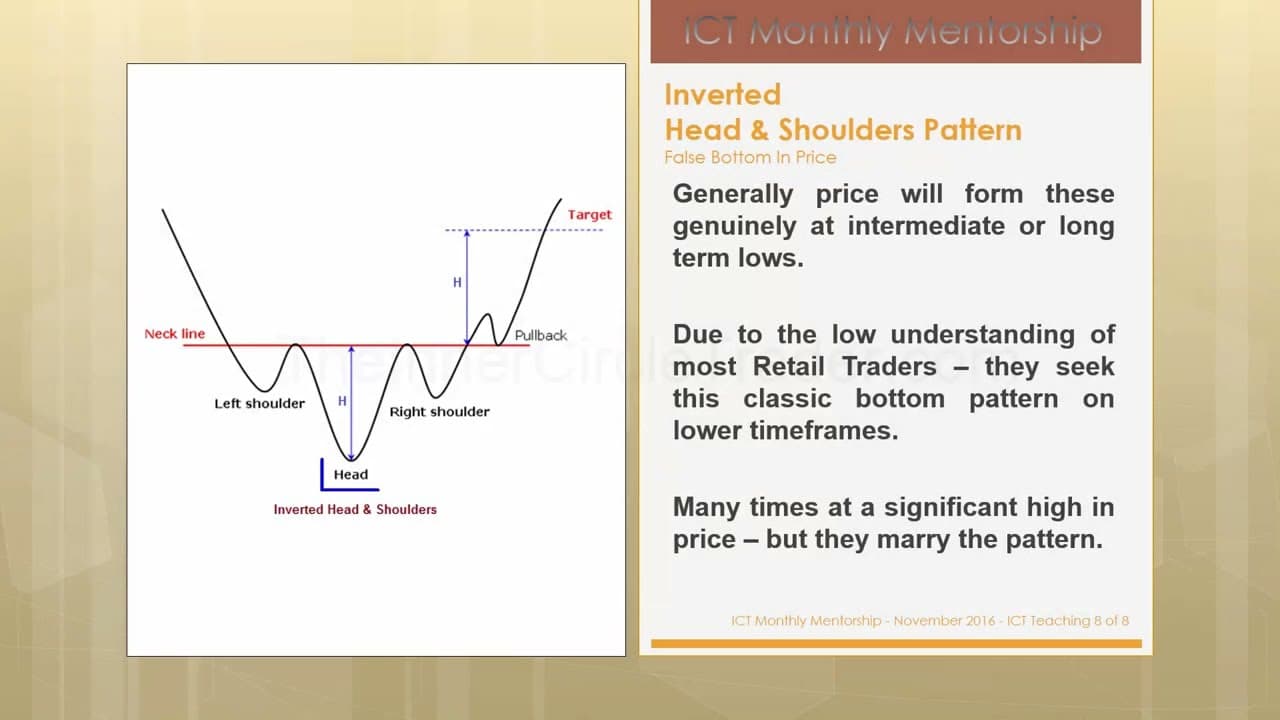
The Market Maker Trap occurs when retail traders misinterpret head and shoulders patterns, leading them to make unprofitable trades on lower time frames. Recognizing institutional order flow allows traders to identify true market trends and profit from false bottom patterns, particularly the inverted head and shoulders, by leveraging the missteps of less experienced traders.
Transcript
for the month of november 2016 ict mentorship we're talking about false tops and bottom patterns as it relates to classical head and shoulders now head and shoulders pattern is typically seen with a price high that trades in a small little retracement then it creates a higher high and it retraces back lower and it creates another lower price peak o... Read More
Key Insights
- 🤕 The head and shoulders pattern is commonly misunderstood and misused by retail traders.
- 🤕 Inverted head and shoulders patterns can present profitable selling opportunities.
- 💐 Understanding institutional order flow can help identify false patterns and profitable trading opportunities.
- 💹 Retail traders often force the understanding of classical chart patterns into the charts, leading to unprofitable trades.
- ⏳ Using higher time frame analysis and looking for institutional order flow can help identify the true direction of price.
- 🥺 Recognizing retail traps and capitalizing on them can lead to successful trades.
- ✋ Buy stops and sell stops play a crucial role in false top and bottom patterns.
Install to Summarize YouTube Videos and Get Transcripts
Explore YouTube Video Summarizer or Get YouTube Transcript Extractor
Questions & Answers
Q: What is the difference between a regular head and shoulders pattern and an inverted head and shoulders pattern?
In a regular head and shoulders pattern, three successive peaks in price are connected with a neckline, while in an inverted head and shoulders pattern, three successive lower lows are connected with a neckline.
Q: Why do retail traders often misuse the head and shoulders pattern?
Retail traders tend to look for head and shoulders patterns on lower time frames and at significant lows in price, which is not when these patterns typically form. They force the understanding of what they've learned from books into the charts, leading to unprofitable trades.
Q: How can institutional order flow help in identifying false top and bottom patterns?
By studying institutional order flow, traders can recognize false patterns in price charts and capitalize on them. For example, seeing a head and shoulders pattern as a retail trap can present a buying opportunity when the neckline is broken.
Q: Can the inverted head and shoulders pattern be used to make profitable trades?
Yes, the inverted head and shoulders pattern can be used to identify selling opportunities, especially when it appears in a bearish market. Traders can sell when the neckline is broken and expect a run on sell stops and a move lower.
Summary & Key Takeaways
-
The head and shoulders pattern is commonly misused by retail traders, who often look for it on lower time frames and at the wrong price levels.
-
The inverted head and shoulders pattern is a false bottom pattern that can be profitable when it appears in charts, especially if it contradicts the higher time frame trend.
-
By understanding institutional order flow and recognizing retail traps, traders can identify buying opportunities when the neckline of a head and shoulders pattern is broken, or selling opportunities when the neckline of an inverted head and shoulders pattern is broken.
Read in Other Languages (beta)
Share This Summary 📚
Summarize YouTube Videos and Get Video Transcripts with 1-Click
Try YouTube Summary with ChatGPT & Claude or YouTube Transcript Generator
Explore More Summaries from The Inner Circle Trader 📚



Summarize YouTube Videos and Get Video Transcripts with 1-Click
Try YouTube Summary with ChatGPT & Claude or YouTube Transcript Generator