Epsilon-delta definition of limits
TL;DR
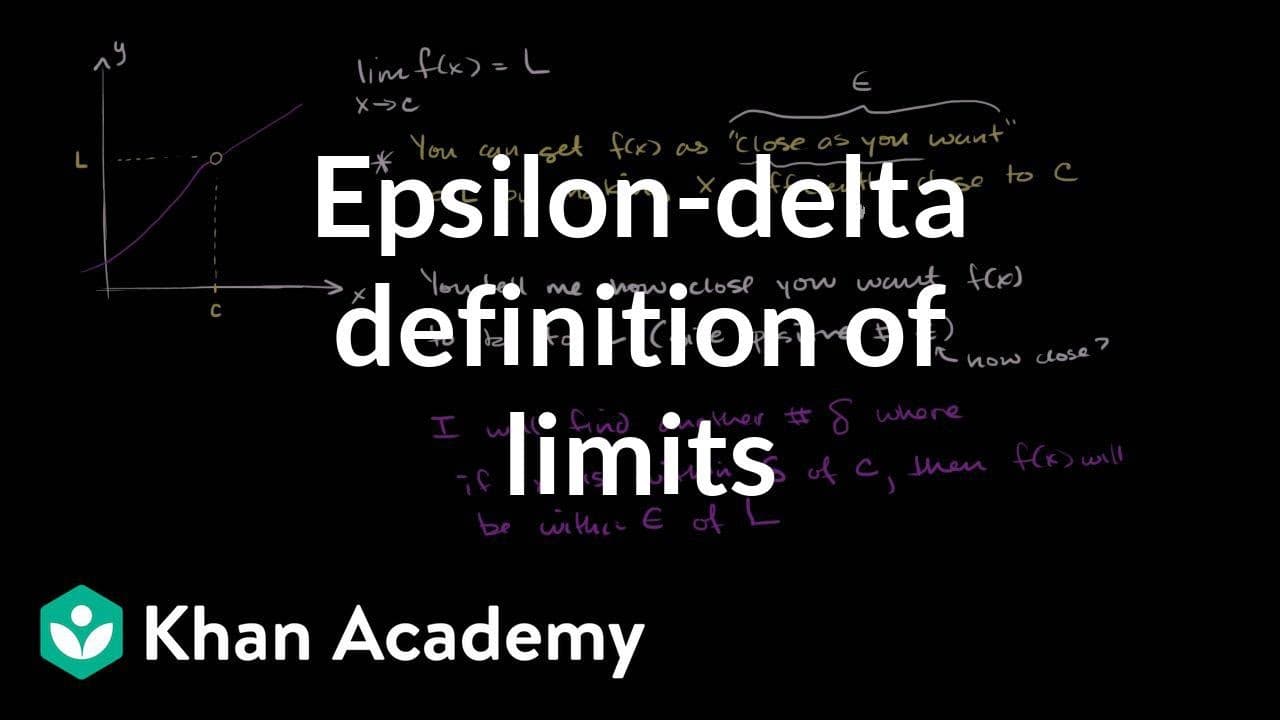
The epsilon-delta definition of limits states that for any desired closeness (epsilon), there exists a range (delta) around a point (C) such that the function (f(x)) will be within epsilon of the limit (L).
Transcript
In the last video, we tried to come up with a somewhat rigorous definition of what a limit is, where we say when you say that the limit of f of x as x approaches C is equal L, you're really saying-- and this is the somewhat rigorous definition-- that you can get f of x as close as you want to L by making x sufficiently close to C. So let's see if w... Read More
Key Insights
- ⛔ The epsilon-delta definition provides a rigorous explanation of limits by allowing you to control how close you want the function's value to be to the limit.
- 👾 It turns the concept of limits into a game where you choose epsilon and the burden is on finding a delta that satisfies your desired closeness.
- 🟠 The definition can be visualized as a range (delta) surrounding a point (C) where any x-value within that range will result in the function's value (f(x)) being within the specified range around the limit.
- 💨 It is a mathematical way of stating that you can approach a limit as closely as desired by appropriately choosing the input values.
Install to Summarize YouTube Videos and Get Transcripts
Explore YouTube Video Summarizer or Get YouTube Transcript Extractor
Questions & Answers
Q: What is the epsilon-delta definition of limits?
The epsilon-delta definition of limits states that for any positive number epsilon, there exists a positive number delta such that if x is within delta of C, then f(x) will be within epsilon of the limit.
Q: How does the epsilon-delta definition work?
The definition works by allowing you to choose how close you want the function's value to be to the limit (epsilon), and then finding a range (delta) around a specific point (C) where every x-value within that range will result in f(x) being within epsilon of the limit.
Q: What does epsilon represent in the epsilon-delta definition?
Epsilon represents the desired closeness or the range within which you want the function's value (f(x)) to be from the limit (L).
Q: What does delta represent in the epsilon-delta definition?
Delta represents the range around the point (C) where if x is within delta of C, the function's value (f(x)) will be within epsilon of the limit.
Summary & Key Takeaways
-
The epsilon-delta definition explains the concept of limits by stating that you can get as close as you want to a limit by making the input values (x) sufficiently close to a specific point (C).
-
It is a game where you tell the person how close you want the function's value (f(x)) to be to the limit (L) by giving a positive number (epsilon).
-
The aim is to find another positive number (delta) that determines the range around the point (C) so that if x is within delta of C, f(x) will be within epsilon of the limit.
Read in Other Languages (beta)
Share This Summary 📚
Summarize YouTube Videos and Get Video Transcripts with 1-Click
Try YouTube Summary with ChatGPT & Claude or YouTube Transcript Generator
Explore More Summaries from Khan Academy 📚



Summarize YouTube Videos and Get Video Transcripts with 1-Click
Try YouTube Summary with ChatGPT & Claude or YouTube Transcript Generator