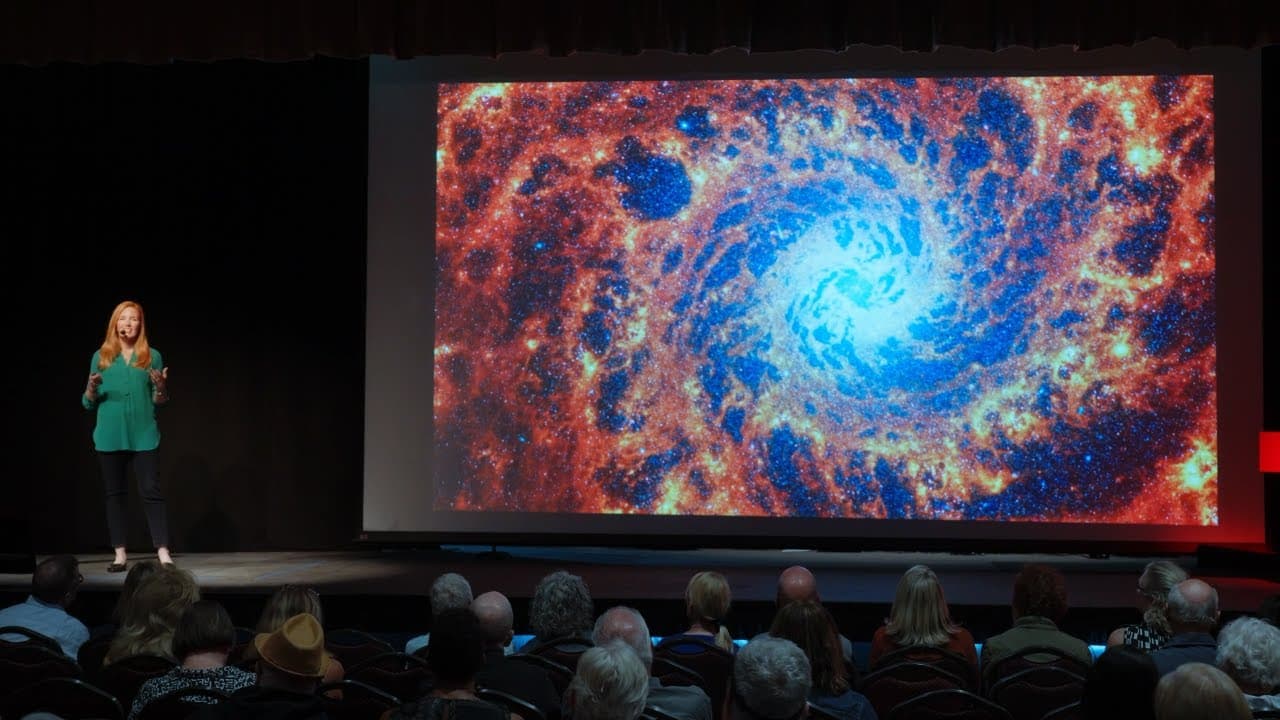
What space telescopes teach us about the universe | Amber Straughn | TEDxCapeMay
TL;DR
An astrophysicist shares insights on the role of telescopes in uncovering cosmic mysteries.
Transcript
[Applause] so imagine for a moment that you're on my family's Farm in R Arkansas it's a beautiful summer night you can hear the Crickets and you could smell the honeysuckle and the sky is filled with thousands of stars those Stars called my name as a kid and I spent countless nights outside looking up and asking some of the same questions that huma... Read More
Key Insights
- 🔇 Childhood wonder and parental support can inspire a lifelong passion for science, exemplified by the speaker's journey to becoming an astrophysicist.
- 🙂 Telescopes like Hubble and JWST significantly advance our understanding of the universe, revealing hidden details through different wavelengths of light.
- 👾 The engineering feat behind the JWST involved innovation and collaboration, showcasing human ingenuity in space exploration.
- 💅 Cosmic imagery from telescopes serves not only scientific purposes but also provides aesthetic beauty, prompting questions about humanity's place in the universe.
- 👨🔬 Only a fraction of the universe is understood, highlighting the importance of future research to unlock the secrets of dark matter and energy.
- 👶 The potential existence of life on other planets remains a central question, driving new exploratory missions.
- ♿ Access to astronomical data fosters community engagement and encourages future generations to pursue their scientific dreams.
Install to Summarize YouTube Videos and Get Transcripts
Explore YouTube Video Summarizer or Get YouTube Transcript Extractor
Questions & Answers
Q: What inspired the speaker to pursue a career in astrophysics?
The speaker’s fascination began when NASA launched the Hubble Space Telescope, which provided stunning images of the cosmos. This sparked a deep curiosity about the universe, supported by encouraging parents who nurtured the speaker’s inquiries about existence, ultimately leading to a career at NASA.
Q: How does the James Webb Space Telescope differ from the Hubble Space Telescope?
The James Webb Space Telescope (JWST) operates primarily in infrared light, making it capable of observing phenomena that the Hubble Space Telescope, which captures visible light, could not. This ability allows JWST to reveal detailed atmospheric compositions of distant exoplanets and to observe early galaxies in the universe.
Q: What challenges did the team face while developing the James Webb Space Telescope?
Creating the JWST involved overcoming significant challenges, including engineering obstacles and the need to invent ten new technologies. The project faced over 300 potential points of failure, making mission success uncertain. Despite these hurdles, the team’s dedication led to successful deployment after years of hard work.
Q: What do recent discoveries from the James Webb Space Telescope tell us about the universe?
Discoveries from JWST indicate that there are potentially many more early galaxies, larger and more abundant than previously predicted. This challenges existing theories of galaxy formation and suggests that our understanding of the universe's expansion and development may need to be revised.
Q: What percentage of the universe is currently understood, according to the speaker?
The speaker mentions that only about 5% of the universe is understood, with the remaining 95% comprising dark matter and dark energy, which are yet to be fully comprehended. This highlights the vast unknowns that persist in cosmic research and the ongoing quest to uncover their nature.
Q: How does the speaker view the human connection to the universe?
The speaker posits that the beauty of cosmic images resonates with us, perhaps reflecting our origins and inherent connection to the universe. This connection fosters a sense of wonder and hope, uniting humanity in the shared pursuit of knowledge and understanding.
Q: What future missions are planned to expand our cosmic exploration?
Future missions include the Nancy Grace Roman telescope, designed to investigate dark energy and dark matter, as well as The Habitable Worlds Observatory, aimed at searching for life on Earth-like planets. These efforts represent significant strides in unraveling the mysteries of the cosmos.
Q: How can the public engage with the findings from modern telescopes?
The speaker encourages public engagement by emphasizing that data and images from telescopes like JWST are accessible to everyone, allowing citizens and amateur astronomers to explore and analyze the wealth of information generated by these cutting-edge instruments.
Summary & Key Takeaways
-
The journey from childhood curiosity to becoming an astrophysicist illustrates the inspiration drawn from the universe, particularly through telescopes like Hubble and James Webb.
-
The James Webb Space Telescope's groundbreaking capabilities allow astronomers to study galaxies, stars, and exoplanets by observing in infrared light, revealing features invisible to the naked eye.
-
Despite understanding only 5% of the universe, upcoming missions, such as the Nancy Grace Roman telescope, aim to investigate dark matter, dark energy, and the potential for life beyond Earth.
Read in Other Languages (beta)
Share This Summary 📚
Summarize YouTube Videos and Get Video Transcripts with 1-Click
Try YouTube Summary with ChatGPT & Claude or YouTube Transcript Generator
Explore More Summaries from TEDx Talks 📚



Summarize YouTube Videos and Get Video Transcripts with 1-Click
Try YouTube Summary with ChatGPT & Claude or YouTube Transcript Generator