Star field and nebula images | Cosmology & Astronomy | Khan Academy
TL;DR
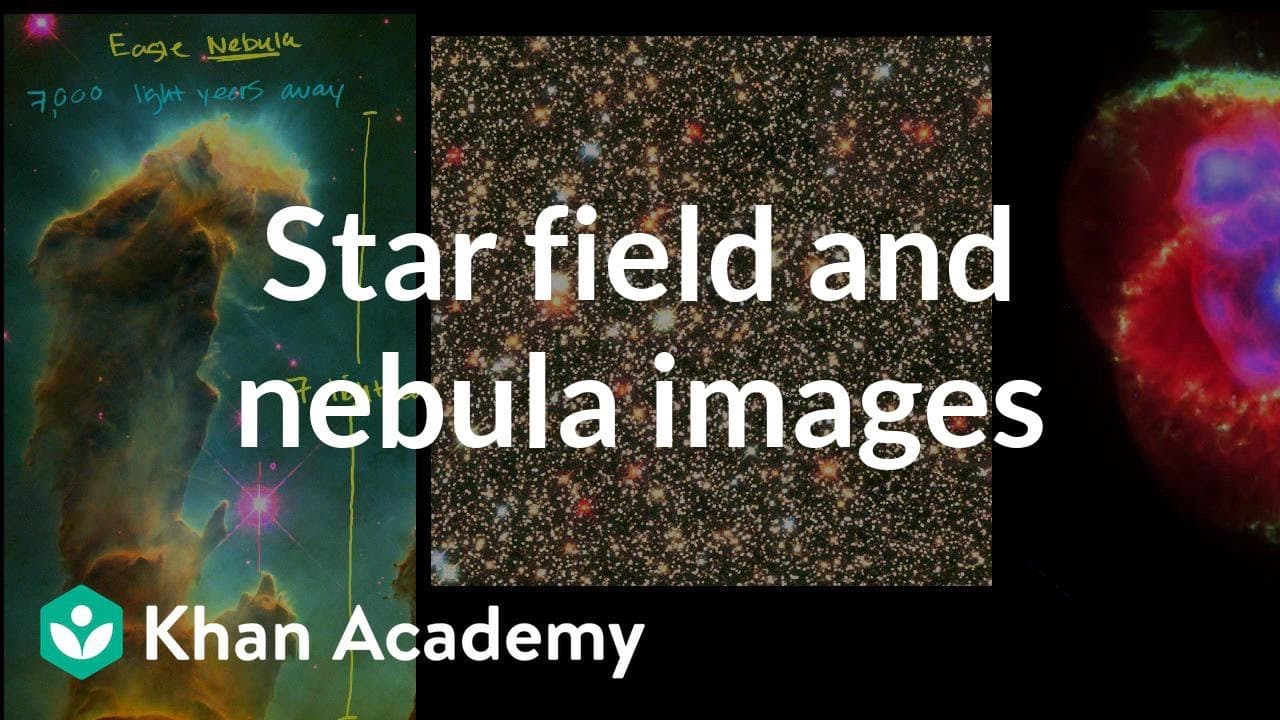
The content showcases breathtaking images of stars forming and evolving, highlighting the Eagle Nebula, the Sagittarius star field, and the Cat's Eye Nebula.
Transcript
since we've been talking how stars formed and the evolution of stars i thought it was about time that we looked at some cool pictures of stars forming or stars themselves, or evolution of stars. so this right here is from the Eagle Nebula, Just so you know, the word Nebula is kind of a general word for any interstellar cloud of gas or dust so when ... Read More
Key Insights
- 🤩 Nebulas, such as the Eagle Nebula, serve as rich environments for the formation of new stars.
- 🙂 The Eagle Nebula's pillars are immense, with one measuring 7 light years tall.
- 🤩 The Sagittarius star field showcases a diverse range of stars, each indicating different stages of stellar evolution.
- 🤩 Massive stars burn quickly, emitting bluer or greener light, while less massive stars appear redder in their super giant phase.
- 🤩 The Cat's Eye Nebula is the result of a star shedding its outer layers and is on its way to becoming a white dwarf.
- 🤩 The content offers a glimpse into the vast number of stars within our galaxy, the Milky Way, although the featured star field is just a small fraction.
- 🙂 Observing astronomical phenomena allows us to study objects that are many light years away, offering insights into the past.
Install to Summarize YouTube Videos and Get Transcripts
Explore YouTube Video Summarizer or Get YouTube Transcript Extractor
Questions & Answers
Q: What is the significance of the Eagle Nebula?
The Eagle Nebula is a massive interstellar cloud where stars can form. Its pillars, like the one depicted, act as breeding grounds for the birth of new stars.
Q: How far is the Eagle Nebula from Earth?
The Eagle Nebula is located approximately 7000 light years away from Earth. The photons we observe now left the region 7000 years ago, meaning the structure might have changed significantly.
Q: What do the different colors of stars in the Sagittarius star field indicate?
Red stars are likely in their red giant phase, yellowish-white stars are probably in their main sequence (similar to our sun), and bluish or greener stars are burning quickly and are more massive.
Q: What is a planetary nebula?
A planetary nebula, like the Cat's Eye Nebula, is a nebula formed when a star sheds its outer layers during its red giant phase, ultimately transitioning towards becoming a white dwarf.
Summary & Key Takeaways
-
The Eagle Nebula is a massive interstellar cloud of gas and dust that serves as a breeding ground for stars, with one pillar alone measuring 7 light years tall.
-
The Sagittarius star field presents a diverse range of stars, including red giants, main sequence stars like our sun, and massive stars that burn quickly.
-
The Cat's Eye Nebula is a planetary nebula resulting from a star shedding its outer material, transitioning towards becoming a white dwarf.
Read in Other Languages (beta)
Share This Summary 📚
Summarize YouTube Videos and Get Video Transcripts with 1-Click
Try YouTube Summary with ChatGPT & Claude or YouTube Transcript Generator
Explore More Summaries from Khan Academy 📚



Summarize YouTube Videos and Get Video Transcripts with 1-Click
Try YouTube Summary with ChatGPT & Claude or YouTube Transcript Generator