The astounding athletic power of quadcopters | Raffaello D'Andrea
TL;DR
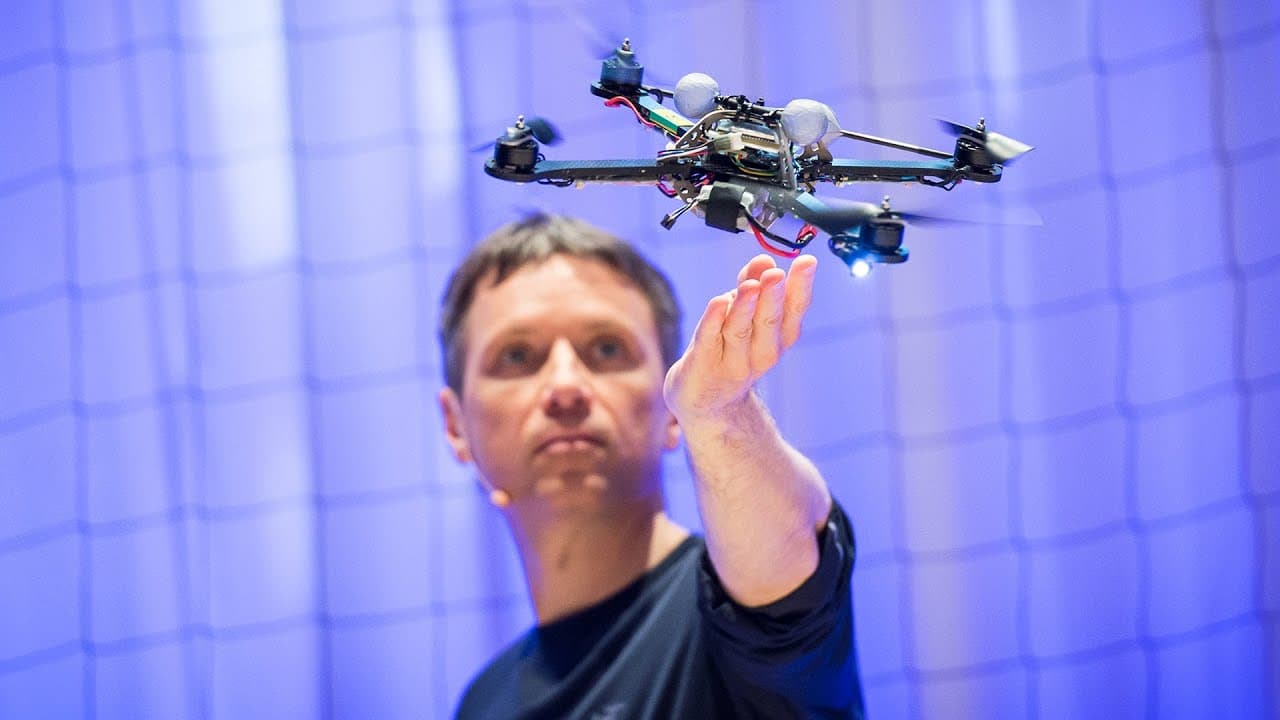
In this content, the concept of machine athleticism and the research behind it are demonstrated using quadrocopters.
Transcript
Translator: Joseph Geni Reviewer: Morton Bast So what does it mean for a machine to be athletic? We will demonstrate the concept of machine athleticism and the research to achieve it with the help of these flying machines called quadrocopters, or quads, for short. Quads have been around for a long time. They're so popular these days because they're... Read More
Key Insights
- 💡 Machines called quadrocopters, or quads, demonstrate the concept of machine athleticism and the research needed to achieve it. Quads are mechanically simple, but they require automatic feedback control to fly due to their inherent instability. Algorithms play a crucial role in designing machine athletes, utilizing mathematical models and control theory. Understanding physical models and the workings of the physical world is essential in determining the difficulty of high-performance tasks. Mathematical models can also be used to design novel machine architectures or algorithms that gracefully handle damage. Machines can learn and improve their performance through practice, just like human athletes. The quad can hit a ball by calculating its trajectory and executing a planned strategy. Machines can also perform dynamic maneuvers collectively. Coupling machine athleticism with human gesture inputs allows for natural interaction. Mathematical models can estimate the forces applied by humans and change the laws of physics for the quad. The impact of machines on our way of life is not just a technical choice, but a social one that requires making the right decisions to bring out the best in both machines and humans.
Install to Summarize YouTube Videos and Get Transcripts
Explore YouTube Video Summarizer or Get YouTube Transcript Extractor
Questions & Answers
Q: What are quadrocopters and why are they popular?
Quadrocopters, or quads, are flying machines controlled by four propellers that can roll, pitch, yaw, and accelerate. They are popular because they are mechanically simple and extremely agile. However, they are inherently unstable and require automatic feedback control to fly.
Q: How do the quadrocopters in the video navigate and fly?
The quadrocopters in the video navigate and fly using a combination of cameras on the ceiling, reflective markers placed on objects in the space, and estimation and control algorithms. The cameras serve as an indoor global positioning system, allowing the quadrocopters to locate objects. The data is then sent to a laptop that runs the algorithms to control the quadrocopters.
Q: How are mathematical models and control theory used in designing algorithms for the quadrocopters?
Mathematical models and control theory are used in the design of algorithms for the quadrocopters. The physics of how the machines behave are captured in a mathematical model, which is then analyzed using control theory. This analysis helps to synthesize algorithms for controlling the quadrocopters, allowing them to perform tasks such as hovering and balancing a pole.
Q: How do quadrocopters handle damage or perform tasks with limited feedback?
Quadrocopters can handle damage or perform tasks with limited feedback by using mathematical models and control theory. By understanding the physics of the problem, algorithms can be designed to gracefully handle damage and perform tasks even without full position feedback. This allows quadrocopters to adapt and continue functioning similar to human athletes performing with physical injuries.
Q: How do quadrocopters interact with humans and other machines?
Quadrocopters can interact with humans and other machines through various means. In the video, a commercial gesture sensor is used to recognize the gestures of a human, allowing for natural interaction with the quadrocopters. Additionally, by using mathematical models and estimation techniques, quadrocopters can estimate forces applied by humans and even change their perceived laws of physics to accommodate different interactions.
Summary
This video showcases the concept of machine athleticism demonstrated with quadrocopters or quads. The speaker explains how these machines can perform agile maneuvers using mathematical models and control theory. They demonstrate tasks such as balancing a pole, carrying a glass of water, and striking a moving ball. The video also explores the possibilities of collective maneuvers and human-machine interaction. The speaker emphasizes the importance of making the right choices regarding the use of machines for improving the human condition.
Questions & Answers
Q: What are quadrocopters, and why are they so popular?
Quadrocopters, or quads for short, are flying machines that are mechanically simple and can perform agile maneuvers. They have four propellers, which allow them to roll, pitch, yaw, and accelerate along their common orientation. They are popular because of their simplicity and agility.
Q: How do quads maintain stability while flying?
Quads are inherently unstable and need some form of automatic feedback control to fly. They use cameras on the ceiling and a laptop as an indoor global positioning system to locate objects with reflective markers. This data is used by estimation and control algorithms on another laptop to send commands to the quad and stabilize its flight.
Q: What is the role of algorithms in creating machine athleticism?
Algorithms play a crucial role in creating machine athleticism. The speaker explains that they use model-based design, capturing the physics of the machines with mathematical models. Control theory is then used to analyze these models and synthesize algorithms for controlling the machines. These algorithms enable tasks such as hovering, balancing a pole, and striking a moving ball.
Q: How is the quad able to balance a pole?
The quad is able to balance a pole by combining the mathematical models of both the quad and the pole. By using control theory, algorithms are created to stabilize the quad-pole system. The quad makes fine adjustments based on the data from the reflective marker on top of the pole to keep it balanced.
Q: Why doesn't the water in the glass spill when the quad is flying?
The water in the glass doesn't spill because of the combined effect of gravity and the direction of the propellers. Since the propellers are pointing up, the net result is that all side forces on the glass are small and mainly dominated by negligible aerodynamic effects at the quad's speeds. This means that the system doesn't need to model the glass, and it naturally doesn't spill.
Q: What can we learn from the ease of carrying a glass of water versus balancing a pole?
The speaker explains that understanding the physics of a task can tell us which ones are easy and which ones are hard. Carrying a glass of water is easy because gravity acts on all objects in the same way, and the quad's propellers create negligible side forces. Balancing a pole is harder because it requires precise adjustments to maintain stability.
Q: How can machines perform with extreme physical damage?
Conventional wisdom suggests that at least four fixed motor propeller pairs are needed for a quad to fly. However, the speaker reveals that analyzing the mathematical model of a quad with only two working propellers uncovers an unconventional way to fly. By relinquishing control of yaw, algorithms can still control roll, pitch, and acceleration. This knowledge allows for the design of machines that can gracefully handle damage without relying on redundancy.
Q: How can quads perform maneuvers before receiving feedback?
In situations where there isn't enough time for position feedback, the quad can perform maneuvers blindly and observe how it finishes the maneuver. Using this information, it can modify its behavior to improve the motion for the next iteration. Similar to how divers and vaulters practice and learn through repeated attempts, the quad learns and executes the maneuver through practice.
Q: How can machines strike a moving ball?
Machines can strike a moving ball by calculating various parameters every 20 milliseconds. They determine where the ball is going, calculate how the quad should hit the ball to make it fly back to where it was thrown from, and plan a trajectory for the quad to reach the impact point. The quad executes only 20 milliseconds' worth of the strategy at a time until it successfully strikes the ball.
Q: Can machines perform dynamic maneuvers collectively?
Yes, machines can perform dynamic maneuvers collectively. The video demonstrates three quads cooperatively carrying a sky net and launching a ball back to the speaker. The algorithms used for this collective maneuver are similar to those used by a single quad to hit the ball. Mathematical models continuously re-plan the cooperative strategy 50 times per second.
Takeaways
The video highlights the concept of machine athleticism and its potential applications. By using mathematical models, control theory, and clever algorithms, machines can perform agile maneuvers and interact with humans. The speaker emphasizes the importance of responsible use of machines and making choices that bring out the best in both machines and humans. The speed and capabilities of machines can have a significant impact on our way of life, and it's crucial to consider their implications in order to improve the human condition.
Summary & Key Takeaways
-
Quadrocopters, or quads, are flying machines that can perform athletic maneuvers through the use of algorithms and mathematical models.
-
The algorithms and mathematical models are designed using control theory to stabilize the quad and enable it to perform tasks such as balancing a pole or hitting a ball.
-
Machine athleticism can be enhanced through collective maneuvers, physical interactions with humans, and changing the laws of physics for the quad.
Read in Other Languages (beta)
Share This Summary 📚
Summarize YouTube Videos and Get Video Transcripts with 1-Click
Try YouTube Summary with ChatGPT & Claude or YouTube Transcript Generator
Explore More Summaries from TED 📚






Summarize YouTube Videos and Get Video Transcripts with 1-Click
Try YouTube Summary with ChatGPT & Claude or YouTube Transcript Generator