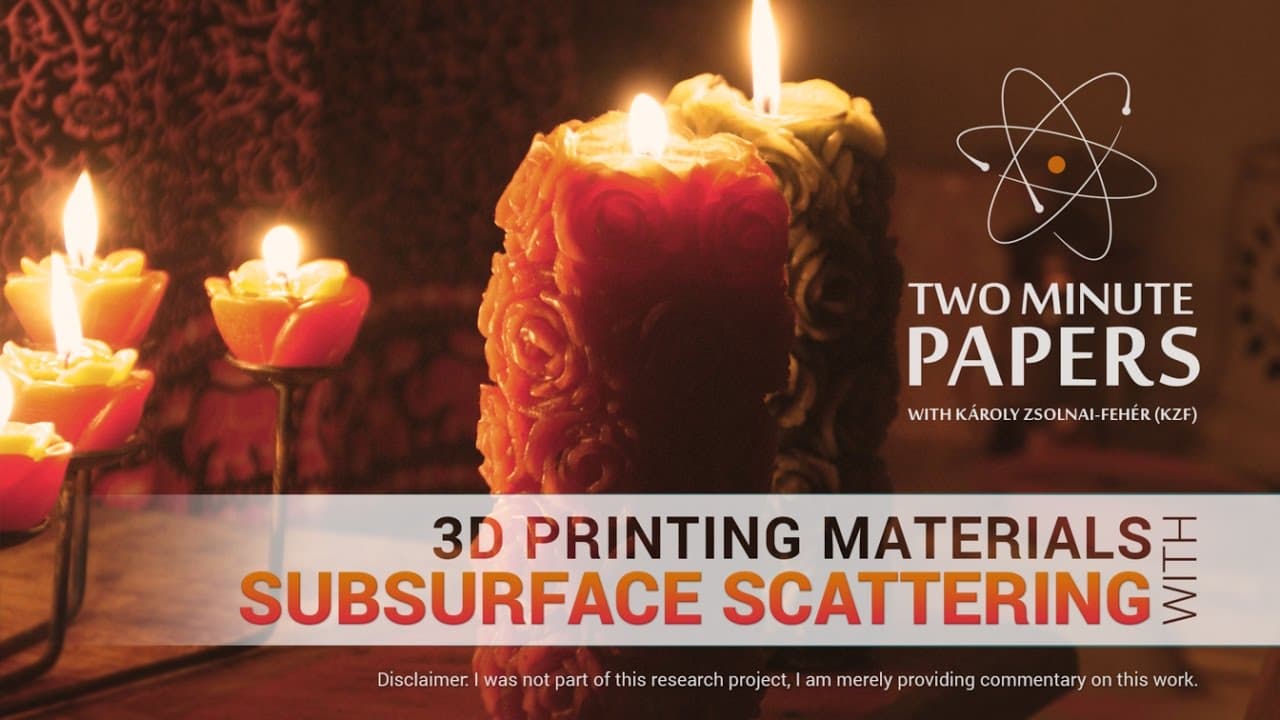
3D Printing Materials With Subsurface Scattering | Two Minute Papers #98
TL;DR
Exploring replicating subsurface scattering in 3D printed materials for realistic appearances.
Transcript
Dear Fellow Scholars, this is Two Minute Papers with Károly Zsolnai-Fehér. Subsurface scattering means that not every ray of light is reflected or absorbed on the surface of a material, but some of it may get inside somewhere, and come out somewhere else. For instance, our skin is a great and fairly unknown example of that. We can witness this beau... Read More
Key Insights
- 🙂 Subsurface scattering is a natural light effect in materials like skin, leaves, and fruits.
- ❓ Replicating this effect in 3D printing involves measuring real material diffusion profiles.
- 🙂 Optimization of light scattering properties in 3D printed materials enhances their realism.
- 🙂 The Hankel transform aids in efficient calculation of light scattering properties in material stacks.
- ❓ Realistic 3D printing appearances are achieved through replicating subsurface scattering.
- 👣 Researchers aim to minimize the difference between target and printed material appearances.
- 🙂 The process involves simulating and optimizing light scattering properties for lifelike reproductions.
Install to Summarize YouTube Videos and Get Transcripts
Explore YouTube Video Summarizer or Get YouTube Transcript Extractor
Questions & Answers
Q: What is subsurface scattering, and where can it be observed in nature?
Subsurface scattering is when light penetrates a material, like skin or fruits, and emerges elsewhere, creating a soft, translucent effect.
Q: How is subsurface scattering being replicated in 3D printed materials?
Researchers use diffusion profiles from real materials to optimize light scattering properties in 3D printed objects for realistic appearances.
Q: What role does the Hankel transform play in this process?
The Hankel transform efficiently calculates light scattering properties in stacks of materials, aiding in replicating realistic appearances in 3D printing.
Q: Why is replicating subsurface scattering in 3D printed materials significant?
It allows for the creation of visually realistic objects with lifelike appearances through optimized light scattering properties.
Summary & Key Takeaways
-
Subsurface scattering is a natural light effect seen in materials like skin, fruits, and leaves.
-
Researchers aim to reproduce this effect in 3D printed materials for lifelike appearances.
-
The process involves measuring real material diffusion profiles and optimizing light scattering properties via a mathematical transform.
Read in Other Languages (beta)
Share This Summary 📚
Summarize YouTube Videos and Get Video Transcripts with 1-Click
Try YouTube Summary with ChatGPT & Claude or YouTube Transcript Generator
Explore More Summaries from Two Minute Papers 📚




Summarize YouTube Videos and Get Video Transcripts with 1-Click
Try YouTube Summary with ChatGPT & Claude or YouTube Transcript Generator