GNN Short Course Chapter 8 - Absolute Perturbations
TL;DR
Graph convolutions remain stable under absolute perturbations, but the model is arbitrary.
Transcript
up to this point we know that graph convolutions are permutation equivalent and that this property is inherited by graph neural networks basically permutation equations says that when we take a graph filter and use it on a given shift operator or on a permuted version of that shift operator nothing changes but what happens to the output of a graph ... Read More
Key Insights
- Graph convolutions are permutation equivalent, meaning the output remains unchanged under permutations of the shift operator.
- Absolute perturbations involve comparing graph filters on different shift operators to measure their output differences.
- The operator norm is used to quantify the distance between filters, accounting for permutations.
- Absolute perturbation distance is defined using the norm of the smallest matrix in the absolute error matrix set.
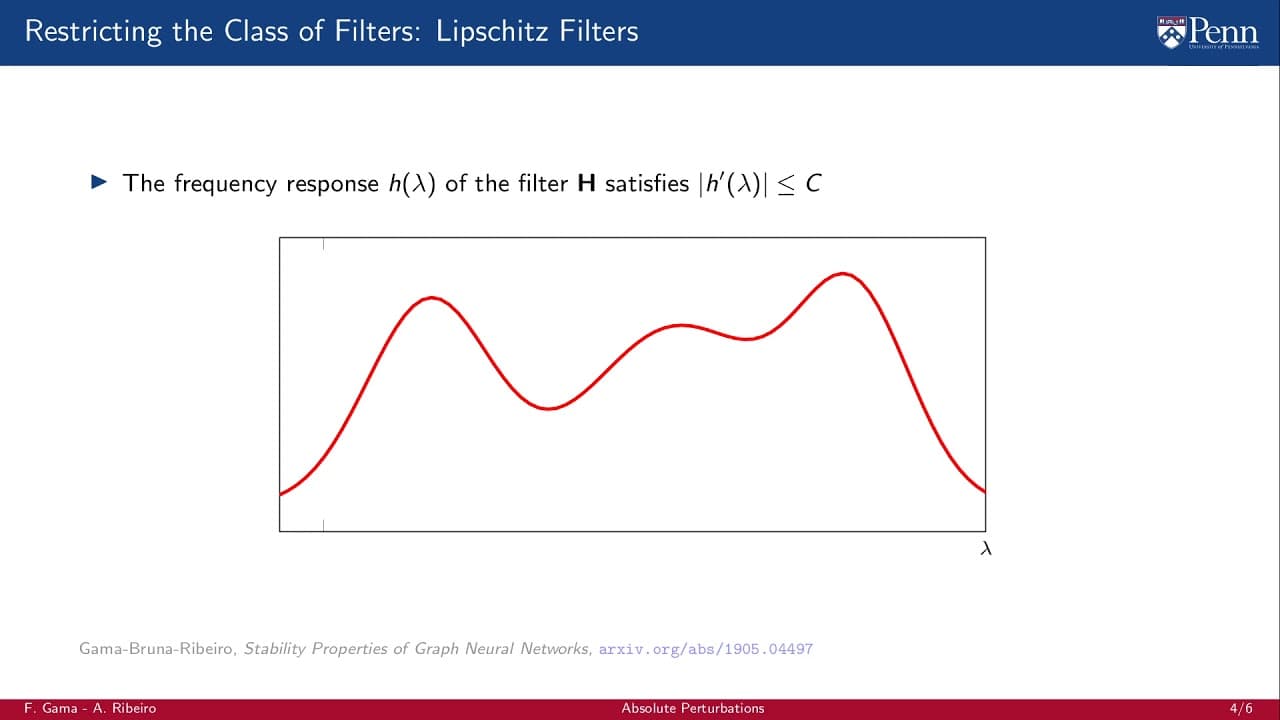
- Lipschitz filters have a bounded frequency response derivative, ensuring stability under absolute perturbations.
- The theorem states that output differences are linearly bounded by the distance between shift operators.
- The perturbation model's utility is limited due to its arbitrary nature, affecting graph topology without cost.
- A more meaningful stability result requires a perturbation model that considers graph topology.
Install to Summarize YouTube Videos and Get Transcripts
Explore YouTube Video Summarizer or Get YouTube Transcript Extractor
Questions & Answers
Q: What is permutation equivalence in graph convolutions?
Permutation equivalence in graph convolutions refers to the property where the output of a graph convolution remains unchanged when the graph's shift operator is permuted. This means that if you apply a graph filter to a permuted version of the shift operator, the result will be the same as applying it to the original shift operator. This property is crucial as it ensures that the graph convolution's output is consistent, regardless of the node ordering in the graph.
Q: How is the distance between graph filters measured?
The distance between graph filters is measured using the operator norm, which quantifies the difference between filters while accounting for permutations. This involves finding a permutation of one of the shift operators that minimizes this norm, thereby providing a measure of the distance between operators modulo permutations. This approach allows for a consistent comparison of graph filters despite variations in the underlying graph structure.
Q: What are Lipschitz filters and their significance?
Lipschitz filters are a class of graph filters characterized by a bounded derivative in their frequency response. This boundedness, defined by a constant c, ensures that the filters maintain stability under absolute perturbations. The significance of Lipschitz filters lies in their ability to provide a linear bound on the output differences of graph convolutions, ensuring that changes in the graph support do not lead to disproportionate changes in the convolution output.
Q: What does the main theorem about graph convolutions state?
The main theorem states that graph convolutions using Lipschitz filters are stable to absolute perturbations. Specifically, given two graphs with shift operators s and s-hat, if their absolute distances are within a certain range, the difference in the convolution outputs is linearly bounded by the distance between the shift operators. This bound is influenced by the Lipschitz constant and the eigenvector misalignment constant, ensuring that the perturbations do not lead to significant output variations.
Q: Why is the absolute perturbation model considered arbitrary?
The absolute perturbation model is considered arbitrary because it allows for significant alterations in graph topology without affecting the associated cost. This means that for the same error norm, the graph structure can be drastically changed, such as altering community connectivity or adding new edges. Such arbitrary changes undermine the model's practical utility, as it does not adequately account for the inherent topology of the graph being perturbed.
Q: What are the limitations of the absolute perturbation model?
The limitations of the absolute perturbation model stem from its ability to arbitrarily alter graph topology without a corresponding increase in cost. This leads to scenarios where the graph's connectivity or community structure can be drastically changed, rendering the model less useful for practical applications. The model fails to consider the inherent topology of the graph, which is crucial for a meaningful stability analysis in graph neural networks.
Q: How can the perturbation model be improved for better stability results?
To improve the perturbation model for better stability results, it should account for the topology of the graph being perturbed. This involves developing a model that considers the structural properties and connectivity patterns of the graph, rather than allowing arbitrary changes. By incorporating topological constraints, the model can provide more meaningful insights into the stability of graph convolutions and graph neural networks under perturbations.
Q: What examples illustrate the shortcomings of the absolute perturbation model?
Examples illustrating the shortcomings of the absolute perturbation model include scenarios where the connectivity within graph communities is altered without cost. For instance, in a stochastic block model, increasing edge weights within communities or adding new connections between previously unconnected nodes can drastically change the graph's structure. These examples highlight the model's inability to account for meaningful topological changes, limiting its practical application in stability analysis.
Summary & Key Takeaways
-
Graph convolutions maintain output stability when subjected to permutations of the shift operator. This property extends to absolute perturbations, where different shift operators are compared using graph filters. The operator norm measures the distance between filters, accounting for permutations, and absolute perturbation distance is defined using the smallest matrix in the error matrix set.
-
Lipschitz filters, characterized by a bounded frequency response derivative, ensure stability under absolute perturbations. The main theorem asserts that output differences are linearly bounded by the distance between shift operators, with the bound dependent on the Lipschitz constant and eigenvector misalignment constant. However, the absolute perturbation model's arbitrary nature limits its practical utility.
-
The absolute perturbation model allows for arbitrary changes in graph topology without affecting the cost, undermining its usefulness. Examples illustrate how graph connectivity can be altered significantly for the same error norm. A more meaningful stability result requires a perturbation model that considers the perturbed graph's topology, beyond the current absolute perturbation model.
Read in Other Languages (beta)
Share This Summary 📚
Summarize YouTube Videos and Get Video Transcripts with 1-Click
Try YouTube Summary with ChatGPT & Claude or YouTube Transcript Generator
Explore More Summaries from Alelab Alelab 📚
Summarize YouTube Videos and Get Video Transcripts with 1-Click
Try YouTube Summary with ChatGPT & Claude or YouTube Transcript Generator