Worked example: Merging definite integrals over adjacent intervals | AP Calculus AB | Khan Academy
TL;DR
Learn how to evaluate definite integrals by finding the areas between a curve and the x-axis using graphical information.
Transcript
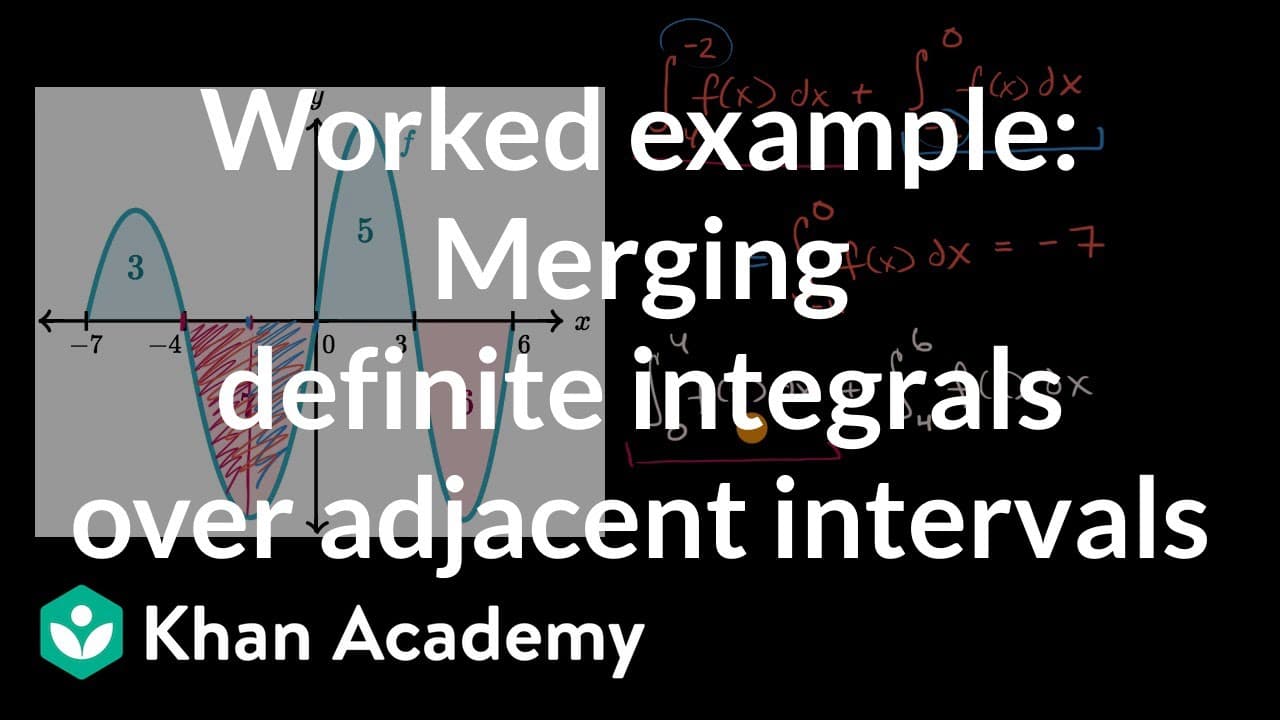
- [Instructor] What we have here is a graph of y is equal to f of x, and these numbers are the areas of these shaded regions, these regions between our curve and the x-axis. What we're going to do in this video is do some examples of evaluating definite integrals using this information and some knowledge of definite integral properties. So let's st... Read More
Key Insights
- ☺️ Definite integrals can be evaluated by finding the areas between a curve and the x-axis.
- ☺️ The value of the integral equals the sum of positive areas above the x-axis and the negative areas below the x-axis.
- 😘 When the upper and lower bounds of two integrals are the same, and the integrand is the same, the integrals can be merged into a single integral.
Install to Summarize YouTube Videos and Get Transcripts
Explore YouTube Video Summarizer or Get YouTube Transcript Extractor
Questions & Answers
Q: How can you evaluate definite integrals using graphical information?
Definite integrals can be evaluated by finding the areas between a curve and the x-axis. Positive areas above the x-axis contribute positively, while negative areas below the x-axis contribute negatively to the overall value of the integral.
Q: What happens when the upper bound and lower bound of a definite integral are the same?
If the upper and lower bounds of a definite integral are the same and the integrand is the same, the two integrals can be merged into a single integral. The resulting value will be equal to the area enclosed between the curve and the x-axis.
Q: How do you calculate the value of a definite integral when given a graph?
To calculate the value of a definite integral given a graph, divide the integral into smaller intervals based on the given bounds. Evaluate the areas above the x-axis as positive values and the areas below the x-axis as negative values. Merge the integrals if the upper and lower bounds match and calculate the overall value.
Q: Can definite integrals be evaluated without graphically representing the function?
Yes, definite integrals can be evaluated without a graphical representation. If the upper and lower bounds are the same and the integrand is the same, the integrals can still be merged using the properties of definite integrals. The resulting value will be the same as finding the integral of the entire interval.
Summary & Key Takeaways
-
The video demonstrates the process of evaluating definite integrals by finding the areas between a curve and the x-axis.
-
Two examples are shown, where the definite integrals are split into smaller intervals and then merged based on integration properties.
-
The areas above the x-axis are positive, while the areas below the x-axis are negative.
Read in Other Languages (beta)
Share This Summary 📚
Summarize YouTube Videos and Get Video Transcripts with 1-Click
Try YouTube Summary with ChatGPT & Claude or YouTube Transcript Generator
Explore More Summaries from Khan Academy 📚



Summarize YouTube Videos and Get Video Transcripts with 1-Click
Try YouTube Summary with ChatGPT & Claude or YouTube Transcript Generator