How to Calculate Percent Abundance of Isotopes
TL;DR
To find the percent abundance of each isotope, set up an equation using the average atomic mass and the masses of the isotopes. For bromine, the percent abundance of bromine-79 is approximately 50.9%, while bromine-81 is about 49.1%, confirming that both together sum to 100%.
Transcript
in this video we're going to talk about how to calculate the percent abundance of each isotope that make up a certain element so in our example we're going to use elemento bromine now this element consists of two predominant naturally occurring isotopes there are others but for the most part natural bromine is made up of those two isotopes now we'r... Read More
Key Insights
- ❓ Bromine consists of two predominant isotopes, bromine-79 and bromine-81.
- 🫀 The average atomic mass of bromine is determined by the weighted average of the masses of these isotopes.
- 🫀 The percent abundance of each isotope can be calculated using the average atomic mass equation.
- ❓ The percent abundance of bromine-79 is approximately 50.9% and bromine-81 is approximately 49.1%.
- 🍹 The percent abundances sum up to 100%, reflecting the total composition of bromine on Earth.
- 🫀 The average atomic mass calculation can be used to validate the accuracy of the percent abundance calculations.
- 💆 The mass and percent abundance values of each isotope are crucial for determining the percent abundance accurately.
Install to Summarize YouTube Videos and Get Transcripts
Explore YouTube Video Summarizer or Get YouTube Transcript Extractor
Questions & Answers
Q: How can we calculate the percent abundance of isotopes in an element?
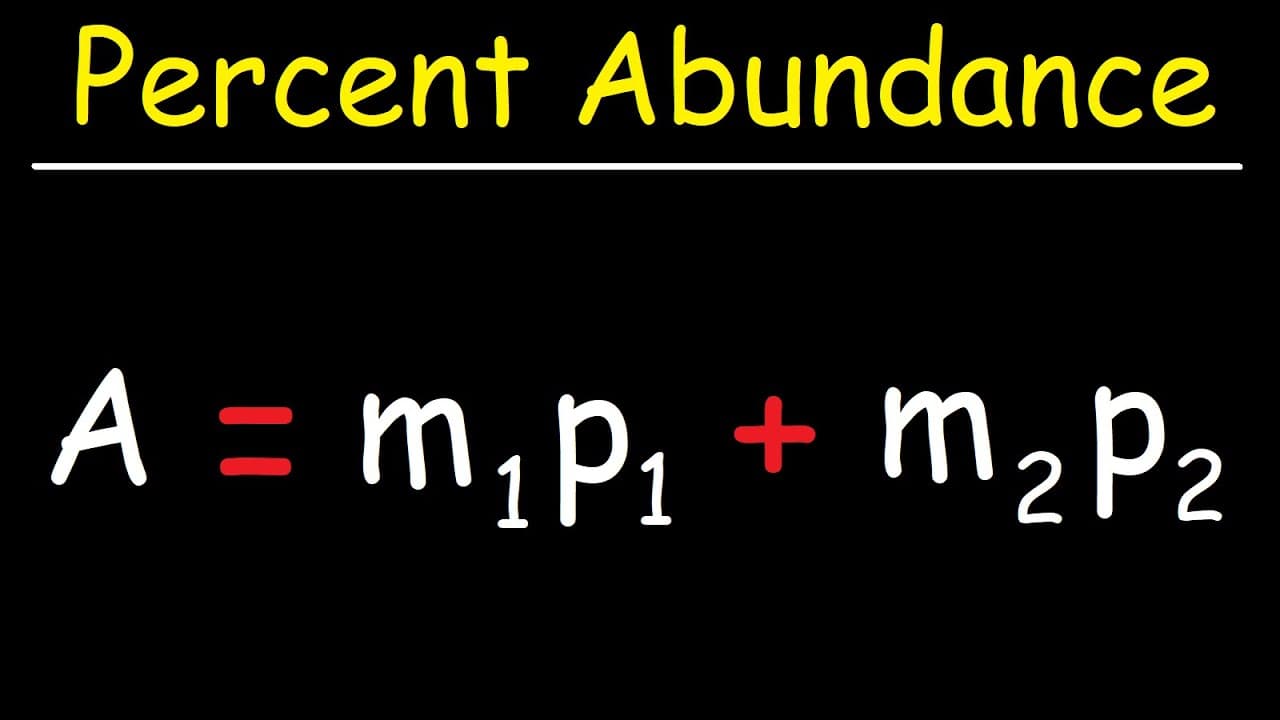
The percent abundance can be found using the equation: Average Atomic Mass = (Mass of Isotope 1 * Percent Abundance of Isotope 1) + (Mass of Isotope 2 * Percent Abundance of Isotope 2). This equation can be modified for more isotopes.
Q: What is the relationship between average atomic mass and percent abundance?
The average atomic mass is a weighted average of the mass of each isotope, where the percent abundance is the weight. Isotopes with higher percent abundance contribute more to the average atomic mass.
Q: How can we determine the percent abundance if one isotope is known to be more abundant than the other?
If one isotope's percent abundance is given, subtracting it from 1 gives the percent abundance of the other isotope. For example, if bromine-79 has a percent abundance of 40%, bromine-81 would have a percent abundance of 60%.
Q: How can we validate the percent abundance calculations?
The calculated percent abundances can be used to find the average atomic mass. Plug the values back into the equation and check if the result matches the given average atomic mass.
Summary & Key Takeaways
-
Bromine consists of two predominant isotopes, bromine-79 and bromine-81.
-
The average atomic mass of bromine is 79.9 atomic mass units.
-
By using the equation for average atomic mass, the percent abundance of each isotope can be calculated.
Read in Other Languages (beta)
Share This Summary 📚
Summarize YouTube Videos and Get Video Transcripts with 1-Click
Try YouTube Summary with ChatGPT & Claude or YouTube Transcript Generator
Explore More Summaries from The Organic Chemistry Tutor 📚



Summarize YouTube Videos and Get Video Transcripts with 1-Click
Try YouTube Summary with ChatGPT & Claude or YouTube Transcript Generator