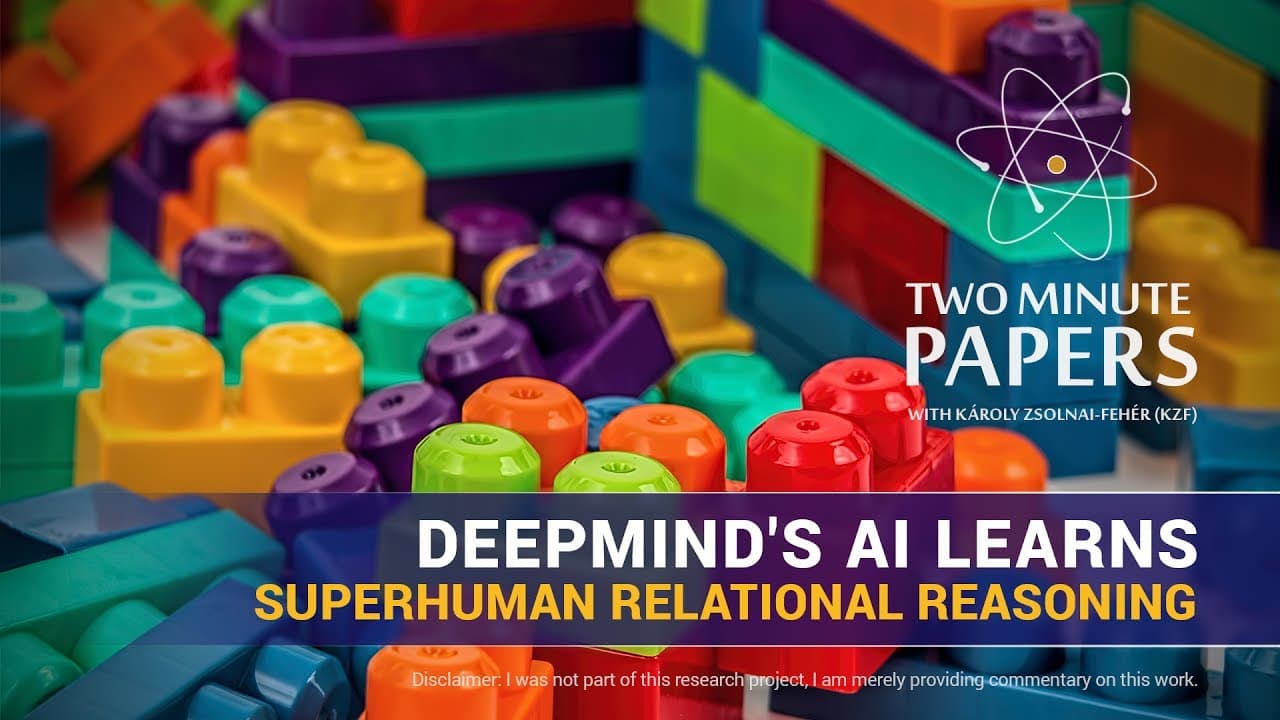
DeepMind's AI Learns Superhuman Relational Reasoning | Two Minute Papers #168
TL;DR
Google DeepMind's neural networks excel at relational reasoning tasks, showing potential for general intelligence.
Transcript
Dear Fellow Scholars, this is Two Minute Papers with Károly Zsolnai-Fehér. This paper is from the Google DeepMind guys, and is about teaching neural networks to be capable of relational reasoning. This means that we can present the algorithm with an image and ask it relatively complex relational questions. For instance, if we show it this image and... Read More
Key Insights
- 🧑🏫 Teaching neural networks relational reasoning tasks enhances their capabilities significantly.
- ❓ Relational reasoning requires cognitive understanding of image structures beyond pixel data.
- ❓ DeepMind's approach combines relational network modules with LSTM networks for improved performance.
- 👨🔬 Achieving superhuman performance in certain tasks highlights the potential for progress in machine learning research.
- ❓ Relational reasoning is essential for advancing general intelligence in neural networks.
- 👨🔬 Failure cases in relational reasoning tasks provide valuable insights for further research.
- 👾 The rapid pace of machine learning research is evident in the quick adoption of new techniques and algorithms.
Install to Summarize YouTube Videos and Get Transcripts
Explore YouTube Video Summarizer or Get YouTube Transcript Extractor
Questions & Answers
Q: How does the neural network learn relational reasoning tasks?
The neural network learns relational reasoning by augmenting an existing network with a relational module, enabling it to process complex questions based on images and sequences.
Q: Why is relational reasoning challenging for computer algorithms?
Relational reasoning is challenging because it requires cognitive understanding of image components beyond pixel data, a skill humans excel at but computers struggle with.
Q: How does DeepMind's approach to relational reasoning compare to existing algorithms?
DeepMind's approach surpasses existing algorithms and even achieves superhuman performance in certain cases, showcasing the advancements in machine learning research.
Q: What implications does the success in relational reasoning have for achieving general intelligence?
Success in relational reasoning is a crucial step towards achieving general intelligence, as it demonstrates the ability of neural networks to grasp complex relationships within data.
Summary & Key Takeaways
-
DeepMind's neural networks learn relational reasoning tasks, answering complex questions about images.
-
Relational reasoning requires cognitive understanding beyond pixel data in images.
-
Integrating relational network modules into LSTM neural networks enhances performance in various tasks.
Read in Other Languages (beta)
Share This Summary 📚
Summarize YouTube Videos and Get Video Transcripts with 1-Click
Try YouTube Summary with ChatGPT & Claude or YouTube Transcript Generator
Explore More Summaries from Two Minute Papers 📚




Summarize YouTube Videos and Get Video Transcripts with 1-Click
Try YouTube Summary with ChatGPT & Claude or YouTube Transcript Generator