Log Tables (extra bit) - Numberphile
TL;DR
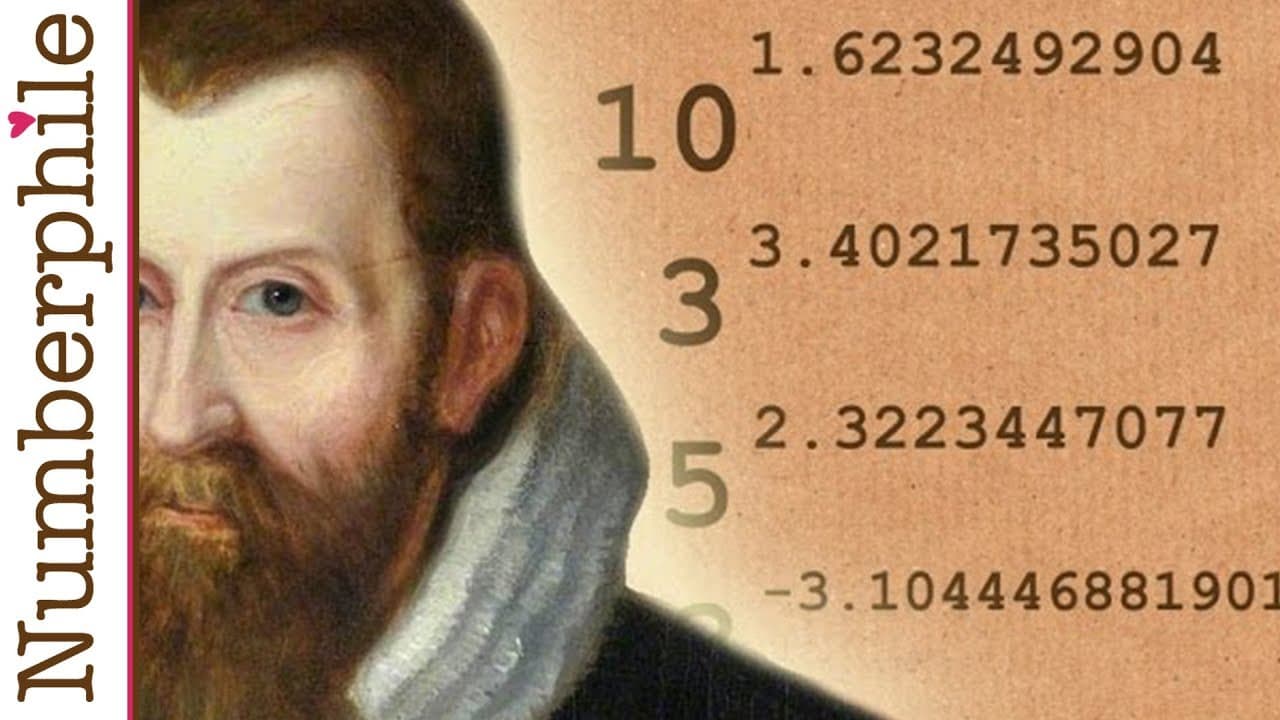
John Napier's creation of logarithm tables predates famous mathematicians, showcasing intricate number crunching methods.
Transcript
So recently professor Bowley showed us log tables; how in the good old days he used to use books like this to do big calculations. I'd suggest having a look at the video before watching this one if you need to get up to speed, but at the end of the last one we promised we talked about how these tables were created. Now the log tables we were lookin... Read More
Key Insights
- ⌛ John Napier's creation of logarithm tables predates renowned mathematicians of his time.
- #️⃣ Napier's complex number calculations and unique base number method laid the foundation for logarithmic functions.
- ⚾ Sir Briggs' transformation of Napier's base number calculations to base 10 increased accessibility and reduced errors in mathematical tables.
- 🚰 Eliminating errors in tables was crucial for accurate scientific measurements and calculations.
- 🚒 Babbage's attempt to invent a difference engine aimed at removing errors from mathematical tables for greater accuracy.
- 💦 The intricate process of creating logarithm tables showcased the dedication and meticulous work of mathematicians in earlier centuries.
- ⚾ The evolution of mathematical tables from complex bases to base 10 highlights the importance of easy usability in scientific calculations.
Install to Summarize YouTube Videos and Get Transcripts
Explore YouTube Video Summarizer or Get YouTube Transcript Extractor
Questions & Answers
Q: Who was John Napier, and what significant contribution did he make to mathematics?
John Napier was a Scottish mathematician who created logarithm tables between 1594 and 1614, predating famous mathematicians. His work introduced the concept of logarithms, crucial for complex scientific and mathematical calculations.
Q: How did John Napier create logarithm tables, and what was the significance of his base number choice?
Napier's method involved intricate calculations using a unique base number formula, which he meticulously calculated during a 20-year period. His base number choice enabled easier calculations, laying the foundation for logarithmic functions.
Q: How did Sir Briggs contribute to the development of logarithm tables, and why was his transformation significant?
Sir Briggs transformed Napier's complex base number calculations to base 10, making logarithm tables more accessible and reducing errors in calculations. His adaptation facilitated widespread use and adoption of logarithms in mathematical computations.
Q: Why was it crucial to eliminate errors in mathematical tables, and how did Babbage attempt to address this issue?
Errors in mathematical tables could lead to inaccurate scientific measurements and calculations, affecting experiments and theories. Babbage attempted to invent a difference engine to remove errors from tables, ensuring greater accuracy in mathematical computations.
Summary & Key Takeaways
-
John Napier created logarithm tables before famous mathematicians, paving the way for future scientists.
-
Napier's method involved complex number calculations to generate logarithms using a unique base number.
-
Sir Briggs later transformed Napier's base number calculations to base 10 for easier use, reducing errors in extensive calculations.
Read in Other Languages (beta)
Share This Summary 📚
Summarize YouTube Videos and Get Video Transcripts with 1-Click
Try YouTube Summary with ChatGPT & Claude or YouTube Transcript Generator
Explore More Summaries from Numberphile 📚






Summarize YouTube Videos and Get Video Transcripts with 1-Click
Try YouTube Summary with ChatGPT & Claude or YouTube Transcript Generator