How Far Can New Electric Cars Drive on One Charge?
TL;DR
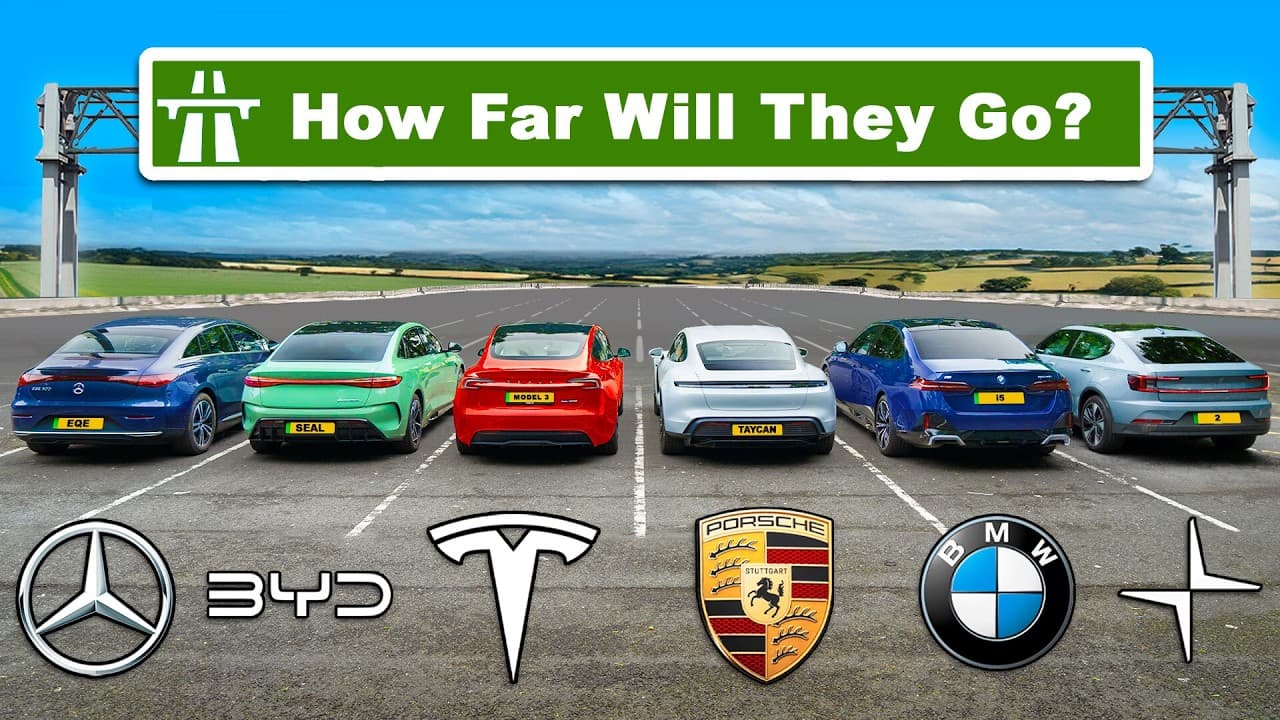
The Porsche Taycan outperformed other electric cars in a range test, covering 368 miles on a full charge, though it only achieved 88% of its claimed range. The Tesla Model 3 was the most efficient, reaching 90% of its claimed range with a consumption of 4.7 miles per kWh. Charging infrastructure issues were highlighted during the test.
Transcript
I've gathered together the very latest and greatest electric cars and I'm going to drive them at the motorway to see how far they'll go before they conch out and exactly what happens when they do run out of battery push hard hard hard hard hard 5T within the charger like the middle of nowhere next to a cemetery which car is going to win so let me t... Read More
Key Insights
- The Porsche Taycan covered 368 miles, the furthest among the tested cars, but only achieved 88% of its claimed range.
- The Tesla Model 3 was the most efficient, achieving 4.7 miles per kWh and covering 352 miles, which is 90% of its claimed range.
- The Mercedes EQE achieved 94% of its claimed range, the highest percentage in the test, covering 357 miles.
- The BMW i5 covered the shortest distance, 296 miles, reaching 82% of its claimed range.
- Charging infrastructure in the UK remains a challenge, with limited charging points and issues with charging speeds.
- The BYD Seal achieved 87% of its claimed range, covering 310 miles with an efficiency of 3.8 miles per kWh.
- The Polestar 2 covered 332 miles, achieving 82% of its claimed range with an efficiency of 4.2 miles per kWh.
- Driving conditions, such as weather and road types, can significantly impact the real-world range of electric vehicles.
Install to Summarize YouTube Videos and Get Transcripts
Explore YouTube Video Summarizer or Get YouTube Transcript Extractor
Questions & Answers
Q: How far can the Porsche Taycan travel on a full charge?
The Porsche Taycan covered 368 miles on a full charge during the test, achieving 88% of its claimed range of 421 miles. Despite having the largest battery, its efficiency was not the highest, averaging 3.8 miles per kWh.
Q: What is the most efficient electric car in the test?
The Tesla Model 3 was the most efficient car in the test, achieving 4.7 miles per kWh. It covered 352 miles, which is 90% of its claimed range of 390 miles, making it the most efficient in terms of energy consumption.
Q: How did the Mercedes EQE perform in terms of range?
The Mercedes EQE achieved a range of 357 miles, which is 94% of its claimed range of 380 miles. This made it the best performer in terms of achieving its claimed range percentage, with an efficiency of 4 miles per kWh.
Q: What challenges were faced with charging infrastructure?
The test highlighted challenges with the UK's charging infrastructure, including limited charging points and issues with charging speeds. Some service stations had insufficient or malfunctioning chargers, impacting the test's progress.
Q: How did the BMW i5 perform in the range test?
The BMW i5 covered 296 miles on a full charge, achieving 82% of its claimed range of 362 miles. It was the least efficient in the test, with an energy consumption of 3.7 miles per kWh, and ran out of power sooner than other vehicles.
Q: What was the range and efficiency of the BYD Seal?
The BYD Seal covered 310 miles, achieving 87% of its claimed range of 354 miles. Its energy consumption was 3.8 miles per kWh, placing it in the middle of the pack in terms of efficiency compared to other vehicles in the test.
Q: How did the Polestar 2 perform in terms of range and efficiency?
The Polestar 2 covered 332 miles, achieving 82% of its claimed range of 406 miles. It demonstrated good efficiency with an average of 4.2 miles per kWh, making it more efficient than the BMW and BYD in the test.
Q: What factors can impact the real-world range of electric vehicles?
Real-world range of electric vehicles can be significantly impacted by driving conditions such as weather, road types, and driving habits. For instance, adverse weather conditions and high-speed driving can reduce the range compared to the manufacturer's claimed figures.
Summary & Key Takeaways
-
The Porsche Taycan covered the longest distance in the test, reaching 368 miles, though it only achieved 88% of its claimed range. It was not the most efficient, averaging 3.8 miles per kWh.
-
The Tesla Model 3 was the most efficient vehicle in the test, achieving 4.7 miles per kWh and covering 352 miles, which is 90% of its claimed range.
-
Charging infrastructure challenges were highlighted, with limited charging points and issues with charging speeds impacting the test.
Read in Other Languages (beta)
Share This Summary 📚
Summarize YouTube Videos and Get Video Transcripts with 1-Click
Try YouTube Summary with ChatGPT & Claude or YouTube Transcript Generator
Explore More Summaries from carwow 📚



Summarize YouTube Videos and Get Video Transcripts with 1-Click
Try YouTube Summary with ChatGPT & Claude or YouTube Transcript Generator