Resonant Transformer - Generation of High Voltage and High Current - High Voltage Engineering
TL;DR
Resonant transformer generates high AC voltage using a transformer and resonant conditions, exhibiting maximum current at resonance.
Transcript
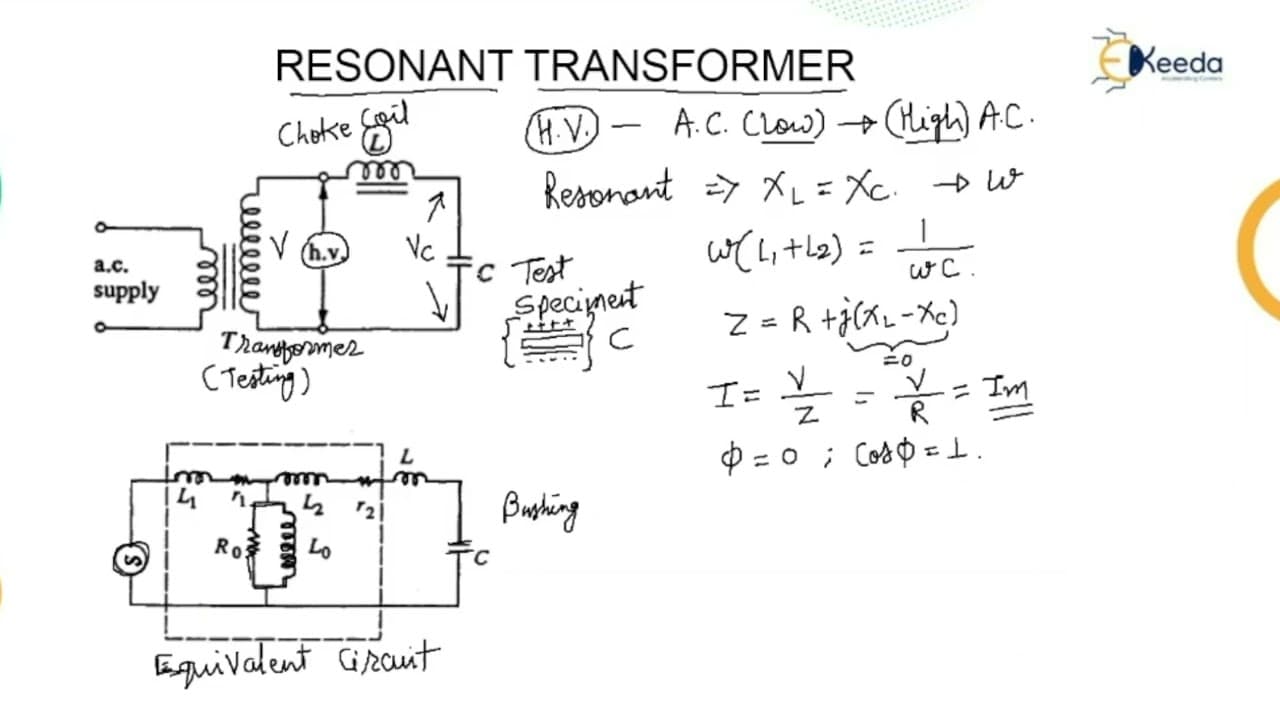
hello friends today we are going to discuss our next topic related to high ac voltage generation called as resonant transformer there is a transformer which is used definitely of high voltage where input is ac voltage definitely low voltage but the output from that transformer is high ac voltage so this low voltage input winding converts the or rat... Read More
Key Insights
- ⚡ Resonant transformer uses transformer windings and capacitive reactance to generate high AC voltage.
- 💐 Resonance condition maximizes current flow by reducing impedance to resistance.
- 🌸 Applications of resonant transformer include cable testing for dielectric losses and partial discharge.
- 🫠 Advantages of resonant transformer include sign wave output and no high power arcing.
- 🪡 Disadvantages include the need for a variable choke and potential current surges.
- ⚡ Resonant transformer is crucial for high voltage testing due to its ability to produce high current output.
- ❓ Series and parallel resonance circuits are used to demonstrate different configurations in resonant systems.
Install to Summarize YouTube Videos and Get Transcripts
Explore YouTube Video Summarizer or Get YouTube Transcript Extractor
Questions & Answers
Q: How does a resonant transformer generate high AC voltage?
A resonant transformer uses low voltage input winding and capacitive reactance to transfer and convert low voltage to high AC output by achieving a resonant condition.
Q: What is the significance of resonance in a transformer circuit?
Resonance in a transformer circuit facilitates maximum current flow, minimizing impedance to resistance, resulting in high current output with unity power factor.
Q: What are the applications of a resonant transformer?
A resonant transformer is used for cable testing, measuring dielectric losses, and detecting partial discharges, providing high current and voltage output for testing purposes.
Q: What are the advantages and disadvantages of using a resonant transformer?
The advantages include sign wave output, low power arcing, and capability for cascading high voltages, while disadvantages involve the need for a variable choke and potential current surges.
Summary & Key Takeaways
-
Resonant transformer converts low voltage input to high AC output using transformer windings and capacitive reactance.
-
Resonant condition achieved when inductive reactance equals capacitive reactance, maximizing current flow.
-
Resonant transformer application includes cable testing for dielectric losses, with advantages and disadvantages.
Read in Other Languages (beta)
Share This Summary 📚
Summarize YouTube Videos and Get Video Transcripts with 1-Click
Try YouTube Summary with ChatGPT & Claude or YouTube Transcript Generator
Explore More Summaries from Ekeeda 📚





Summarize YouTube Videos and Get Video Transcripts with 1-Click
Try YouTube Summary with ChatGPT & Claude or YouTube Transcript Generator