The Sine Function: f(x) = sin(x)
TL;DR
Explaining the sine function, graph, unit circle, special angles, derivatives, and limits.
Transcript
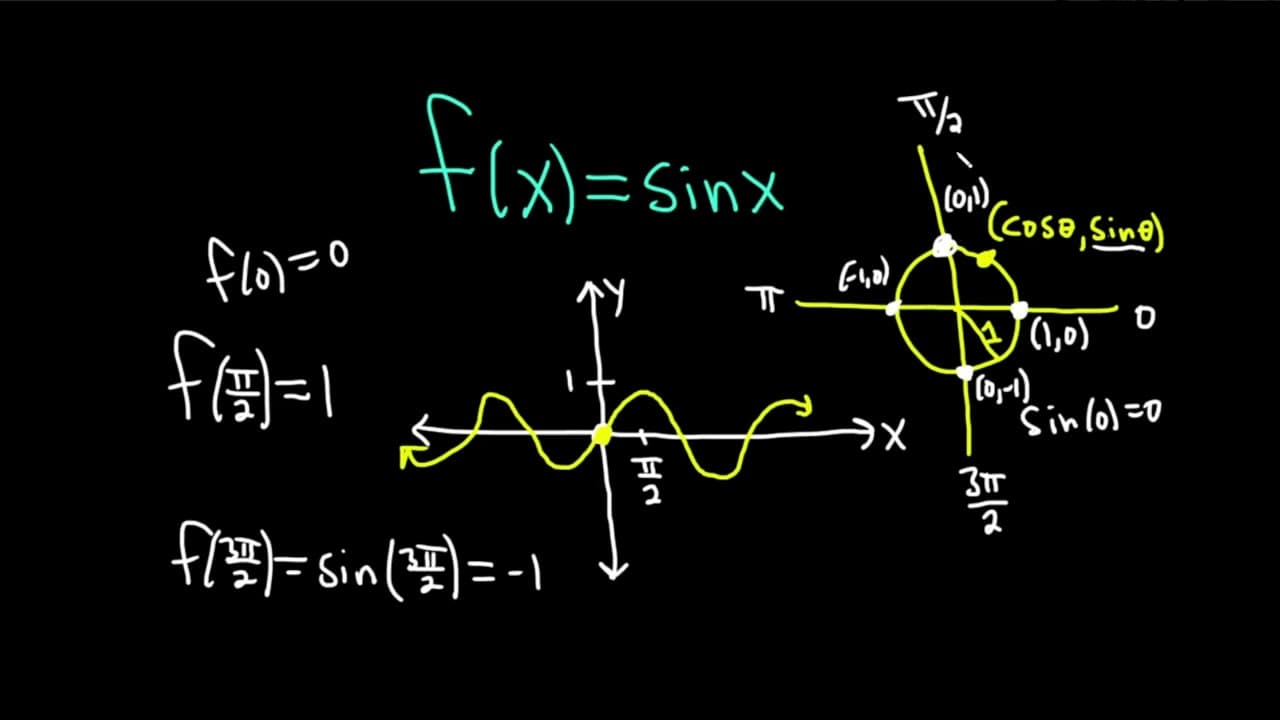
in this video I want to talk a little bit about the function sine X so f of x is equal to sine X and you can talk about this function all day I'm just going to show you a couple things in this video things that I think are good to know so first the graph of sine X I'm going to do a really rough sketch here my graphing is not very good so this is th... Read More
Key Insights
- 🔺 The sine function graph resembles waves with key points at quadrantal angles.
- 👨💼 The unit circle aids in determining sine values for essential angles like 0, π/2, and π.
- 😥 Derivative of sine is cosine, representing slope on the graph at a point.
- 🧡 Sine function is bounded by ±1, showcasing its limited range of values.
- 👨💼 Understanding the sine function involves trigonometric, geometric, and calculus concepts.
- 😥 Graph tangents at points like π/2 help interpret derivative values related to sine.
- 🛀 Sine's absolute value inequality shows its always bounded nature.
Install to Summarize YouTube Videos and Get Transcripts
Explore YouTube Video Summarizer or Get YouTube Transcript Extractor
Questions & Answers
Q: How does the unit circle help in finding sine values?
The unit circle provides ordered pairs, with sinθ as the y-coordinate, for essential angles like 0, π/2, π, and 3π/2.
Q: What is the significance of the derivative of the sine function?
The derivative of sine, cosine, gives the slope of the sine graph at a point, helping determine characteristics like maximums or minimums.
Q: Why is the value of the sine function bounded?
The sine function is bounded by ±1, making its absolute value always less than or equal to 1, showcasing its limited range of values.
Q: How does the sine function relate to trigonometry and calculus?
Sine's geometric properties from the unit circle link to the derivative in calculus, providing insight into slopes and rates of change in trigonometric functions.
Summary & Key Takeaways
-
The sine function graph is a wave with key points at quadrantal angles.
-
The unit circle helps determine sine values for special angles.
-
The derivative of sine is cosine, representing slope on the graph.
Read in Other Languages (beta)
Share This Summary 📚
Summarize YouTube Videos and Get Video Transcripts with 1-Click
Try YouTube Summary with ChatGPT & Claude or YouTube Transcript Generator
Explore More Summaries from The Math Sorcerer 📚



Summarize YouTube Videos and Get Video Transcripts with 1-Click
Try YouTube Summary with ChatGPT & Claude or YouTube Transcript Generator