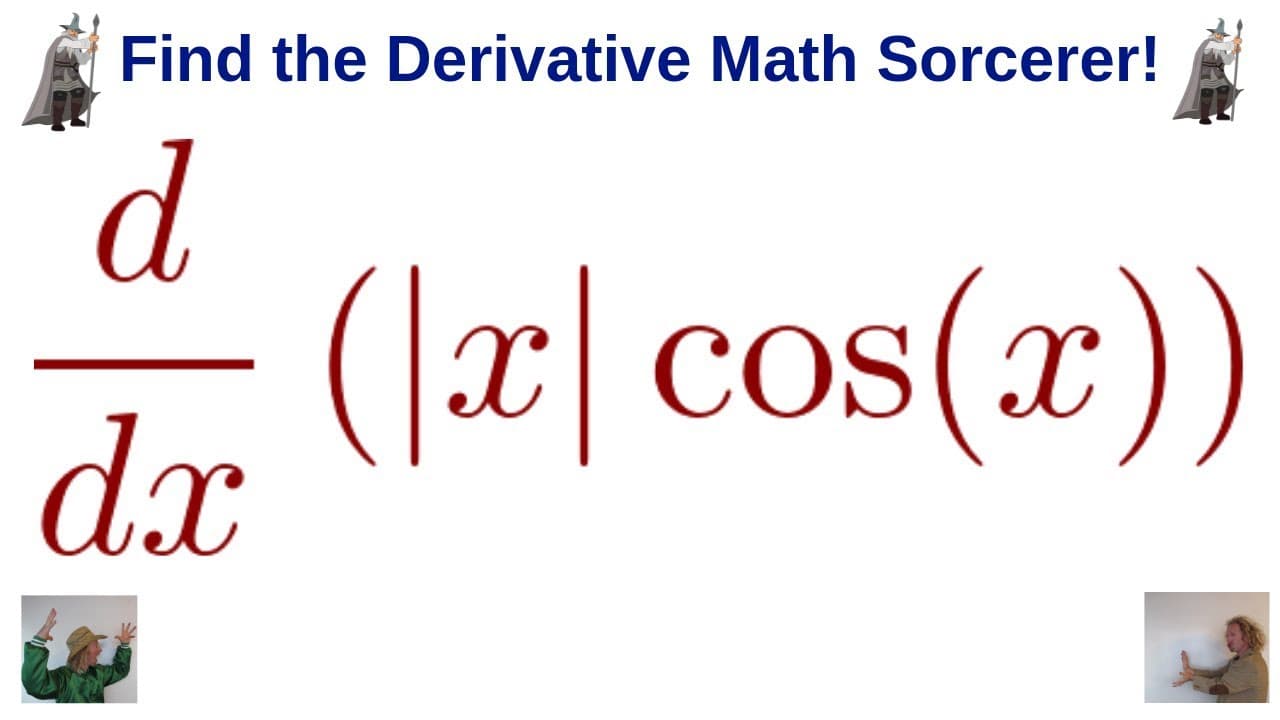
The Derivative of f(x) = |x|*cos(x)
TL;DR
Learn how to find the derivative of the absolute value of x times cosine x, using the product rule and chain rule.
Transcript
hey YouTube in this video we're going to find the derivative of the absolute value of x times cosine X keep in mind you can't differentiate the absolute value of x at zero so we'll assume that X is not zero throughout this process alright so solution so first I'll rewrite the function so f of x equals the absolute value of x times cosine X and we'r... Read More
Key Insights
- 😒 Use the chain rule when differentiating functions involving the absolute value of x.
- 🧑🏭 Product rule is essential for finding the derivative of functions with multiple factors.
- ➗ Careful consideration of mathematical properties like division by zero is crucial in derivative calculations.
- 👨💼 Understanding trigonometric functions like cosine and sine is fundamental for calculus applications.
- ❓ Rewriting functions using suitable formulas can simplify the differentiation process.
- ❓ Unique characteristics of functions like the absolute value require specific differentiation methods.
- 😥 The derivative reveals the rate of change of a function at any given point.
Install to Summarize YouTube Videos and Get Transcripts
Explore YouTube Video Summarizer or Get YouTube Transcript Extractor
Questions & Answers
Q: How is the absolute value of x represented mathematically?
The absolute value of x is represented as the square root of x squared or x squared to the power of one-half, allowing it to be differentiated.
Q: Why can't the absolute value of x be differentiated at zero?
The derivative of the absolute value of x is not defined at zero because it is a non-continuous function with a sharp corner at that point.
Q: What rule is used to find the derivative in this scenario?
The product rule is used to differentiate the absolute value of x times cosine x, considering the chain rule for the absolute value representation.
Q: Why does x need to be assumed as non-zero for this differentiation process?
X is assumed as non-zero to avoid division by zero in the derived expression, ensuring the mathematical operations are valid.
Summary & Key Takeaways
-
Explanation of rewriting the function f(x) as absolute value of x times cosine x using a formula.
-
Application of the product rule and chain rule to find the derivative of the function.
-
Final result: Derivative of absolute value of x times cosine x is x/(absolute value of x) * cosine x - (absolute value of x) * sine x.
Read in Other Languages (beta)
Share This Summary 📚
Summarize YouTube Videos and Get Video Transcripts with 1-Click
Try YouTube Summary with ChatGPT & Claude or YouTube Transcript Generator
Explore More Summaries from The Math Sorcerer 📚


Summarize YouTube Videos and Get Video Transcripts with 1-Click
Try YouTube Summary with ChatGPT & Claude or YouTube Transcript Generator