E2 E1 Sn2 Sn1 Reactions Example 2
TL;DR
The video discusses the reactivity differences between a bulky base and a smaller nucleophile in organic chemistry reactions.
Transcript
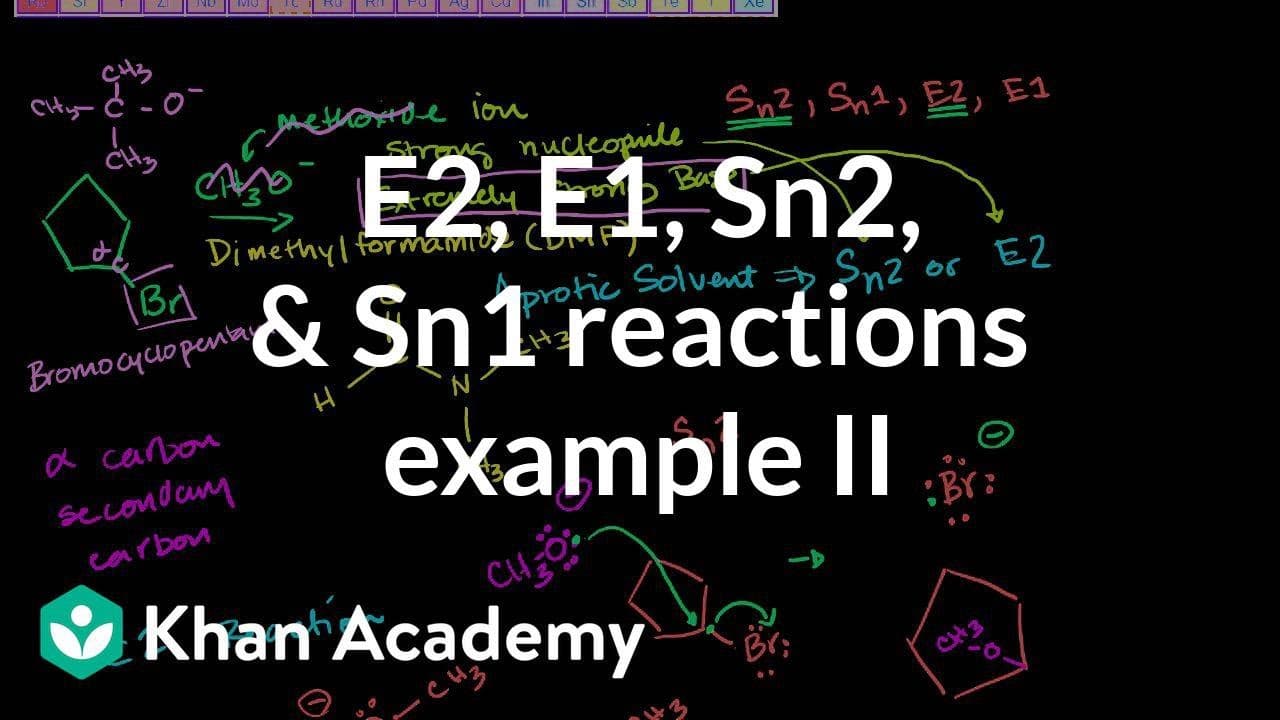
What I want to do in this video is think about what type of reaction we might have if we have ingredients very similar to what we saw in the last video. But instead of our nucleophile or our base being methoxide, it's going to be something slightly more involved. So it's still going to have the O minus, but it's going to be bonded to a carbon, whic... Read More
Key Insights
- ⚾ The bulky base, bonded to a carbon with methyl groups, is a strong base but not a good nucleophile due to its size.
- 🛩️ The choice between a bulky base and a small nucleophile determines whether the reaction proceeds via the Sn2 or E2 mechanism.
- ☠️ The solvent choice, dimethylformamide, does not determine the reaction direction but can influence reaction rate and selectivity.
- 💁 In an E2 reaction, a proton is removed by the base while a leaving group is eliminated, forming a double bond.
- 👊 The Sn2 reaction involves a nucleophile attacking the substrate and displacing a leaving group, resulting in inversion of stereochemistry.
- 🛩️ A smaller nucleophile, like methoxide, can effectively react with the substrate due to its small size and strong reactivity.
- ⚾ The size of the base or nucleophile significantly affects its ability to interact with the substrate and determine the reaction outcome.
Install to Summarize YouTube Videos and Get Transcripts
Explore YouTube Video Summarizer or Get YouTube Transcript Extractor
Questions & Answers
Q: How does the size of the base affect its reactivity as a nucleophile in organic chemistry reactions?
The size of the base plays a crucial role in its reactivity. A smaller nucleophile, like methoxide, can efficiently react with the substrate due to its small size, acting as both a strong base and a strong nucleophile. However, a bulky base, bonded to a carbon with methyl groups, is no longer a good nucleophile because its size inhibits it from effectively reacting with the substrate.
Q: What is the difference between an Sn2 reaction and an E2 reaction?
In an Sn2 reaction, a nucleophile attacks the substrate while simultaneously displacing a leaving group, resulting in a concerted reaction with inversion of stereochemistry. On the other hand, an E2 reaction involves the removal of a proton by a base from a substrate with the simultaneous removal of a leaving group, resulting in the formation of a double bond and the elimination of a molecule.
Q: How does the choice between a bulky base and a small nucleophile impact the reaction outcome?
The choice between a bulky base and a small nucleophile determines whether the reaction will proceed via an Sn2 or E2 mechanism. The bulky base, while acting as a strong base, is not a good nucleophile and only leads to an E2 reaction. In contrast, a small nucleophile like methoxide can act as both a strong base and a strong nucleophile, leading to an Sn2 reaction.
Q: What is the role of the solvent in determining the reaction direction?
The solvent used, dimethylformamide, is an aprotic solvent that favors Sn2 or E2 reactions. It does not solvate the nucleophile or base, allowing them to directly interact with the substrate. Therefore, the solvent choice alone does not determine the reaction direction, but it can influence the reaction rate and selectivity.
Summary & Key Takeaways
-
The video explores the impact of using a bulky base in organic chemistry reactions instead of a small nucleophile.
-
The bulky base, bonded to a carbon atom and three methyl groups, is not a good nucleophile but still acts as a strong base.
-
The reaction follows a similar mechanism as seen in the previous video, but with the bulky base leading strictly to an E2 reaction rather than an Sn2 reaction.
Read in Other Languages (beta)
Share This Summary 📚
Summarize YouTube Videos and Get Video Transcripts with 1-Click
Try YouTube Summary with ChatGPT & Claude or YouTube Transcript Generator
Explore More Summaries from Khan Academy 📚



Summarize YouTube Videos and Get Video Transcripts with 1-Click
Try YouTube Summary with ChatGPT & Claude or YouTube Transcript Generator