What Is the Laplace Transform of the Dirac Delta Function?
TL;DR
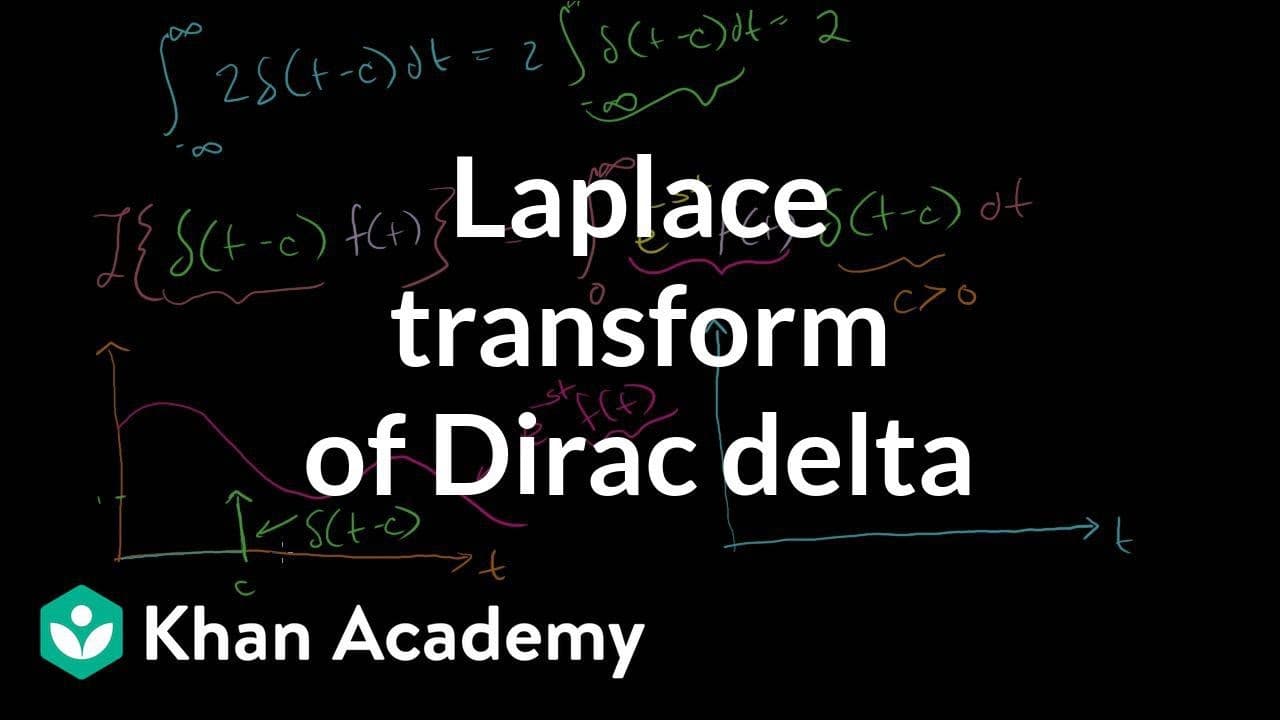
The Laplace transform of the Dirac delta function equals 1, while the Laplace transform of a shifted Dirac delta function is calculated as e^(-cs), where c is the shift point. This means that the delta function represents an infinitely tall spike at a specific point with an area of 1, allowing it to model sudden impulses in mathematical functions.
Transcript
In the last video, I introduced you to what is probably the most bizarro function that you've encountered so far. And that was the Dirac delta function. And I defined it to be-- and I'll do the shifted version of it. You're already hopefully reasonably familiar with it. So Dirac delta of t minus c. We can say that it equals 0, when t does not equal... Read More
Key Insights
- ❓ The Dirac delta function is a mathematical representation of an infinitely tall and narrow spike, used to model sudden impacts or impulses.
- 💄 The area under the Dirac delta function is equal to 1, making it a pseudoinfinity with different degrees of infinity.
- 😥 When multiplied with another function, the Dirac delta function results in a scaled spike, with the height determined by the value of the function at the point of interest.
Install to Summarize YouTube Videos and Get Transcripts
Explore YouTube Video Summarizer or Get YouTube Transcript Extractor
Questions & Answers
Q: What is the definition of the Dirac delta function?
The Dirac delta function is a mathematical concept that is zero everywhere except at a specific point, where it is infinitely high and has an area under the curve equal to 1.
Q: How does the Dirac delta function behave when multiplied with another function?
When multiplied with another function, the Dirac delta function results in a scaled spike at the point of interest. The height of the spike is equal to the value of the function at that point.
Q: What is the Laplace transform of the Dirac delta function?
The Laplace transform of the Dirac delta function is equal to 1, as it is a constant term.
Q: What is the Laplace transform of a shifted delta function?
The Laplace transform of a shifted delta function is given by evaluating the function at the shift point. It can be represented as e^(-cx), where c is the shift value.
Summary & Key Takeaways
-
The Dirac delta function is defined as zero everywhere except at a specific point, where it is infinitely high and has an area under the curve equal to 1.
-
When multiplied with another function, the Dirac delta function results in a scaled spike at the point of interest.
-
The Laplace transform of the Dirac delta function is equal to 1, while the Laplace transform of a shifted delta function is given by evaluating the function at the shift point.
Read in Other Languages (beta)
Share This Summary 📚
Summarize YouTube Videos and Get Video Transcripts with 1-Click
Try YouTube Summary with ChatGPT & Claude or YouTube Transcript Generator
Explore More Summaries from Khan Academy 📚





Summarize YouTube Videos and Get Video Transcripts with 1-Click
Try YouTube Summary with ChatGPT & Claude or YouTube Transcript Generator