Graphs of MC, AVC and ATC
TL;DR
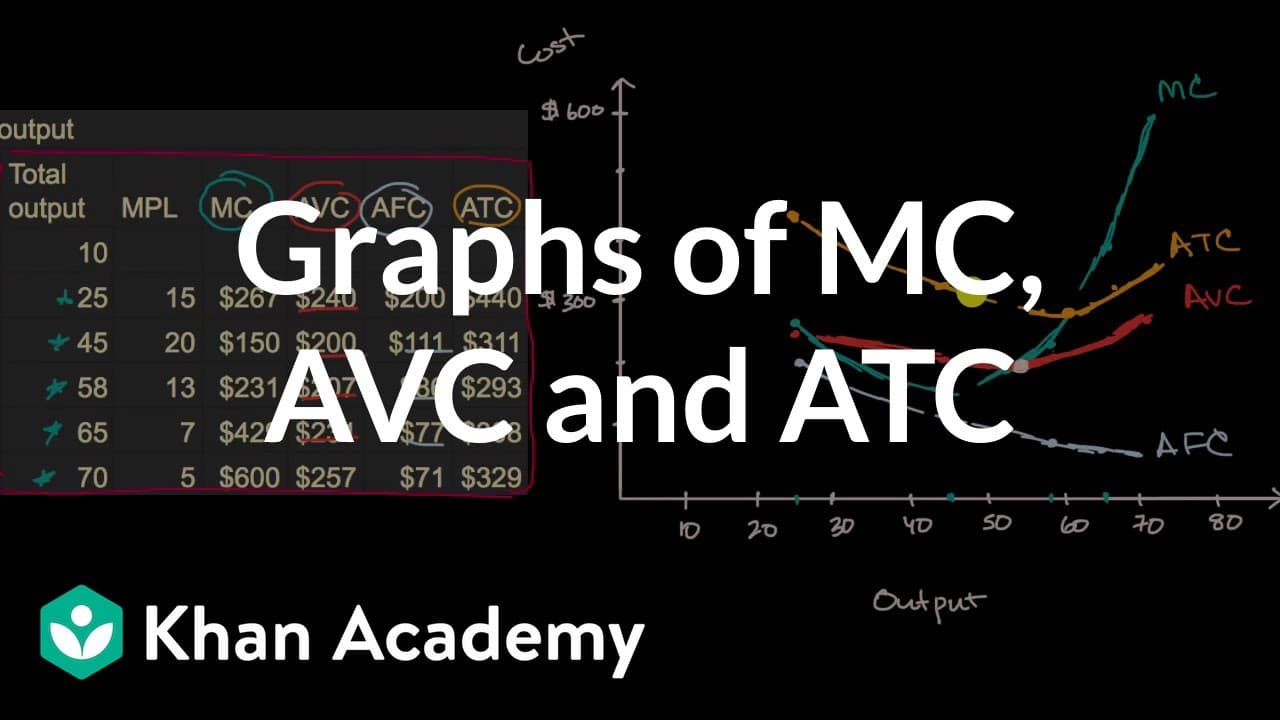
This video explains how to graph marginal cost, average variable cost, and average total cost curves and their relationship.
Transcript
- [Instructor] In the previous video, we began our study of ABC Watch Factory and we tried to understand the economics of the business based on some data that we had already collected on our costs and how much output we could produce based on how many labor units we had. And then from that, we calculated things, like the marginal product of labor, ... Read More
Key Insights
- 🇨🇷 Graphing cost curves helps businesses understand how costs vary with different levels of output.
- 🇨🇷 The marginal cost curve shows the cost of producing one additional unit and helps evaluate profit maximization strategies.
- 🇨🇷 The average variable cost curve initially decreases due to spreading fixed costs, but starts to increase once the marginal cost exceeds it.
- 🇨🇷 The average total cost curve represents the average cost per unit, including both variable and fixed costs.
- 🇨🇷 The intersection point of the marginal cost and average variable cost curves represents the minimum point of the average variable cost curve.
- 🇨🇷 The intersection point of the marginal cost and average total cost curves represents the minimum point of the average total cost curve.
- 🇨🇷 Average fixed costs decrease as output increases since fixed costs are spread over more units.
Install to Summarize YouTube Videos and Get Transcripts
Explore YouTube Video Summarizer or Get YouTube Transcript Extractor
Questions & Answers
Q: What is the purpose of graphing cost curves in economics?
Graphing cost curves helps analyze how costs change with different levels of output, allowing businesses to make informed decisions about production and pricing strategies.
Q: How does marginal cost differ from average variable cost?
Marginal cost is the cost of producing one additional unit, while average variable cost is the average cost per unit at a given level of output. Marginal cost can fluctuate, while average variable cost smooths out these fluctuations.
Q: Why does the average variable cost decrease initially and then increase?
The average variable cost decreases initially because as output increases, fixed costs are spread over more units, reducing the average cost per unit. However, once the marginal cost exceeds the average variable cost, it starts to bring up the average cost per unit.
Q: How do the average total cost and average variable cost curves differ?
The average total cost curve includes both variable and fixed costs, while the average variable cost curve only considers variable costs. As a result, the average total cost is always higher than the average variable cost at any given level of output.
Summary & Key Takeaways
-
The video focuses on graphing the marginal cost, average variable cost, and average total cost curves based on different levels of output.
-
The marginal cost curve shows how the cost changes with each additional unit produced.
-
The average variable cost and average total cost curves show the average cost per unit and how it is affected by the level of output.
Read in Other Languages (beta)
Share This Summary 📚
Summarize YouTube Videos and Get Video Transcripts with 1-Click
Try YouTube Summary with ChatGPT & Claude or YouTube Transcript Generator
Explore More Summaries from Khan Academy 📚



Summarize YouTube Videos and Get Video Transcripts with 1-Click
Try YouTube Summary with ChatGPT & Claude or YouTube Transcript Generator