What Is the Sodium-Potassium Pump and Its Function?
TL;DR
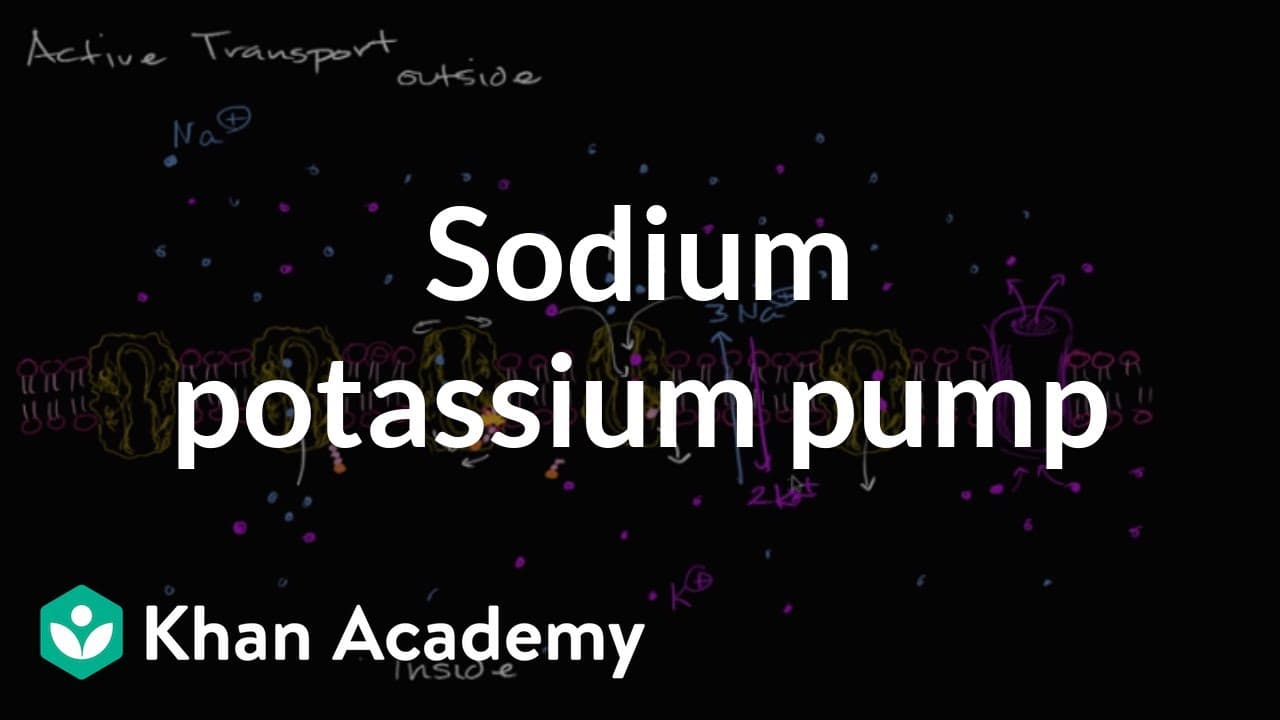
The sodium-potassium pump is an active transport mechanism that uses ATP to move three sodium ions out of the cell and two potassium ions in, crucially contributing to the resting membrane potential of cells. This pump maintains essential ion concentration gradients, enabling functions like neuron signaling and additional active transport processes.
Transcript
- [Voiceover] What I hope to do in this video is give ourselves an appreciation for the sodium-potassium pump, and as the name implies, it pumps sodium and potassium, but it does it in different directions. So this little depiction right over here, this is my drawing, my rendition of the sodium-potassium pump, it's a trans-membrane, I guess you cou... Read More
Key Insights
- 😑 The sodium-potassium pump is an ATP-dependent mechanism that actively transports sodium and potassium ions across cell membranes.
- 😣 It plays a vital role in establishing and maintaining the resting membrane potential of cells, especially in neurons.
- 🥶 The pump's activity creates concentration gradients that allow for other active transport processes, such as co-transport of glucose molecules.
Install to Summarize YouTube Videos and Get Transcripts
Explore YouTube Video Summarizer or Get YouTube Transcript Extractor
Questions & Answers
Q: How does the sodium-potassium pump work?
The sodium-potassium pump is a transmembrane protein complex that undergoes confirmation changes to pump three sodium ions out of cells and two potassium ions into cells, using the energy released by ATP phosphorylation.
Q: What is the significance of the sodium-potassium pump in cells?
The sodium-potassium pump helps maintain the concentration gradients of sodium and potassium ions, which are essential for establishing the resting membrane potential. It also enables other forms of active transport and co-transport processes in cells.
Q: How does the concentration gradient of sodium and potassium ions affect the movement of ions through channel proteins?
The concentration gradient of sodium and potassium ions determines the direction of their movement through channel proteins. The pump establishes a higher sodium concentration outside the cell and a higher potassium concentration inside the cell, allowing potassium ions to flow out through channel proteins while maintaining the membrane potential.
Q: What is the resting membrane potential, and why is it important?
The resting membrane potential is the voltage difference across a cell membrane when it is not conducting any signals. It is crucial for neural cells to transmit signals efficiently. The sodium-potassium pump helps establish and maintain the resting membrane potential, which is typically around -70 millivolts.
Summary & Key Takeaways
-
The sodium-potassium pump is a protein complex that pumps sodium and potassium ions in opposite directions across cell membranes.
-
It undergoes a series of confirmation changes, aided by ATP phosphorylation, to alternate its affinity for sodium and potassium ions.
-
The pump helps maintain the concentration gradients of sodium and potassium, which play a crucial role in establishing the resting membrane potential of cells.
Read in Other Languages (beta)
Share This Summary 📚
Summarize YouTube Videos and Get Video Transcripts with 1-Click
Try YouTube Summary with ChatGPT & Claude or YouTube Transcript Generator
Explore More Summaries from Khan Academy 📚



Summarize YouTube Videos and Get Video Transcripts with 1-Click
Try YouTube Summary with ChatGPT & Claude or YouTube Transcript Generator