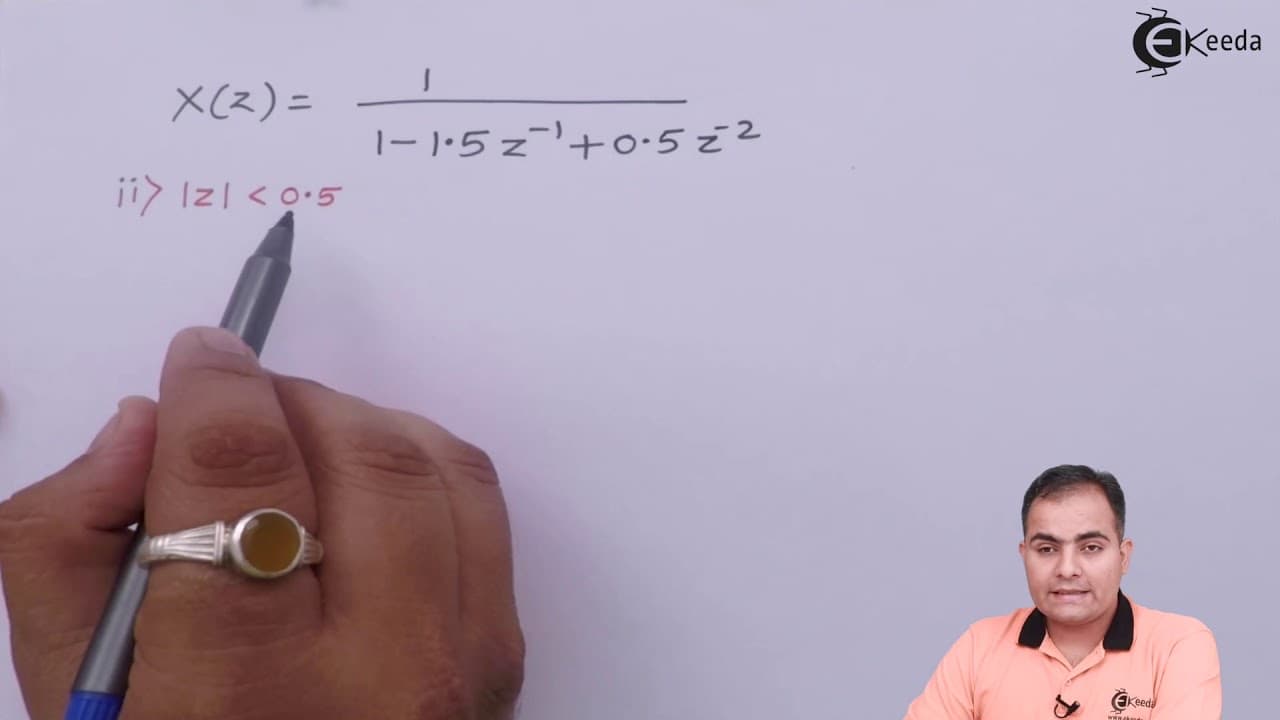
Inverse Z Transform Of Signal Using Power Series Expansion Method And Residue Theorem Problem 02
TL;DR
Study of power series expansion method for determining inverse z-transform with positive and negative time sequences.
Transcript
click the bell icon to get latest videos from Ikeda hello friends and today we are going to study a new numerical which is based on power series expansion a problem number two that we are going to study right now now basically whenever a causal sequence is given in the power series expansion method whenever a causal sequence is given then always tr... Read More
Key Insights
- 🤪 Power series expansion helps in determining inverse z-transform for a given function.
- 🤪 Dividing the numerator by increasing power of Z calculates amplitudes for non-causal time sequences.
- 🤪 Dividing the numerator by decreasing power of Z calculates amplitudes for causal time sequences.
- 🤪 Sequence amplitudes for positive and negative time sequences are obtained by comparing coefficients of Z powers in X of Z.
- 🪪 Correct identification of causal and non-causal sequences is essential for accurate amplitude calculations.
- 💤 Comparison of X of Z with Z-transform definition aids in finding coefficients for different powers of Z.
- ✊ Power series expansion method requires understanding the nature of the sequence to determine amplitudes accurately.
Install to Summarize YouTube Videos and Get Transcripts
Explore YouTube Video Summarizer or Get YouTube Transcript Extractor
Questions & Answers
Q: What is the key concept behind determining amplitudes for positive and negative time sequences in power series expansion method?
The key concept lies in dividing the numerator by increasing power of Z for non-causal time sequences and by decreasing power of Z for causal time sequences.
Q: How does the choice of power series expansion method affect the calculation of amplitudes for different time sequences?
The method chosen for power series expansion determines whether the amplitudes are calculated for positive or negative time sequences, based on the powers of Z used in the division.
Q: Why is it important to correctly identify whether the given sequence is causal or non-causal in power series expansion?
Identifying the nature of the sequence (causal or non-causal) is crucial in determining the correct method for calculating amplitudes in power series expansion and obtaining accurate results.
Q: How does the comparison of X of Z with the definition of Z-transform help in determining sequence amplitudes?
Comparing X of Z with the Z-transform definition aids in finding the coefficients for different powers of Z, which represent amplitudes for positive and negative time sequences accurately.
Summary & Key Takeaways
-
The video discusses calculating amplitudes for positive and negative time sequences using power series expansion method for determining inverse z-transform.
-
It covers solving a particular numerical problem involving power series expansion for a given function X of Z.
-
The process involves dividing the numerator by increasing power of Z for non-causal time sequences and by decreasing power of Z for causal time sequences.
Read in Other Languages (beta)
Share This Summary 📚
Summarize YouTube Videos and Get Video Transcripts with 1-Click
Try YouTube Summary with ChatGPT & Claude or YouTube Transcript Generator
Explore More Summaries from Ekeeda 📚






Summarize YouTube Videos and Get Video Transcripts with 1-Click
Try YouTube Summary with ChatGPT & Claude or YouTube Transcript Generator