Multiplying: using an area model | Multiplication and division | Arithmetic | Khan Academy
TL;DR
Learn how to multiply using an area model by breaking down the numbers into smaller parts.
Transcript
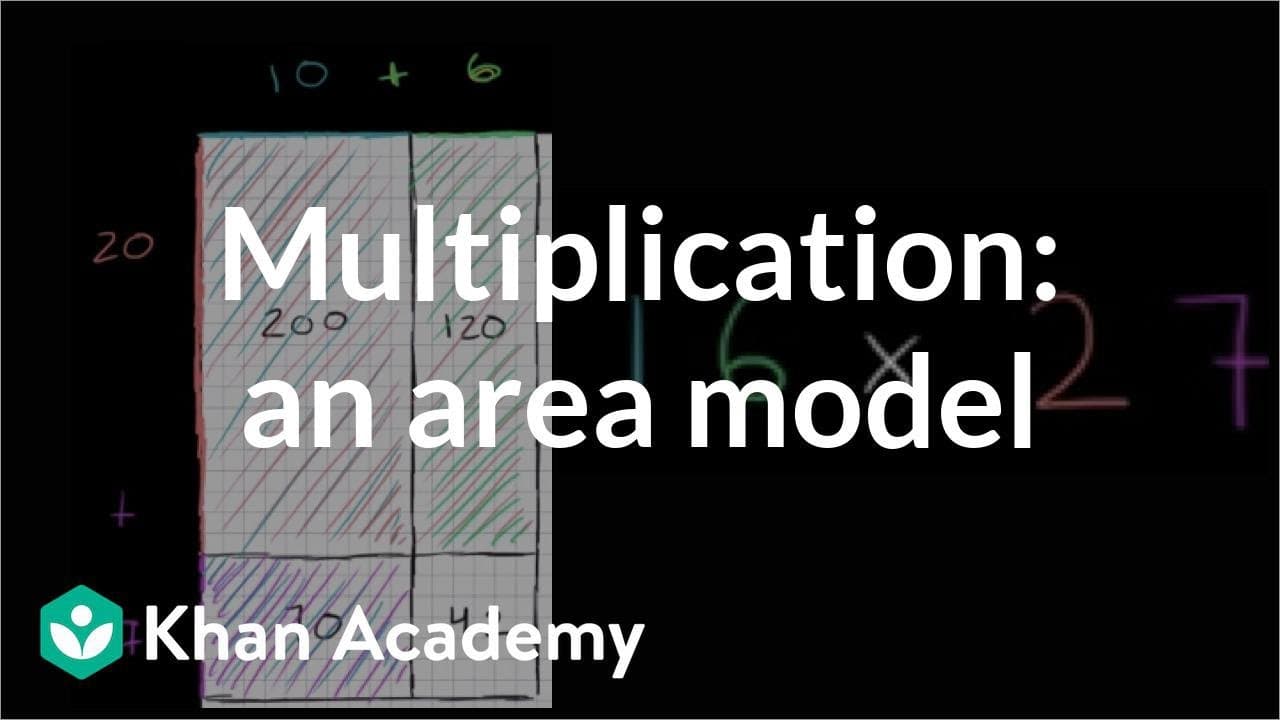
So I'm going to multiply 16 times 27. I'm going to do it using something called an area model. And the whole point of an area model is to really understand what's going on in the multiplication process. So 16, you can represent literally as 10 plus 6. This 1 is in the tens place. It represents one 10. So we can represent that as 10 plus 6. Let me d... Read More
Key Insights
- 🍳 An area model helps visualize the multiplication process by breaking down numbers into different sections.
- 🤑 The sections represent different parts of the numbers, such as tens and ones.
- 🪜 Each section's area is calculated separately and then added together to find the final product.
- 🍳 The area model method provides a comprehensive understanding of multiplication and how to break down numbers for accurate calculations.
- 🧑🎓 It can be useful for students who struggle with traditional multiplication methods.
- ✖️ The area model demonstrates the connection between multiplication and calculating areas in geometry.
- ⌛ The method can be applied to various multiplication problems, not just the specific example of 16 times 27.
Install to Summarize YouTube Videos and Get Transcripts
Explore YouTube Video Summarizer or Get YouTube Transcript Extractor
Questions & Answers
Q: What is the purpose of an area model in multiplication?
The purpose of an area model in multiplication is to help understand the process by visually representing the numbers as lengths and calculating the areas of different sections.
Q: How is the number 16 represented in the area model?
The number 16 is represented as 10 plus 6 in the area model, where 10 represents one 10 and 6 represents six ones.
Q: How is the number 27 represented in the area model?
The number 27 is represented as 20 plus 7 in the area model, where 20 represents two tens and 7 represents seven ones.
Q: How is the final product of 16 times 27 calculated using the area model?
The final product of 16 times 27 is calculated by finding the areas of different sections in the area model and adding them together. In this case, it is 200 plus 120 plus 70 plus 42, which equals 432.
Summary & Key Takeaways
-
An area model is used to understand the process of multiplication, by visually representing the numbers as lengths.
-
The content demonstrates how to multiply 16 by 27 using the area model.
-
The numbers are broken down into 10s and 1s, and the areas of each section are calculated separately.
-
The individual areas are then added together to determine the final product of 16 times 27, which is 432.
Read in Other Languages (beta)
Share This Summary 📚
Summarize YouTube Videos and Get Video Transcripts with 1-Click
Try YouTube Summary with ChatGPT & Claude or YouTube Transcript Generator
Explore More Summaries from Khan Academy 📚



Summarize YouTube Videos and Get Video Transcripts with 1-Click
Try YouTube Summary with ChatGPT & Claude or YouTube Transcript Generator