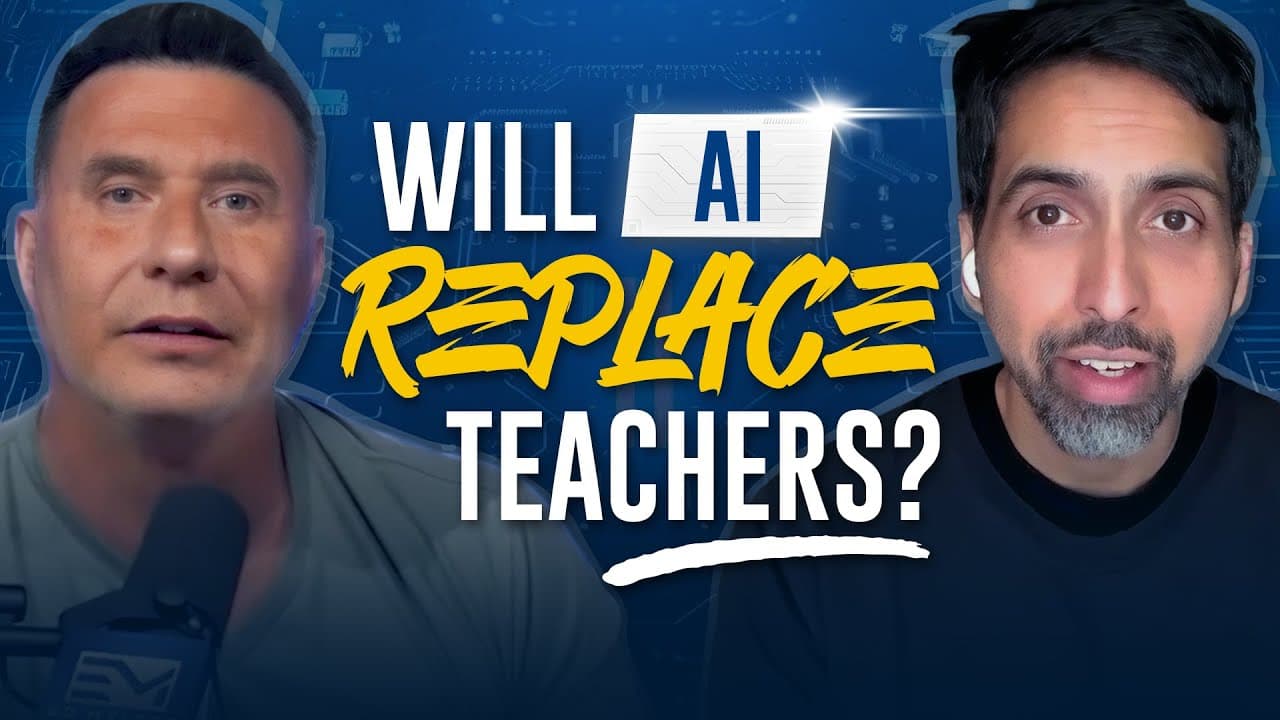
Will AI Replace Teachers? feat. @khanacademy Founder Sal Khan
TL;DR
AI is transforming education and job markets rapidly.
Transcript
most of you should know if you don't the KH Academy is one of the most revolutionary nonprofit organizations on the planet talk about a little bit about the foundation of why you started KH Academy in 2004 I had just gotten married I was a year out of business school I was an analyst at a hedge fund my 12-year-old cousin naadia was having trouble i... Read More
Key Insights
- Sal Khan founded Khan Academy to address gaps in traditional education, emphasizing personalized learning through technology.
- AI can revolutionize education by providing personalized assessments and learning experiences beyond standardized tests.
- AI tools can democratize access to quality education, offering opportunities for students globally, regardless of their background.
- There are concerns about AI's impact on job markets, with potential displacements in various sectors due to automation.
- AI has the potential to enhance creativity by providing tools for students to explore and express their ideas more freely.
- The future of education may include AI as a guidance counselor, offering personalized advice and support to students.
- Despite AI advancements, human teachers remain crucial for emotional connections and mentorship in education.
- Sal Khan believes in pursuing passion over wealth, focusing on meaningful contributions to education rather than financial gains.
Install to Summarize YouTube Videos and Get Transcripts
Explore YouTube Video Summarizer or Get YouTube Transcript Extractor
Questions & Answers
Q: How did Khan Academy start?
Khan Academy began when Sal Khan started tutoring his cousin Nadia in math remotely. He noticed common patterns in the educational challenges faced by students and decided to create software to help them. This eventually led to the founding of Khan Academy, which aims to provide free, world-class education to anyone, anywhere.
Q: What role does AI play in education according to Sal Khan?
Sal Khan believes AI can revolutionize education by offering personalized assessments and learning experiences. AI can move beyond standardized tests, allowing students to engage in simulations, design experiments, and express their thoughts creatively. This personalized approach can help address gaps in traditional education systems.
Q: What are the potential challenges of integrating AI in education?
Some potential challenges include the risk of AI being used as a shortcut for learning, undermining students' work ethic. There's also concern about AI's impact on job markets, with potential displacements in various sectors. Ethical considerations and the potential for misuse, such as deep fakes, are also significant concerns.
Q: How can AI democratize access to education?
AI can democratize access to education by providing personalized learning experiences to students worldwide, regardless of their background. It can offer guidance and support that might not be available in traditional settings, giving students in underprivileged areas access to quality education and opportunities for growth.
Q: Why does Sal Khan believe human teachers are still important?
Sal Khan emphasizes that human teachers are crucial for forming emotional connections with students, mentoring, and providing personalized support. While AI can offer many educational benefits, the human element in teaching, such as empathy and personal interaction, remains irreplaceable.
Q: What advice does Sal Khan give to the younger generation?
Sal Khan advises the younger generation to focus on developing traditional skills like reading comprehension, communication, and critical thinking. He also emphasizes the importance of entrepreneurship and the ability to leverage AI tools to create and innovate, as these skills will be vital in the future job market.
Q: What industries might benefit from AI according to Sal Khan?
Industries related to engineering, computer science, and technology are likely to benefit from AI. These fields will see increased productivity and demand for skilled professionals who can leverage AI tools effectively. Additionally, creative fields may also benefit from AI's ability to enhance and support innovation.
Q: What are Sal Khan's fears about AI?
Sal Khan's fears about AI include the potential for misuse, such as deep fakes and fraud, as well as economic dislocation due to job automation. He is also concerned about the rapid pace of AI advancements, which may outpace society's ability to adapt and address the ethical and practical challenges it presents.
Summary & Key Takeaways
-
Sal Khan discusses the origins and growth of Khan Academy, highlighting its mission to provide free, world-class education to anyone, anywhere. He emphasizes the role of AI in revolutionizing education by offering personalized learning experiences and addressing gaps in traditional systems.
-
The conversation explores AI's potential to democratize education, making it more accessible to students worldwide. Sal Khan also addresses concerns about AI's impact on job markets, suggesting that entrepreneurial skills will become increasingly important in a rapidly changing world.
-
Sal Khan shares his personal journey and decision to prioritize passion over financial success. He expresses optimism about AI's role in enhancing creativity and learning but also acknowledges the potential challenges and ethical considerations as AI becomes more integrated into society.
Read in Other Languages (beta)
Share This Summary 📚
Summarize YouTube Videos and Get Video Transcripts with 1-Click
Try YouTube Summary with ChatGPT & Claude or YouTube Transcript Generator
Explore More Summaries from Ed Mylett 📚






Summarize YouTube Videos and Get Video Transcripts with 1-Click
Try YouTube Summary with ChatGPT & Claude or YouTube Transcript Generator