Centripetal force and acceleration intuition | Physics | Khan Academy
TL;DR
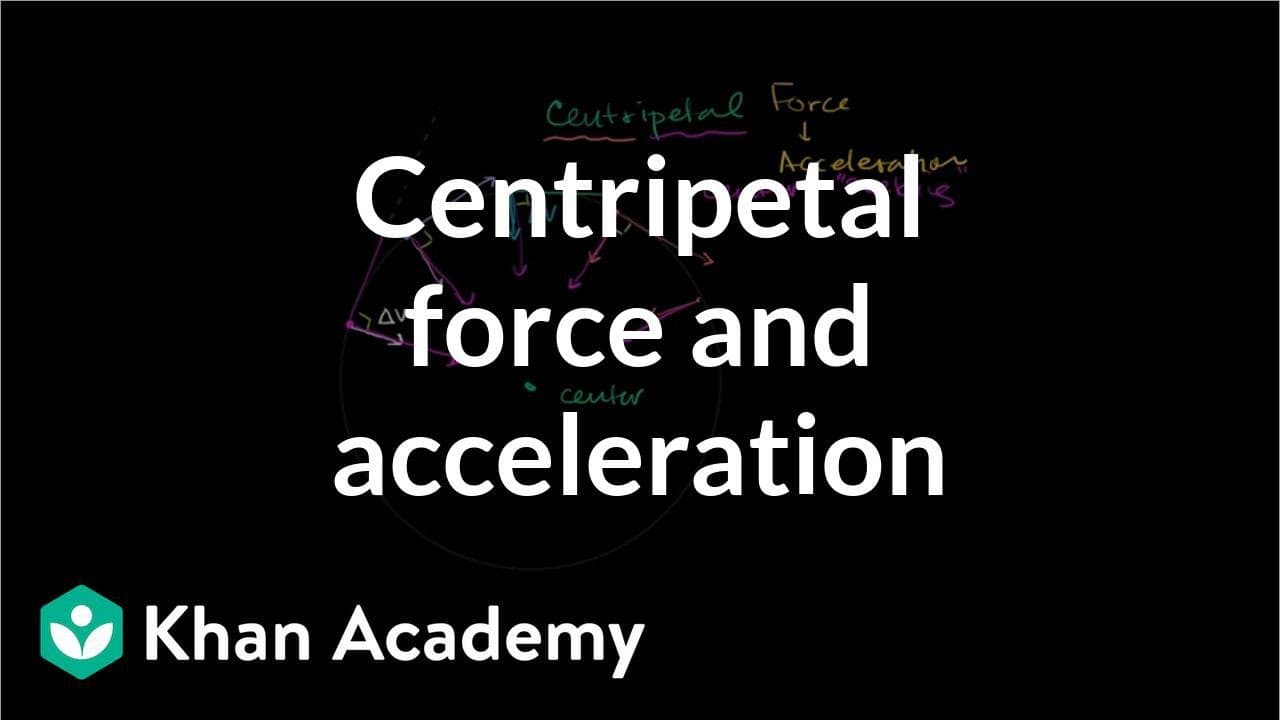
The video explains the concept of centripetal force and how it is responsible for objects moving in a circular path.
Transcript
Let's say we observe some object-- let's say for the sake of argument, it's happening in space It's traveling in a circular path with the magnitude of its velocity being constant Let me draw its velocity vector The length of this arrow is the magnitude of the velocity I want to be clear. In order for it to be traveling in the circular path the dire... Read More
Key Insights
- 💱 Circular motion requires a change in velocity, which can only occur with the presence of a centripetal force.
- 💱 The change in velocity is always perpendicular to the direction of the velocity vector.
- 🧑🏭 Centripetal force can be provided by factors such as tension in a string, gravity, or friction.
- 👻 Centripetal force causes centripetal acceleration, which allows an object to move towards the center of a circle.
Install to Summarize YouTube Videos and Get Transcripts
Explore YouTube Video Summarizer or Get YouTube Transcript Extractor
Questions & Answers
Q: What is a centripetal force?
A centripetal force is a force that acts towards the center of a circular path and allows an object to move in that path.
Q: Can you give an example of a centripetal force in everyday life?
One example is a car moving in a circular track, where the force of friction between the tires and the road provides the centripetal force.
Q: What happens to the change in velocity in circular motion?
The change in velocity is always perpendicular to the direction of the velocity itself, constantly seeking the center of the circle.
Q: How does centripetal force keep objects in orbit?
For objects in orbit, such as satellites around the Earth, the centripetal force is provided by the force of gravity, which keeps them from flying out into space.
Summary & Key Takeaways
-
Objects moving in a circular path require a change in velocity, which is caused by a force acting towards the center of the circle.
-
The change in velocity is always perpendicular to the direction of the velocity itself.
-
Centripetal force can be provided by various factors, such as tension in a string, gravity, or friction.
Read in Other Languages (beta)
Share This Summary 📚
Summarize YouTube Videos and Get Video Transcripts with 1-Click
Try YouTube Summary with ChatGPT & Claude or YouTube Transcript Generator
Explore More Summaries from Khan Academy 📚



Summarize YouTube Videos and Get Video Transcripts with 1-Click
Try YouTube Summary with ChatGPT & Claude or YouTube Transcript Generator