Worked example: problem involving definite integral (algebraic) | AP Calculus AB | Khan Academy
TL;DR
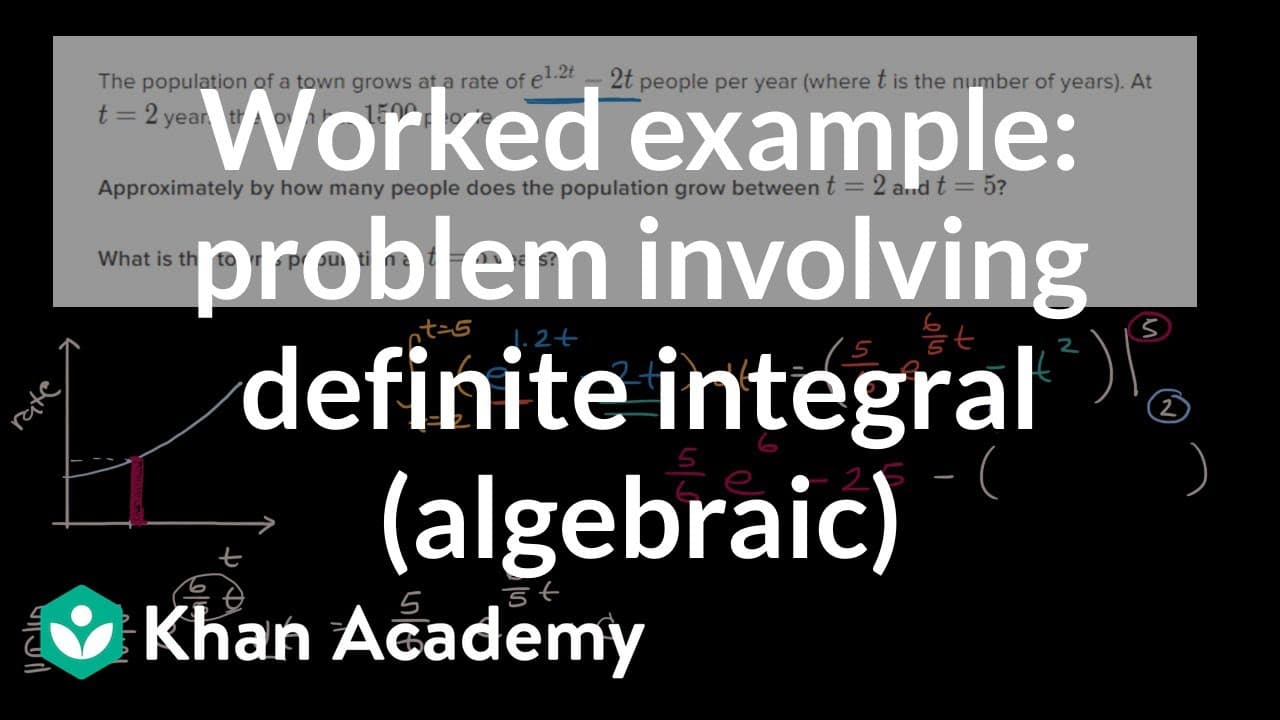
The population of a town grows at a specific rate, and by using calculus, we can calculate the population growth between two time periods and predict the population at a specific time.
Transcript
- [Instructor] We are told the population of a town grows at a rate of e to the 1.2t power minus two t people per year where t is the number of years. At t equals two years, the town has 1,500 people. First, they ask us approximately by how many people does the population grow between t equals two and t equals five, and then what is the town's popu... Read More
Key Insights
- ☠️ The rate of change of a population can be expressed using calculus and the definite integral of the growth rate equation.
- ⌛ The definite integral represents the accumulation or total change in the population over a specific time period.
- 👻 Calculating the definite integral allows us to determine the population growth and predict the population at a given time.
Install to Summarize YouTube Videos and Get Transcripts
Explore YouTube Video Summarizer or Get YouTube Transcript Extractor
Questions & Answers
Q: How is the population growth rate of a town expressed in the given equation?
The population growth rate is represented by the equation e^(1.2t - 2t), where t is the number of years. This equation gives us the rate of change of the population per year.
Q: How can we calculate the population growth between two specific time periods?
To calculate the population growth, we need to find the definite integral of the population growth rate equation from the starting time to the ending time. This integral will give us the change in population during that period.
Q: What does the rate curve represent in this population growth scenario?
The rate curve represents how the rate of population growth changes over time. It shows us the rate of change in the population at different points in time.
Q: How can we determine the population of the town at a specific time using the given equation?
To determine the population at a specific time, we need to know the initial population and add the population growth calculated using the definite integral. This will give us the total population at that time.
Summary & Key Takeaways
-
The population of a town grows at a rate given by the equation e^(1.2t - 2t), where t represents the number of years.
-
To calculate the population growth between two specific times, we need to find the definite integral of the given equation from one time to another.
-
By evaluating the definite integral, we can determine that the population of the town grows by approximately 306 people between the second and fifth year, resulting in a population of 1,806 at the fifth year.
Read in Other Languages (beta)
Share This Summary 📚
Summarize YouTube Videos and Get Video Transcripts with 1-Click
Try YouTube Summary with ChatGPT & Claude or YouTube Transcript Generator
Explore More Summaries from Khan Academy 📚



Summarize YouTube Videos and Get Video Transcripts with 1-Click
Try YouTube Summary with ChatGPT & Claude or YouTube Transcript Generator