Finite Element Analysis - Metal Cutting Theory and Dynamometry - Machining Sciences and Tool Design
TL;DR
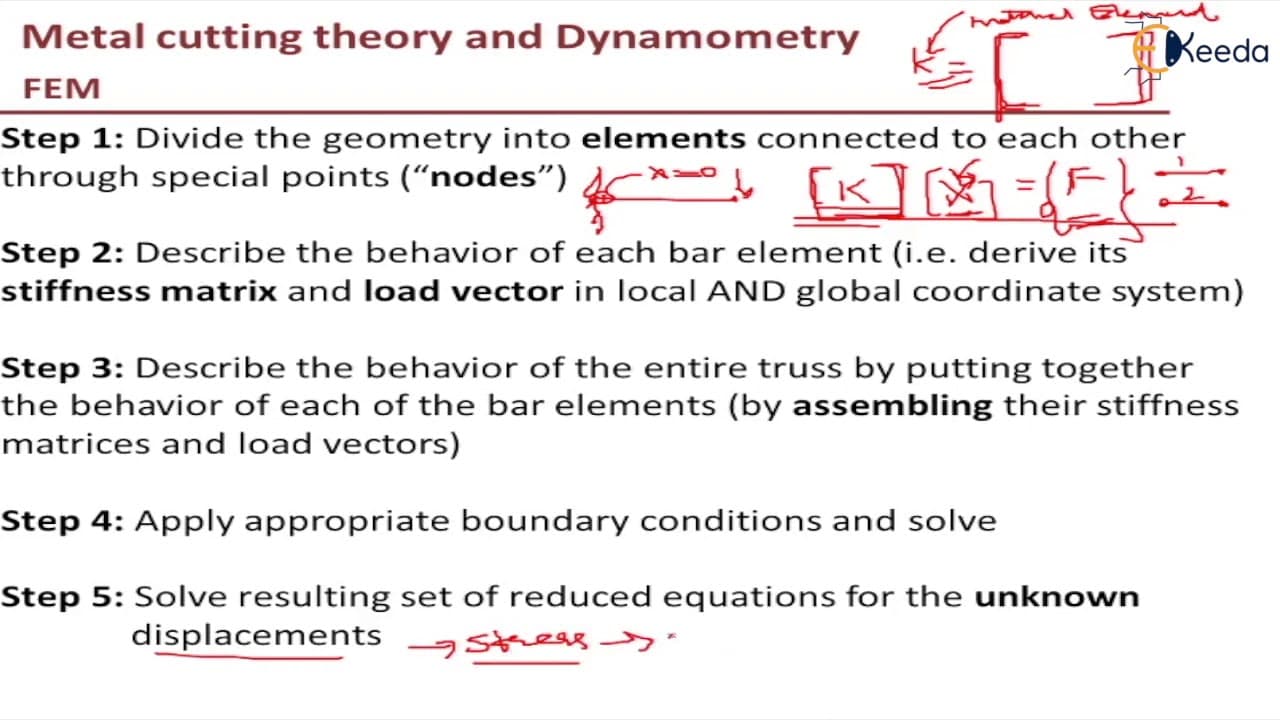
Finite Element Method (FEM) simplifies solving metal cutting problems by dividing irregular shapes into regular elements for accurate analysis.
Transcript
hello students my name is santosh kumar and i am the course instructor for machining sciences and tool design we are discussing module number one that is metal cutting theory and dynamometry so in this video we will discuss about finite element method so we discussed about different types of modeling used in metal cutting so that we discussed about... Read More
Key Insights
- 🤘 FEM divides irregular shapes into regular elements for accurate metal cutting analysis.
- 🤘 Stiffness matrix, load vector, and boundary conditions are essential in solving metal cutting problems using FEM.
- 🖐️ Lagrangian and Eulerian formulations play crucial roles in FEM for metal cutting chip formation analysis.
- 🌥️ The Arbitrary Lagrangian Eulerian method in FEM is ideal for problems with large strains and shape changes.
- 🤘 One-Mississippi criteria is employed in FEM for metal cutting analysis to determine failure under extreme strains.
- 🤘 Continuous flow approach in FEM ensures accurate analysis of new surfaces in metal cutting without separation problems.
- 🤘 Application of FEM in metal cutting analysis provides insight into solving complex problems with accurate numerical methods.
Install to Summarize YouTube Videos and Get Transcripts
Explore YouTube Video Summarizer or Get YouTube Transcript Extractor
Questions & Answers
Q: How does FEM simplify solving metal cutting problems?
FEM divides irregular domains into elements connected through nodes, allowing for more accurate analysis by applying numerical methods and boundary conditions.
Q: What is the significance of defining stiffness matrix and load vector in FEM?
The stiffness matrix and load vector help in understanding the behavior of each element, allowing for precise calculations of displacements and stresses in metal cutting scenarios.
Q: How are Lagrangian and Eulerian formulations used in FEM for metal cutting chip formation?
Lagrangian formulation is used when the chip shape is unknown, while Eulerian formulation is applied when the steady-state chip shape is known, enhancing accuracy in metal cutting analysis.
Q: What is the advantage of using the Arbitrary Lagrangian Eulerian method in FEM?
The Arbitrary Lagrangian Eulerian method combines the advantages of Lagrangian and Eulerian formulations, making it suitable for problems involving both solid mechanics and fluid flow in metal cutting processes.
Summary & Key Takeaways
-
FEM employs numerical methods to solve metal cutting problems by dividing domains into elements and connecting them through nodes.
-
The method involves defining stiffness matrix, load vector, and applying boundary conditions to solve for displacements and stresses.
-
FEM is useful for analyzing metal cutting chip formation problems through Lagrangian and Eulerian formulations.
Read in Other Languages (beta)
Share This Summary 📚
Summarize YouTube Videos and Get Video Transcripts with 1-Click
Try YouTube Summary with ChatGPT & Claude or YouTube Transcript Generator
Explore More Summaries from Ekeeda 📚





Summarize YouTube Videos and Get Video Transcripts with 1-Click
Try YouTube Summary with ChatGPT & Claude or YouTube Transcript Generator