How to Solve Dimensional Analysis Problems Easily
TL;DR
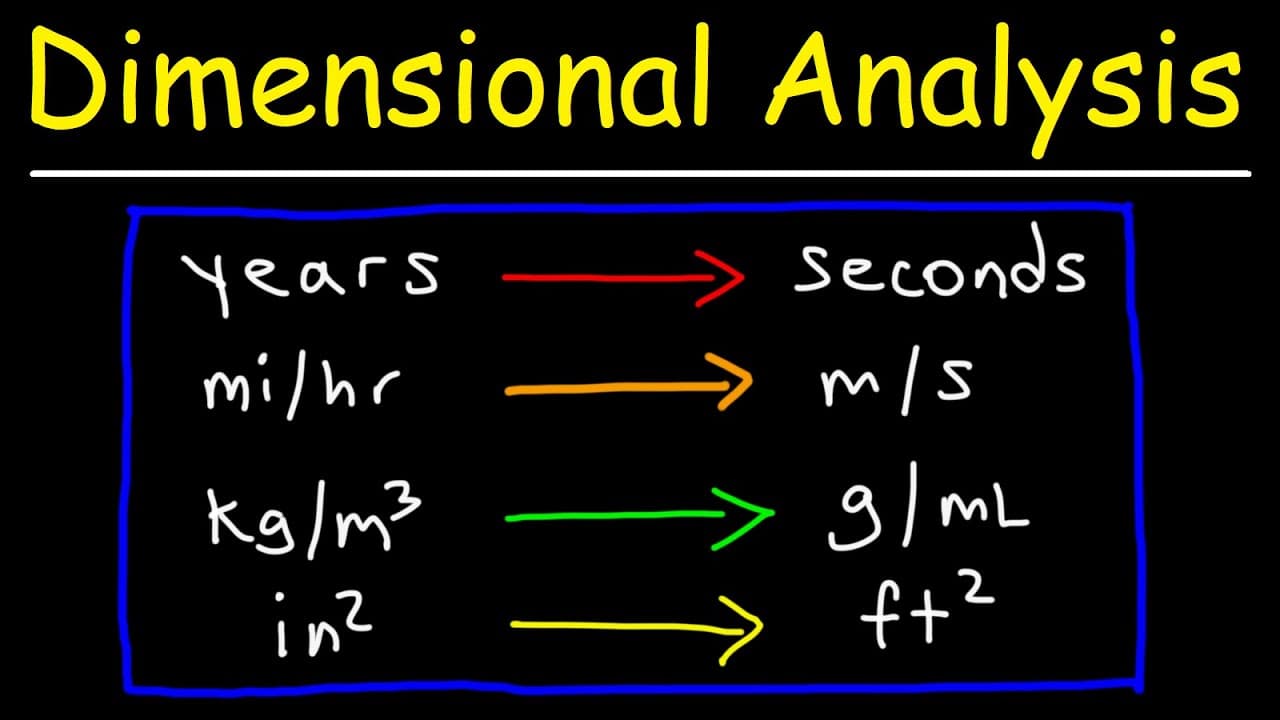
To solve dimensional analysis problems, identify the units you need to convert between and use appropriate conversion factors to cancel out unwanted units while keeping track of your calculations. This method allows for accurate conversions, such as from years to seconds or miles per hour to meters per second, ensuring the final answer reflects the desired unit.
Transcript
in this lesson we're going to work on some dimensional analysis problems so let's begin with this one how many seconds are there in a year so what we're going to do is we're going to convert from years to days and then days to hours hours to minutes and minutes to seconds so let's start with what we're given we're given one year and we want to conv... Read More
Key Insights
- 🧑🏭 Dimensional analysis involves converting units by multiplying or dividing with appropriate conversion factors.
- 🇦🇪 Conversion factors allow for the cancellation of units, leaving only the desired unit in the final answer.
- 🇦🇪 Converting between different unit systems, such as miles per hour to meters per second, requires multiple conversion factors for each unit.
- 🤒 Conversion between kilograms per cubic meter and grams per milliliter involves converting kilograms to grams and cubic meters to milliliters.
- ✖️ To find the area of a rectangle, multiply its length by its width.
- 🇦🇪 Unit conversions are essential in various scientific fields, such as physics and chemistry, to work with consistent units of measurement.
- 👻 Understanding the relationships between different units allows for accurate and efficient calculations.
Install to Summarize YouTube Videos and Get Transcripts
Explore YouTube Video Summarizer or Get YouTube Transcript Extractor
Questions & Answers
Q: How do you convert years to seconds using dimensional analysis?
To convert years to seconds, you need to convert years to days, days to hours, hours to minutes, and finally minutes to seconds. Multiply the given value by the conversion factors for each unit.
Q: How do you convert miles per hour to meters per second?
To convert miles per hour to meters per second, you need to convert miles to kilometers, kilometers to meters, hours to minutes, and then minutes to seconds. Use the appropriate conversion factors and multiply/divide accordingly.
Q: How do you convert the density of aluminum from kilograms per cubic meter to grams per milliliter?
To convert from kilograms per cubic meter to grams per milliliter, you need to convert kilograms to grams and cubic meters to milliliters. Use the conversion factors for each unit and perform the necessary multiplication/division.
Q: How do you calculate the area of a rectangular object?
To calculate the area of a rectangle, you multiply the length by the width. In the given example, the area of the door mat is found by multiplying 26 inches by 18 inches.
Summary & Key Takeaways
-
The first problem involves converting years to seconds by converting years to days, days to hours, hours to minutes, and minutes to seconds.
-
The second problem demonstrates how to convert miles per hour to meters per second by converting miles to kilometers and then kilometers to meters, while also converting hours to minutes and then minutes to seconds.
-
The third problem calculates the density of aluminum metal in grams per milliliter by converting kilograms to grams and cubic meters to milliliters.
-
The fourth problem finds the area of a rectangular door mat in square inches and square feet by multiplying the length and width.
-
The fifth problem calculates the time it takes for John to read a 200-page book by converting pages to minutes and then minutes to hours.
Read in Other Languages (beta)
Share This Summary 📚
Summarize YouTube Videos and Get Video Transcripts with 1-Click
Try YouTube Summary with ChatGPT & Claude or YouTube Transcript Generator
Explore More Summaries from The Organic Chemistry Tutor 📚



Summarize YouTube Videos and Get Video Transcripts with 1-Click
Try YouTube Summary with ChatGPT & Claude or YouTube Transcript Generator