Interesting perimeter and area problems | Perimeter, area, and volume | Geometry | Khan Academy
TL;DR
This content provides examples of solving perimeter and area problems using geometric figures.
Transcript
Lets do some example problems here, so we have the perimeter of each of the outer triangles is 30. So for example if I took The sum of this side, this side, and that side I will get 30 and that is true of all these outer triangles, these 5 outer triangles. They then tell us that the perimeter of FGHIJ So FGHIJ the perimeter of this pentagon right o... Read More
Key Insights
- 🥳 Perimeter problems can require subtracting the lengths of certain parts of a shape to find the desired perimeter.
- 🔺 Splitting a trapezoid into recognizable shapes, such as a rectangle and a triangle, can simplify the calculation of its area.
- 💠 Shifting sides and rearranging the shape can help determine the perimeter of a complex figure.
- 💠 Recognizing patterns and using properties of shapes, such as opposite sides being equal, is crucial for solving geometric problems.
- 🥳 Breaking down a complex problem into smaller, more manageable parts can make it easier to find a solution.
- 🥳 Visualizing the geometrical relationships between different parts of a shape can aid in problem-solving.
- 🏑 The concepts of perimeter and area are fundamental in geometry and have practical applications in various fields.
Install to Summarize YouTube Videos and Get Transcripts
Explore YouTube Video Summarizer or Get YouTube Transcript Extractor
Questions & Answers
Q: How do you calculate the perimeter of the star shape discussed in the video?
To find the perimeter of the star shape, you need to calculate the perimeter of the outer triangles (30 each) and subtract the length of the bases of the triangles (50 for the inner pentagon). Therefore, the perimeter of the star is 100.
Q: How is the area of the trapezoid in the second example determined?
The area of the trapezoid is found by calculating the area of the rectangle (6 times 7) and the area of the right triangle (1/2 times 3 times 7). Adding these two areas together gives the total area of the trapezoid, which is 52.5.
Q: What strategy is used to find the perimeter of the complex shape in the third example?
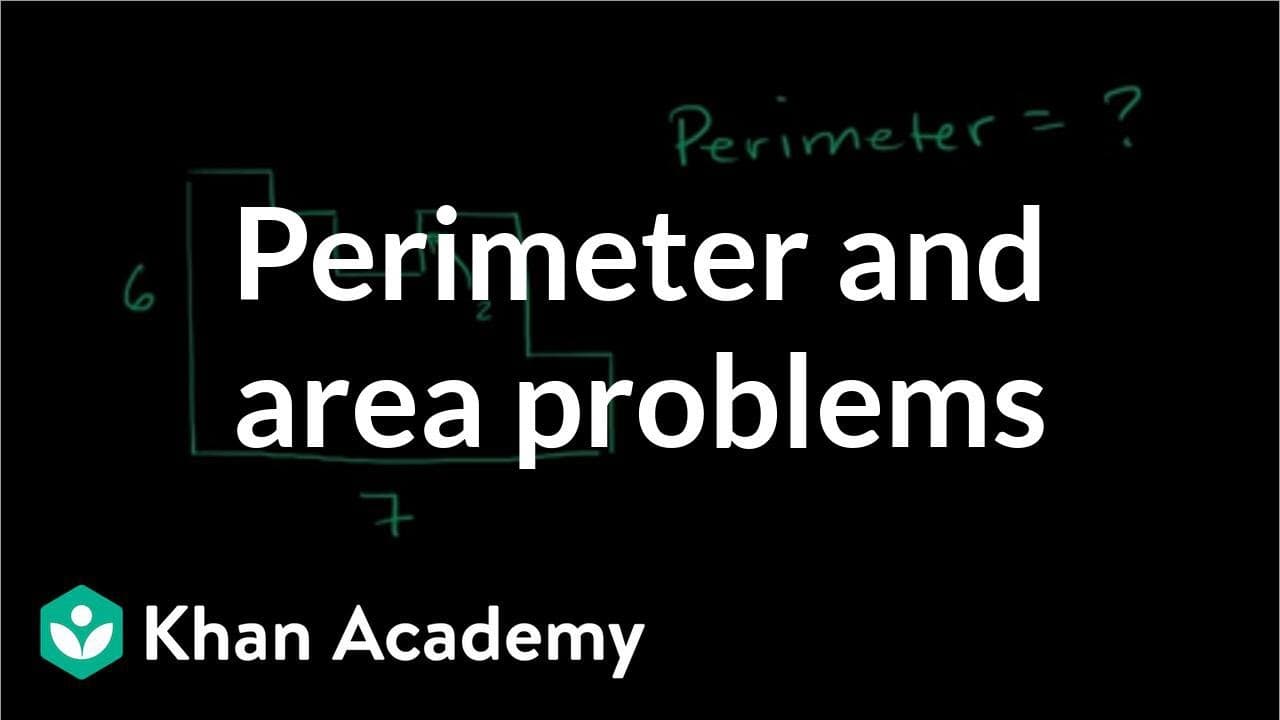
The strategy involves shifting the sides of the shape to create a rectangle with known side lengths. The shifted sides are then added up to determine the perimeter. Any unshifted sides are added separately. In the example, the perimeter of the complex shape is found to be 30.
Q: Are all angles in the diagrams in the video right angles?
Yes, in the video, it is assumed that all angles in the diagrams are right angles, even though they are not explicitly shown.
Summary & Key Takeaways
-
The first example involves finding the perimeter of a star shape by subtracting the bases of the outer triangles from the perimeter of the outer triangles.
-
The second example demonstrates how to find the area of a trapezoid by splitting it into a rectangle and a right triangle.
-
The third example shows a technique of shifting sides to determine the perimeter of a complex shape.
Read in Other Languages (beta)
Share This Summary 📚
Summarize YouTube Videos and Get Video Transcripts with 1-Click
Try YouTube Summary with ChatGPT & Claude or YouTube Transcript Generator
Explore More Summaries from Khan Academy 📚



Summarize YouTube Videos and Get Video Transcripts with 1-Click
Try YouTube Summary with ChatGPT & Claude or YouTube Transcript Generator