Naming ionic compound with polyvalent ion | Atoms, compounds, and ions | Chemistry | Khan Academy
TL;DR
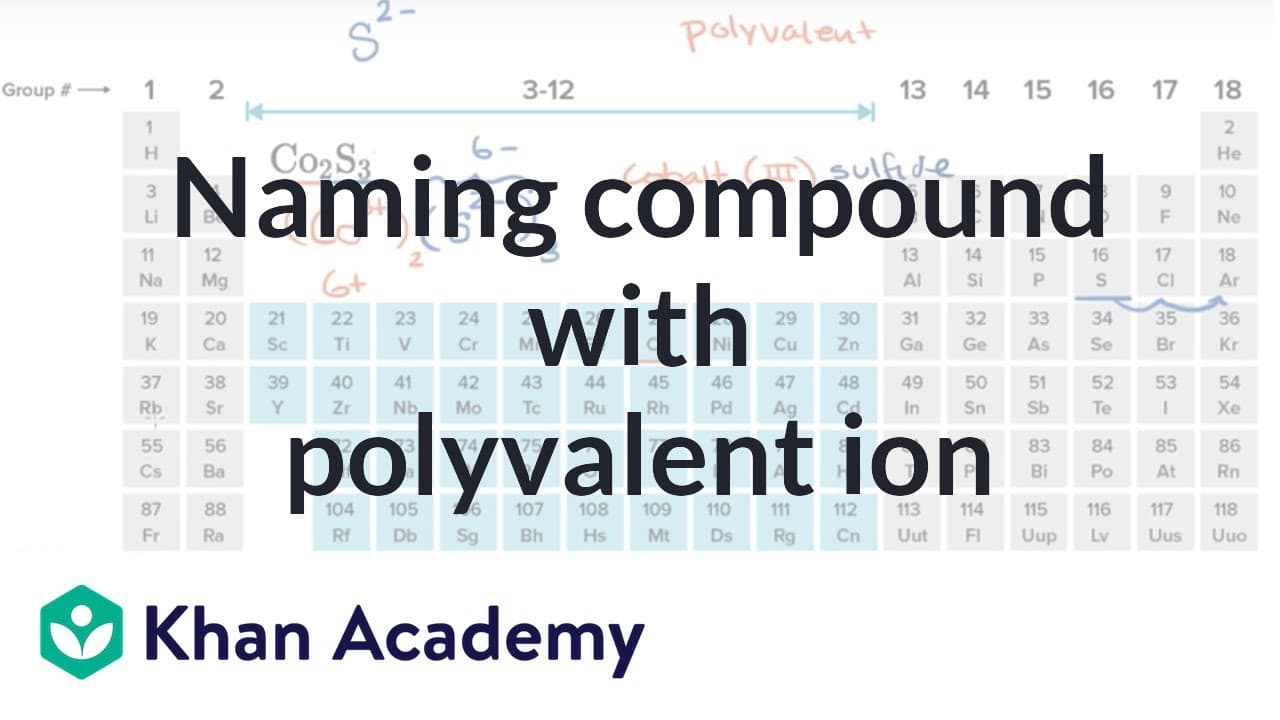
Learn how to name ionic compounds by determining the charge of cobalt and sulfur in the compound.
Transcript
- [Instructor] So we have the formula for an ionic compound here, and the goal of this video is what do we call this thing? It clearly involves some cobalt and some sulfur, but how do we name it? Well, the convention is, is the first element to be listed is going to be our cation, and if we look at cobalt over here, we see that it is a D-block elem... Read More
Key Insights
- 🍹 Determining the charges on cations and anions is crucial for naming and understanding ionic compounds.
- 🚫 Elements in the D-block, like cobalt, can have multiple charges due to varying electron configurations.
- ➖ Sulfur, as an anion, has a charge of two minus in this compound.
- 🈂️ The charges on each element in the compound can be calculated by balancing the overall charge of the compound.
- 🍹 Writing the charge of the cation in the compound name is necessary for polyvalent elements like cobalt.
- 🎁 The compound in the video is named Cobalt III Sulfide, indicating the charge on cobalt and the anion present.
- 🈂️ The charge of the cation can be determined by examining the charges of the anion(s) in the compound.
Install to Summarize YouTube Videos and Get Transcripts
Explore YouTube Video Summarizer or Get YouTube Transcript Extractor
Questions & Answers
Q: Why is it important to determine the charges on each element in an ionic compound?
Determining the charges allows us to correctly name the compound and understand its chemical properties. It also helps in predicting the formula of the compound.
Q: How is the charge of the cation determined in this compound?
In this case, the charge of cobalt is determined by balancing the charges in the compound. By knowing the charge of the anion (sulfur), the charge of the cation can be calculated.
Q: Why is cobalt referred to as polyvalent?
Cobalt is polyvalent because it can have multiple charges when it forms ionic compounds. This is common for elements in the D-block of the periodic table.
Q: Can cobalt have different charges in other ionic compounds?
Yes, cobalt can have different charges in other ionic compounds. The charge depends on the specific compound and the elements it is combined with.
Summary & Key Takeaways
-
The formula for the ionic compound involves cobalt and sulfur, but it is necessary to determine the charges on each element to name the compound correctly.
-
Cobalt is the cation in the compound, but its charge is unknown due to its placement in the D-block elements.
-
Sulfur is the anion in the compound and has a charge of two minus.
-
By balancing the charges, it is determined that the cobalt in the compound has a charge of three plus, resulting in the compound being named Cobalt III Sulfide.
Read in Other Languages (beta)
Share This Summary 📚
Summarize YouTube Videos and Get Video Transcripts with 1-Click
Try YouTube Summary with ChatGPT & Claude or YouTube Transcript Generator
Explore More Summaries from Khan Academy 📚



Summarize YouTube Videos and Get Video Transcripts with 1-Click
Try YouTube Summary with ChatGPT & Claude or YouTube Transcript Generator