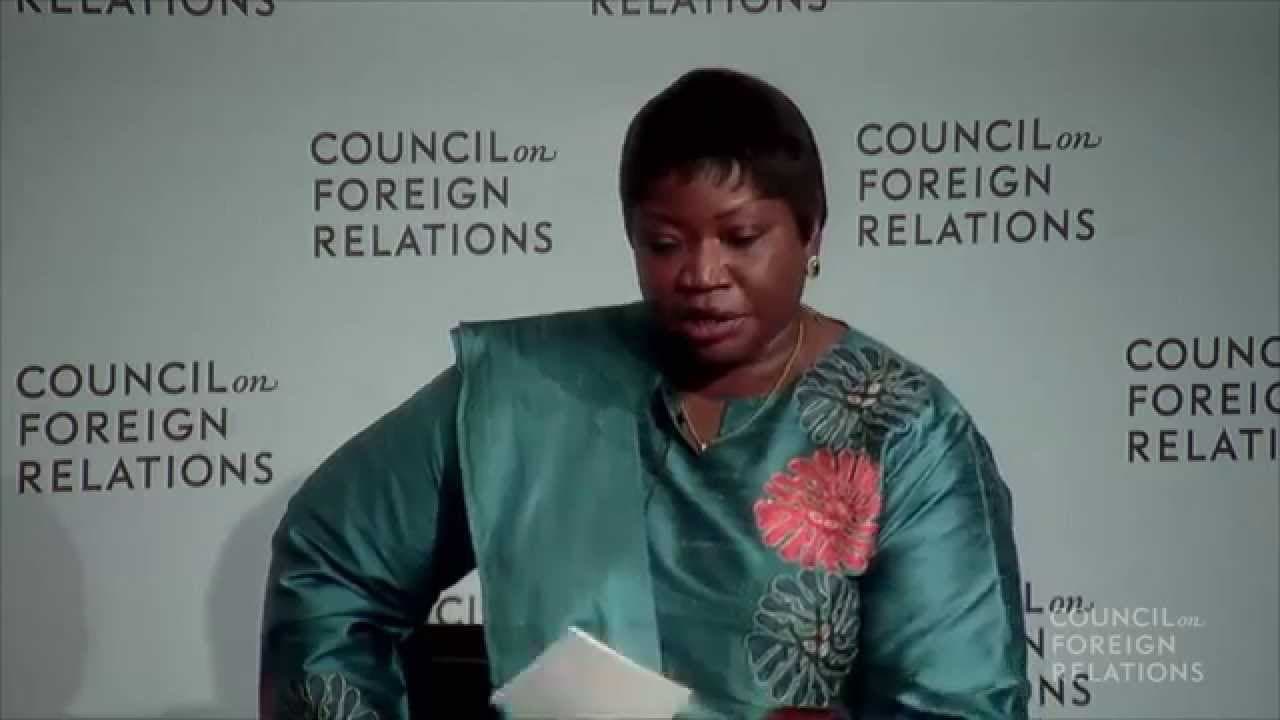
Fatou Bensouda on the International Criminal Court and Gender-Based Crimes
TL;DR
Fatou Bensouda discusses ICC's policy on prosecuting gender-based crimes.
Transcript
SCHEFFER: Welcome, everyone,to the Council on Foreign Relations here in New York. We have a very special evening tonight, with Madam Prosecutor Fatou Bensouda of the International Criminal Court, for a session that's entitled 'Prosecuting Sexual and Gender-Based Violence; New Directions in International Criminal Justice'. We have a web -- this is l... Read More
Key Insights
- Fatou Bensouda emphasizes the importance of a focused policy on sexual and gender-based crimes within the ICC to ensure these crimes receive the recognition and attention they deserve.
- The Rome Statute provides a legal framework for prosecuting sexual and gender-based crimes as standalone offenses and as part of larger crimes like genocide and war crimes.
- Challenges in prosecuting these crimes include underreporting, victim stigmatization, and the need for alternative evidence forms like forensic reports.
- The ICC's jurisdiction is limited to crimes committed in state parties or by nationals of state parties, with exceptions for UN Security Council referrals.
- Bensouda highlights the significant overlap between crimes like child soldier conscription and sexual violence, as seen in the Lubanga case.
- The ICC faces challenges such as politicization, resource constraints, and the need for state cooperation in executing court decisions and investigations.
- The ICC aims to complement national jurisdictions, stepping in only when states are unwilling or unable to prosecute serious crimes.
- Bensouda stresses the importance of maintaining the ICC's credibility and independence by basing decisions solely on evidence and law, not political considerations.
Install to Summarize YouTube Videos and Get Transcripts
Explore YouTube Video Summarizer or Get YouTube Transcript Extractor
Questions & Answers
Q: What is the significance of the ICC's new policy on sexual and gender-based crimes?
The ICC's new policy on sexual and gender-based crimes is significant because it provides a clear framework for how these crimes will be investigated and prosecuted. It aims to ensure that such crimes receive the attention they deserve and are not treated as requiring extra evidence compared to other war crimes. This policy also seeks to guide national systems in handling these crimes effectively.
Q: How does the ICC's jurisdiction affect its ability to prosecute crimes in Syria and Iraq?
The ICC's jurisdiction is limited to crimes committed on the territory of state parties or by nationals of state parties. Since Syria and Iraq are not state parties, the ICC cannot directly intervene unless there is a UN Security Council referral or an Article 12-3 declaration by the states accepting ICC jurisdiction. This limitation affects the ICC's ability to prosecute crimes committed by groups like ISIS in these countries.
Q: What challenges does the ICC face in prosecuting sexual and gender-based crimes?
The ICC faces several challenges in prosecuting sexual and gender-based crimes, including underreporting, victim stigmatization, and the need for alternative forms of evidence, such as forensic reports and hospital records. Additionally, the ICC must ensure the protection of witnesses and navigate the complexities of proving command responsibility for these crimes.
Q: How does the ICC approach the issue of complementarity with national jurisdictions?
The ICC operates on the principle of complementarity, meaning it only steps in when national jurisdictions are unwilling or unable to prosecute serious crimes. The ICC encourages states to take up their responsibility to investigate and prosecute, providing guidance and support where needed. The ICC monitors national efforts and intervenes if states fail to act, as seen in cases like Kenya.
Q: What role does the ICC play in addressing crimes committed by groups like ISIS?
The ICC can potentially prosecute crimes committed by groups like ISIS if nationals of state parties are involved. The ICC is closely monitoring information about ISIS members from state parties and considering opening preliminary examinations. However, without jurisdiction over the territories where these crimes occur, the ICC's ability to act is limited unless there is international cooperation or a Security Council referral.
Q: What lessons has the ICC learned from the Kenyatta case regarding witness protection?
The Kenyatta case highlighted the challenges of witness interference and the need for improved witness protection. The ICC has learned the importance of finding alternative evidence forms and ensuring robust witness protection systems. The registry is working closely with the prosecutor's office to enhance protection measures, considering the extended family structures and potential risks to witnesses.
Q: How does the ICC handle the issue of politicization in its work?
The ICC faces the challenge of politicization, as its actions are often perceived as politically motivated. To counter this, the ICC emphasizes basing its decisions solely on evidence and law, maintaining independence, and focusing on the legal merits of each case. The court strives to operate without fear or favor, ensuring justice is served based on factual and legal grounds.
Q: What is the ICC's vision for the future of international criminal justice?
The ICC envisions becoming a credible and trusted institution that effectively brings accountability for serious international crimes. It aims to complement national jurisdictions, encouraging states to fulfill their responsibilities while providing a framework for international justice. The ICC seeks to overcome challenges like resource constraints and cooperation issues to meet the high expectations of victims and the international community.
Summary & Key Takeaways
-
Fatou Bensouda, the ICC prosecutor, discusses the importance of a policy on sexual and gender-based crimes, emphasizing their prevalence in conflict situations and the need for a dedicated approach to prosecuting these crimes effectively.
-
Bensouda highlights the challenges faced by the ICC, including jurisdictional limitations, the need for state cooperation, and the impact of politicization on the court's work, while stressing the importance of maintaining the court's credibility.
-
The discussion covers the ICC's efforts to integrate gender perspectives into all levels of investigation and prosecution, as well as the challenges of witness protection and the need for alternative evidence in cases of underreported crimes.
Read in Other Languages (beta)
Share This Summary 📚
Summarize YouTube Videos and Get Video Transcripts with 1-Click
Try YouTube Summary with ChatGPT & Claude or YouTube Transcript Generator
Explore More Summaries from Council on Foreign Relations 📚


Summarize YouTube Videos and Get Video Transcripts with 1-Click
Try YouTube Summary with ChatGPT & Claude or YouTube Transcript Generator