Equivalent fractions with models
TL;DR
This video explains how to find equivalent fractions by visually dividing shapes into equal sections and determining the equivalent values.
Transcript
- [Instructor] So what we're going to do in this video is think about equivalent fractions. So let's say we have the fraction 3/4, and I wanna think about what is an equivalent number of eighths? So 3/4 is equal to how many eighths? And to represent that how many, I could put a question mark there, but instead of a question mark, I'll just put a le... Read More
Key Insights
- 🗂️ Understanding equivalent fractions involves dividing shapes into equal sections and comparing the shaded sections.
- ❓ Equivalent fractions have different numerators and denominators, but they represent the same value.
- 🦻 Visual representation using shapes can aid in visualizing and comprehending the concept of equivalent fractions.
- 🗂️ Dividing shapes into equal sections helps determine the fraction equivalent to a given fraction.
- ❓ The relationship between equivalent fractions can be determined by comparing the shaded sections in the visual representation.
- 🗂️ Equivalent fractions can be simplified by dividing both the numerator and denominator by their greatest common divisor.
- 🗂️ Equivalent fractions are useful in various mathematical operations, such as adding, subtracting, multiplying, and dividing fractions.
Install to Summarize YouTube Videos and Get Transcripts
Explore YouTube Video Summarizer or Get YouTube Transcript Extractor
Questions & Answers
Q: How can you find an equivalent number of eighths for the fraction 3/4?
To find an equivalent number of eighths for 3/4, divide a shape into four equal sections and shade three of them. Then, divide another shape into eighths and count how many eighths are shaded, which is six eighths. Therefore, 3/4 is equivalent to 6/8.
Q: How can you determine how many thirds are equivalent to the fraction 4/6?
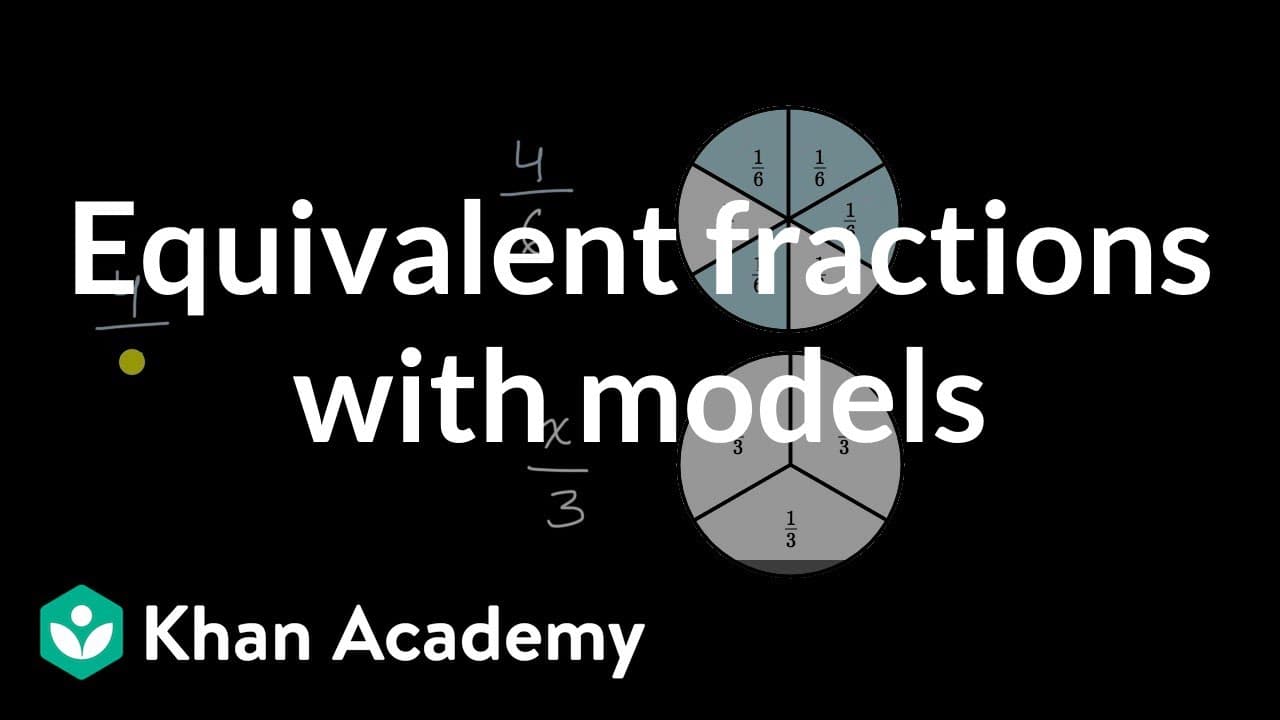
Divide a shape into six equal sections and shade four of them. Then, divide another shape into thirds. Find that each third is equivalent to two of the six sections. The two additional shaded sections are also equivalent to another third, totaling to 4/6 being equivalent to 2/3.
Q: What is the method used to find equivalent fractions in the video?
The method involves visually dividing shapes into equal sections and determining the corresponding fractions of the shaded sections. By comparing fractions with different denominators, equivalent fractions can be found by exploring the relationships between the shaded sections.
Q: How can visual representation help in understanding equivalent fractions?
Visual representation helps in understanding equivalent fractions by providing a tangible and intuitive way to compare fractions. By dividing shapes and shading sections, it becomes easier to see the relationship between different fractions and determine their equivalence.
Summary & Key Takeaways
-
The video demonstrates finding an equivalent number of eighths for the fraction 3/4 by visually dividing shapes into fourths and eighths.
-
Another example is provided for finding how many thirds are equivalent to the fraction 4/6, using a visual representation of divided shapes.
-
The method involves dividing shapes into equal sections and determining the corresponding fractions.
Read in Other Languages (beta)
Share This Summary 📚
Summarize YouTube Videos and Get Video Transcripts with 1-Click
Try YouTube Summary with ChatGPT & Claude or YouTube Transcript Generator
Explore More Summaries from Khan Academy 📚



Summarize YouTube Videos and Get Video Transcripts with 1-Click
Try YouTube Summary with ChatGPT & Claude or YouTube Transcript Generator