Integration of Rational Functions By Completing The Square - Calculus
TL;DR
Learn how to integrate rational functions by completing the square and using integration formulas for inverse trigonometric functions.
Transcript
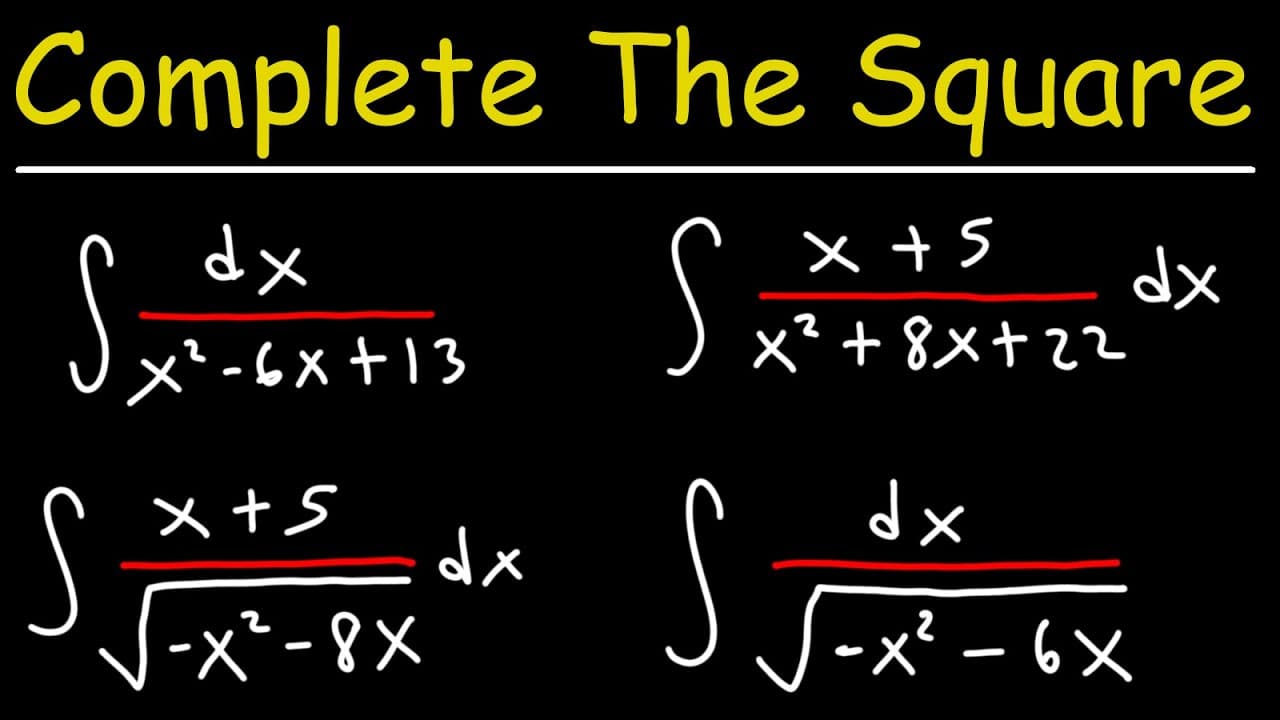
consider the problem on the screen what is the antiderivative or the indefinite integral of DX over x squared minus 6X plus 13. how can we find this answer well we need to use we need to integrate it by completing the square but before we do that there are some formulas that you need to know for problems like this so you may want to write this down... Read More
Key Insights
- ❎ Completing the square is a useful technique in integrating rational functions.
- 🖐️ Integration formulas for inverse trigonometric functions play a crucial role in solving these types of integrals.
- 😑 The process involves factoring, substituting variables, and applying the suitable integration formula based on the form of the expression.
- 😒 Understanding how to use completing the square and integration formulas can simplify the integration of rational functions.
- ❓ Practice and familiarity with these techniques are essential to becoming proficient in integrating rational functions.
- 🍻 Further examples and practice problems on integration techniques can be found in the links provided in the video description for additional learning opportunities.
- 🫠 Rational functions with a square root in the denominator require the use of arc sine or arc secant formulas, while those without square roots involve the arctan formula.
- 😑 Substituting variables and simplifying the expression help to obtain the final integrated result.
Install to Summarize YouTube Videos and Get Transcripts
Explore YouTube Video Summarizer or Get YouTube Transcript Extractor
Questions & Answers
Q: How can we integrate a rational function using completing the square?
To integrate a rational function, we can complete the square of the expression, factor it, and then substitute variables to put it in a suitable form for integration.
Q: What are the three important integration formulas for inverse trigonometric functions?
The first formula is the integral of du / (a^2 + u^2) = 1/a * arctan(u/a) + C. The second formula is the integral of du / sqrt(a^2 - u^2) = 1/a * arcsin(u/a) + C. The third formula is the integral of du / (u * sqrt(u^2 - a^2)) = 1/a * arcsec(|u/a|) + C.
Q: How do we choose which integration formula to use?
The choice of integration formula depends on the form of the expression. If there is a square root involved, the arc sine or arc secant formula is used. If there is no square root present, the arctan formula is utilized.
Q: What is the final step after completing the square and applying the appropriate integration formula?
The final step is to substitute the appropriate variable back into the formula and simplify the expression to obtain the final integrated result.
Summary & Key Takeaways
-
The video explains how to integrate rational functions using completing the square and integration formulas for inverse trigonometric functions.
-
Three important integration formulas are introduced: 1) Integral of du / (a^2 + u^2) = 1/a * arctan(u/a) + C, 2) Integral of du / sqrt(a^2 - u^2) = 1/a * arcsin(u/a) + C, and 3) Integral of du / (u * sqrt(u^2 - a^2)) = 1/a * arcsec(|u/a|) + C.
-
The process involves completing the square, substituting variables, and applying the appropriate integration formula based on the form of the expression.
Read in Other Languages (beta)
Share This Summary 📚
Summarize YouTube Videos and Get Video Transcripts with 1-Click
Try YouTube Summary with ChatGPT & Claude or YouTube Transcript Generator
Explore More Summaries from The Organic Chemistry Tutor 📚



Summarize YouTube Videos and Get Video Transcripts with 1-Click
Try YouTube Summary with ChatGPT & Claude or YouTube Transcript Generator