What’s the Difference Between Distance and Displacement?
TL;DR
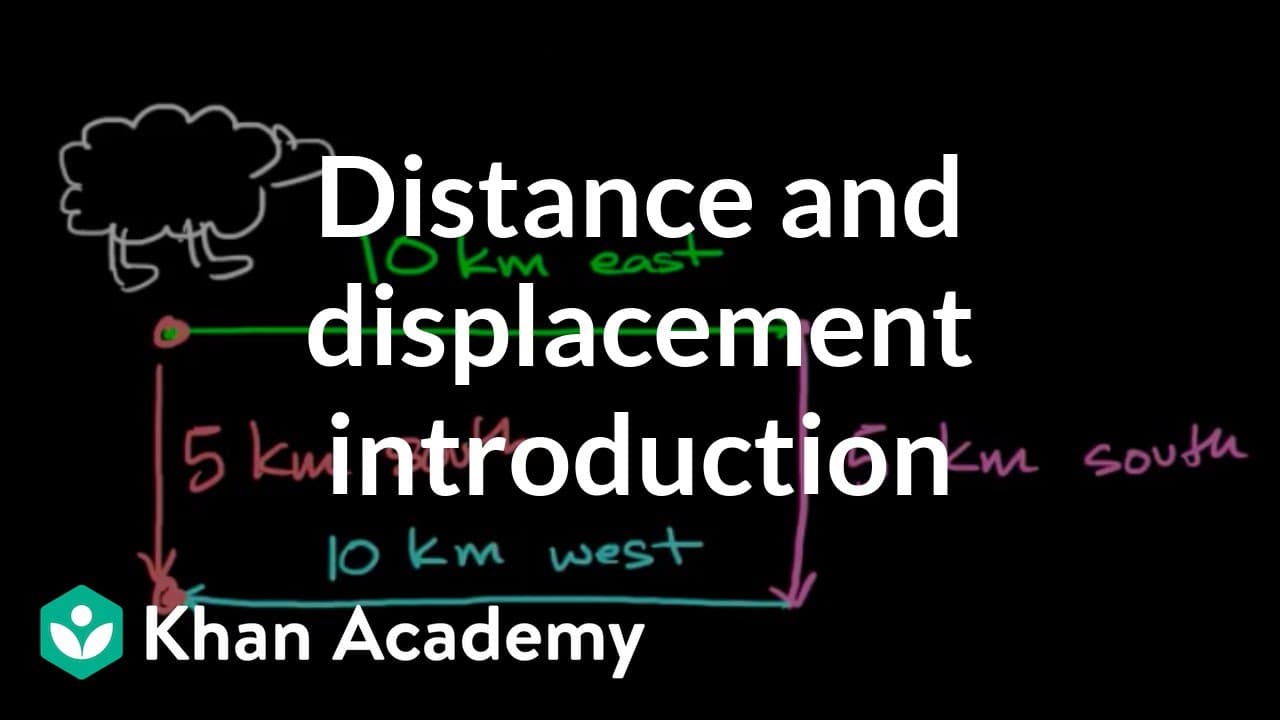
Distance quantifies the total path traveled, amounting to 25 kilometers in the sheep scenario, while displacement refers to the net change in position, which is only 5 kilometers to the south. This highlights how distance measures overall movement, while displacement focuses on the directional change from the starting point.
Transcript
- [Instructor] So let's say we have a sheep and it is hungry. So that is my sheep. My best, quick drawing of a sheep and it is just following the grass wherever it finds good grass to eat and so in pursuit of tasty grass, it first goes 10 kilometers to the east, 10 kilometers east and then it takes a right turn and then it goes five kilometers sout... Read More
Key Insights
- 🧘 Distance traveled is the total length of an object's path, while displacement reflects the change in position.
- ❓ Displacement includes both magnitude (distance) and direction.
- 🗺️ Distance traveled accounts for every part of the journey, regardless of changes in direction.
- 😥 Displacement considers the net change in position from the starting point.
- 🧘 Displacement can be zero if an object returns to its initial position.
- 🗺️ Distance traveled can never be negative, but displacement can be.
- 🗺️ Displacement provides a more concise description of an object's motion than distance traveled.
Install to Summarize YouTube Videos and Get Transcripts
Explore YouTube Video Summarizer or Get YouTube Transcript Extractor
Questions & Answers
Q: How is distance traveled defined in physics?
In physics, distance traveled refers to the total length of an object's journey. It takes into account every distance covered, regardless of changes in direction.
Q: What is displacement?
Displacement, in physics, represents the change in position of an object from its starting point. It includes both the distance and direction moved, indicating the final position relative to the initial position.
Q: Can an object's displacement be greater than its distance traveled?
No, an object's displacement can never be greater than its distance traveled. Displacement considers the shortest path between the starting and ending points, while distance traveled accounts for every part of the object's journey.
Q: Can an object have a displacement of zero but a non-zero distance traveled?
No, if an object's displacement is zero, it means it has returned to its original position, which implies that the distance traveled will also be zero. Displacement and distance traveled are interconnected concepts.
Summary & Key Takeaways
-
The video introduces a scenario where a sheep travels a certain distance in different directions: 10 kilometers east, 5 kilometers south, and 10 kilometers west.
-
The concept of distance traveled is explained as the total length of the journey, which in this case is 25 kilometers.
-
Displacement is defined as the change in position, which in this scenario is 5 kilometers south from the starting point.
Read in Other Languages (beta)
Share This Summary 📚
Summarize YouTube Videos and Get Video Transcripts with 1-Click
Try YouTube Summary with ChatGPT & Claude or YouTube Transcript Generator
Explore More Summaries from Khan Academy 📚



Summarize YouTube Videos and Get Video Transcripts with 1-Click
Try YouTube Summary with ChatGPT & Claude or YouTube Transcript Generator