Number properties terminology 1 | Arithmetic properties | Pre-Algebra | Khan Academy
TL;DR
This video explains and demonstrates the different properties of addition in mathematics, including the commutative, associative, and distributive properties.
Transcript
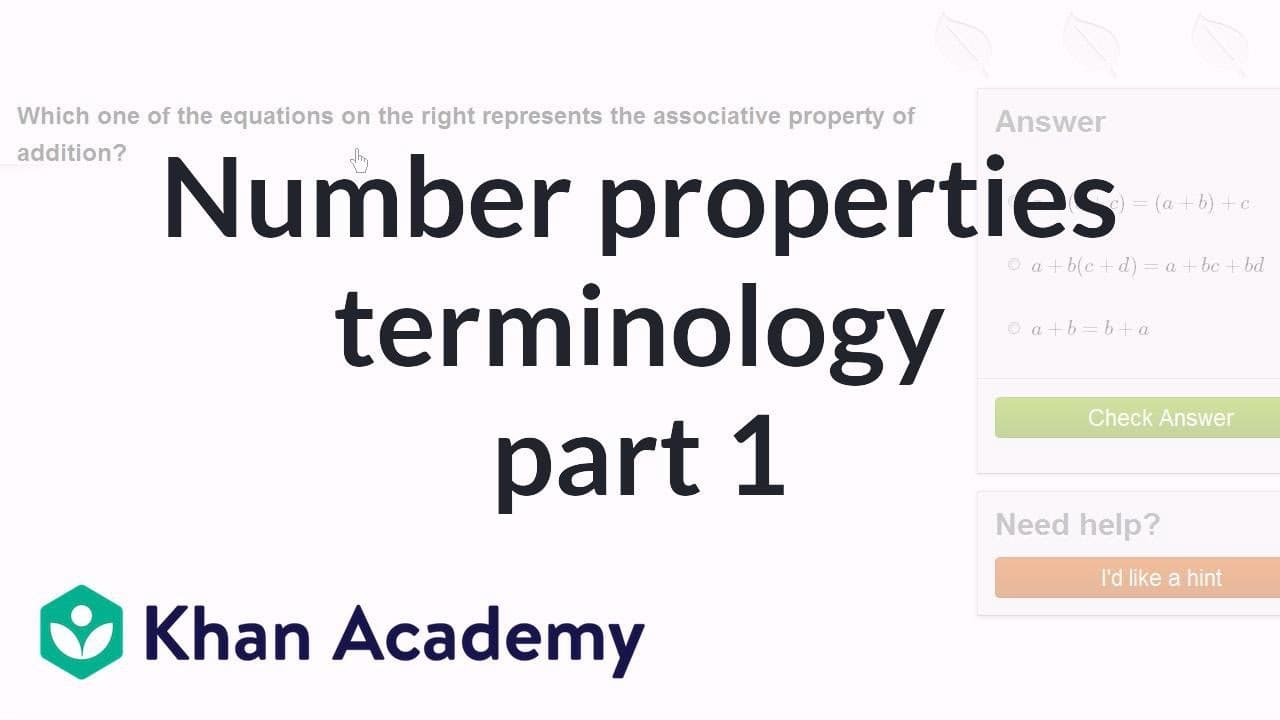
a plus b times open parentheses c plus d is equal to a plus bc plus bd represents which of the following properties? So to get from the left-hand side to the right-hand side, it looks like what they did is they multiplied the b times the c plus d. In fact, they distributed the b. b times c plus d is b times c, plus b times d. So this is clearly the... Read More
Key Insights
- ✖️ The distributive property involves multiplying a number by the sum of two other numbers and distributing the multiplication across the terms inside the parentheses.
- 💱 The associative property allows us to change the grouping of numbers in an addition operation without changing the sum.
- 👻 The commutative property allows us to change the order of numbers being added without affecting the sum.
- 😑 These properties are fundamental in algebra and are used to simplify expressions and solve equations.
- #️⃣ Understanding these properties helps in solving mathematical problems and manipulating numbers effectively.
- 😑 The distributive property is a crucial concept in expanding and factoring algebraic expressions.
- #️⃣ The commutative property can be applied to addition of both numbers and variables.
Install to Summarize YouTube Videos and Get Transcripts
Explore YouTube Video Summarizer or Get YouTube Transcript Extractor
Questions & Answers
Q: What does the distributive property of addition state?
The distributive property states that when a number is multiplied by the sum of two other numbers, it is equivalent to multiplying the number separately by each of the other two numbers and then adding the products. For example, a(b + c) = ab + ac.
Q: Explain the associative property of addition.
The associative property of addition states that grouping numbers being added, regardless of the order, does not affect the sum. So, (a + b) + c = a + (b + c). This property allows us to change the grouping of numbers without changing the sum.
Q: What is the commutative property of addition?
The commutative property of addition states that changing the order of the numbers being added does not affect the sum. In other words, a + b = b + a. This property allows us to rearrange the order of numbers without changing the sum.
Q: Which equation represents the distributive property of addition over multiplication?
The equation that represents the distributive property of addition over multiplication is b(a + c) = ba + bc. It shows that multiplying a number by the sum of two other numbers is the same as multiplying the number separately by each of the other two numbers and then adding the products.
Summary & Key Takeaways
-
The distributive property states that multiplying a number by the sum of two other numbers is the same as multiplying the number separately by each of the other two numbers and then adding the products.
-
The associative property of addition states that the grouping of numbers being added does not affect the sum.
-
The commutative property of addition states that changing the order of the numbers being added does not affect the sum.
Read in Other Languages (beta)
Share This Summary 📚
Summarize YouTube Videos and Get Video Transcripts with 1-Click
Try YouTube Summary with ChatGPT & Claude or YouTube Transcript Generator
Explore More Summaries from Khan Academy 📚



Summarize YouTube Videos and Get Video Transcripts with 1-Click
Try YouTube Summary with ChatGPT & Claude or YouTube Transcript Generator