Another example of rigid transformations for congruence | Congruence | Geometry | Khan Academy
TL;DR
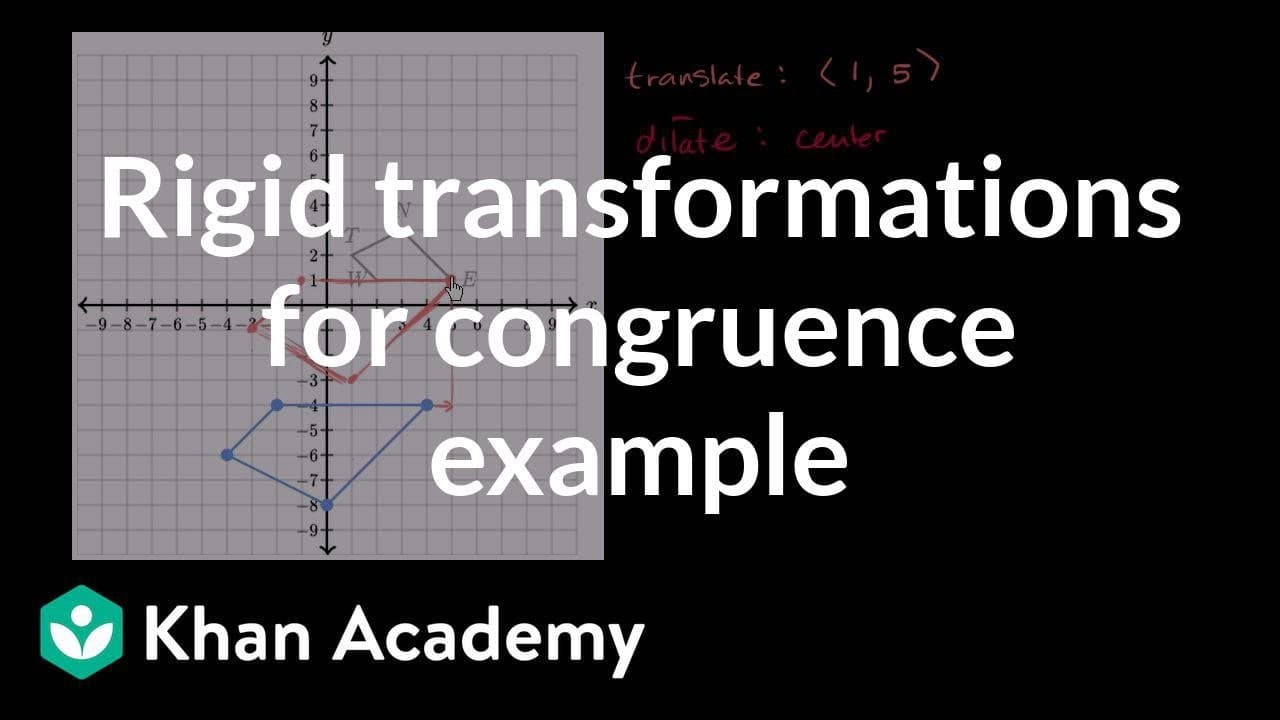
Performing translations, dilations, and reflections on a given quadrilateral to match another, it is found that the figures are not congruent.
Transcript
Perform transformations on the movable quadrilateral until it matches quadrilateral NEUT, quadrilateral NEWT right over here. Are the two figures congruent? So we have our little tools here. But I'm actually going to do it on my scratch pad first to think about how we might want to transform it. So the first thing-- it looks like this point right o... Read More
Key Insights
- ❓ The transformation process involved translation, dilation, and reflection.
- 🇦🇪 The quadrilateral was first translated by shifting it 1 unit right and 5 units up.
- 😥 After translation, the quadrilateral was further transformed through dilation by a scale factor of 1/2 with a center point at (5, 1).
- 🏙️ Finally, the quadrilateral was reflected over the line y = 1 to complete the transformation.
- ⚖️ The figures are not congruent because the dilation step resulted in scaling down the original quadrilateral.
- ⚖️ Congruence is achieved through translations, rotations, and reflections, but not through scaling transformations.
- ❓ The understanding of transformations and congruence is crucial for geometry problems.
Install to Summarize YouTube Videos and Get Transcripts
Explore YouTube Video Summarizer or Get YouTube Transcript Extractor
Questions & Answers
Q: What are the steps to transform the quadrilateral?
The first step is to translate the quadrilateral by shifting it 1 unit to the right and 5 units up. Then, dilate the quadrilateral with a center point at (5, 1) and a scale factor of 1/2. Finally, reflect the quadrilateral over the line y = 1.
Q: Are the two figures congruent?
No, the figures are not congruent. The first figure was larger and needed to be scaled down (dilated) to fit into the second figure. Dilating the figure made it non-congruent to the original.
Q: What were the coordinates used for translation?
The translation involved shifting the quadrilateral 1 unit to the right (in the x-direction) and 5 units up (in the y-direction).
Q: What line was used for reflection in the transformation process?
The line y = 1 was used for reflection during the transformation process.
Summary & Key Takeaways
-
The content demonstrates how to perform transformations (translation, dilation, and reflection) on a quadrilateral to make it match another quadrilateral.
-
The first step is to translate the quadrilateral by shifting it 1 unit to the right and 5 units up.
-
Next, the quadrilateral is dilated by scaling it down with a center point at (5, 1) and a scale factor of 1/2.
Read in Other Languages (beta)
Share This Summary 📚
Summarize YouTube Videos and Get Video Transcripts with 1-Click
Try YouTube Summary with ChatGPT & Claude or YouTube Transcript Generator
Explore More Summaries from Khan Academy 📚



Summarize YouTube Videos and Get Video Transcripts with 1-Click
Try YouTube Summary with ChatGPT & Claude or YouTube Transcript Generator