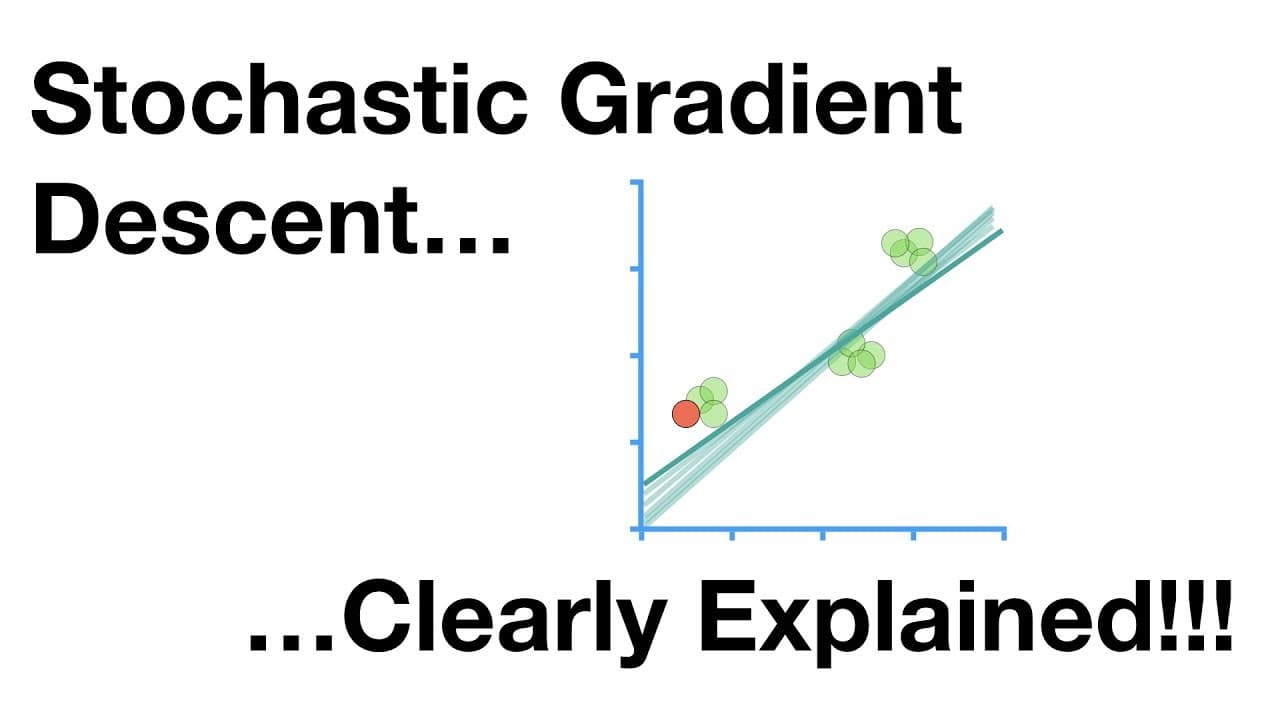
Stochastic Gradient Descent, Clearly Explained!!!
TL;DR
Stochastic gradient descent is a variation of gradient descent that randomly selects one sample per step or a small subset of data, making it useful for big data sets with many parameters.
Transcript
you're gonna do something crazy I'm gonna do something random he's gotta be stochastic he's gotta be stat quest hello I'm Josh stormer and welcome to stat quest today we're going to talk about stochastic gradient descent and it's gonna be clearly explained note this stat quest assumes that you are already familiar with gradient descent if not check... Read More
Key Insights
- 😃 Stochastic gradient descent is an efficient optimization algorithm for big data sets with many parameters.
- 🚐 By randomly selecting one sample per step or using mini-batches, stochastic gradient descent reduces computational complexity.
- 👶 Stochastic gradient descent can provide stable estimates for parameters and quickly incorporate new data.
- ☠️ It is important to choose an appropriate learning rate to ensure the convergence of stochastic gradient descent.
- ❓ Stochastic gradient descent is especially useful when there are redundancies in the data.
- ☠️ The schedule of changing the learning rate from large to small is crucial for successful convergence.
- 🚐 Implementations of stochastic gradient descent often default to using mini-batches instead of single samples.
Install to Summarize YouTube Videos and Get Transcripts
Explore YouTube Video Summarizer or Get YouTube Transcript Extractor
Questions & Answers
Q: What is the primary difference between gradient descent and stochastic gradient descent?
The primary difference is that gradient descent uses all data points in each step, while stochastic gradient descent randomly selects one sample per step or a small subset of data.
Q: Why is stochastic gradient descent useful for big data sets?
Stochastic gradient descent reduces computational complexity by computing derivatives for only a subset of data, making it faster and more feasible for big data sets.
Q: How does stochastic gradient descent handle redundancies in data?
Stochastic gradient descent picks one sample per step, which can account for redundancies in the data and still provide accurate estimates for parameters.
Q: Can stochastic gradient descent easily incorporate new data?
Yes, stochastic gradient descent can easily update parameter estimates by taking another step using the new sample without starting from scratch.
Summary & Key Takeaways
-
Gradient descent is a method used to find the optimal values for parameters in a model by minimizing the loss function.
-
Stochastic gradient descent reduces computational complexity by randomly selecting one sample per step, making it efficient for big data sets with many parameters.
-
Using mini-batches, a small subset of data, can provide stable estimates for parameters in fewer steps.
Read in Other Languages (beta)
Share This Summary 📚
Summarize YouTube Videos and Get Video Transcripts with 1-Click
Try YouTube Summary with ChatGPT & Claude or YouTube Transcript Generator
Explore More Summaries from StatQuest with Josh Starmer 📚
Summarize YouTube Videos and Get Video Transcripts with 1-Click
Try YouTube Summary with ChatGPT & Claude or YouTube Transcript Generator