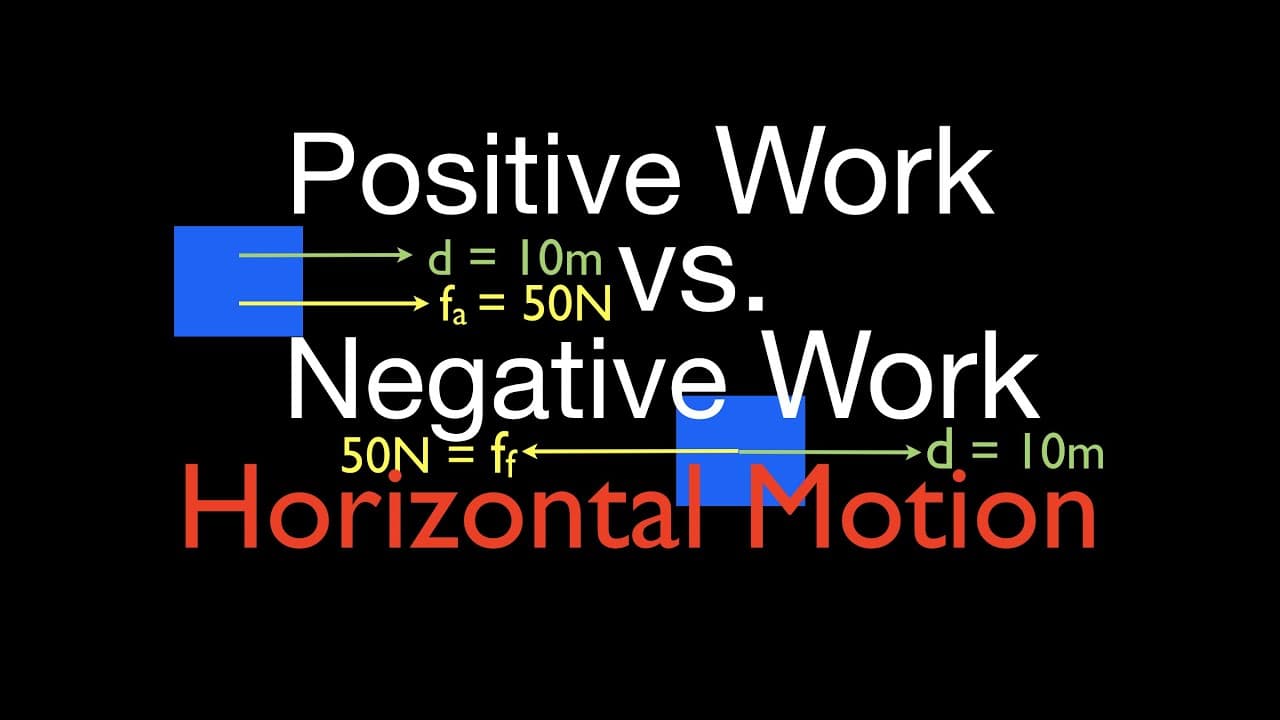
Energy, Work & Power (14 of 31) Positive Work vs. Negative Work for Horizontal Motion
TL;DR
Positive work adds energy, negative work removes energy. Forces parallel do positive work, opposite forces do negative work.
Transcript
okay into the video I'm going to go over the difference between negative and positive work and when I talk about negative positive work for horizontal motion okay in the next video we'll talk about negative positive work and difference between those two things for vertical motion but let's talk about today horizontal motion okay negative and positi... Read More
Key Insights
- 💦 Work is the product of Force, Distance, and the Cosine of the angle between force and displacement.
- 💦 Positive work adds energy, while negative work removes energy from a system.
- 💦 Forces parallel to displacement contribute to positive work, while opposite forces result in negative work.
- 💦 Normal and gravitational forces can do zero work when their angles with displacement are orthogonal.
- 🧑🏭 Work is crucial in understanding the energy transfer interactions between various forces acting on an object.
- 💦 The net work done on an object results in its change in kinetic energy, determining if it accelerates, decelerates, or maintains constant velocity.
- 💦 Calculating work involves considering the angles between forces and displacements to determine the energy exchange accurately.
Install to Summarize YouTube Videos and Get Transcripts
Explore YouTube Video Summarizer or Get YouTube Transcript Extractor
Questions & Answers
Q: What is the equation for calculating work?
Work is calculated as Force times Distance times the Cosine of Theta, where Theta is the angle between the force and displacement, impacting the work done.
Q: What distinguishes positive and negative work?
Positive work adds energy to a system when forces and displacement align, while negative work removes energy when forces act opposite to the displacement direction.
Q: How does the angle between force and displacement affect work?
The angle, Theta, between force and displacement determines the impact on work done, with parallel forces resulting in positive work and opposite forces leading to negative work.
Q: How can forces like normal and gravitational forces do zero work?
When the angle between displacement and forces like normal and gravity is 90 or 270 degrees, the Cosine function results in zero work as their contributions are perpendicular to motion.
Summary & Key Takeaways
-
Work is calculated as Force times Distance times the Cosine of Theta, where Theta is the angle between force and displacement.
-
Positive work occurs when force and displacement are in the same direction, such as an applied force. Negative work happens with opposing forces like friction.
-
Zero work can occur with forces like normal and gravitational forces when their angles with displacement result in zero or no contribution to work.
Read in Other Languages (beta)
Share This Summary 📚
Summarize YouTube Videos and Get Video Transcripts with 1-Click
Try YouTube Summary with ChatGPT & Claude or YouTube Transcript Generator
Explore More Summaries from Step by Step Science 📚
Summarize YouTube Videos and Get Video Transcripts with 1-Click
Try YouTube Summary with ChatGPT & Claude or YouTube Transcript Generator