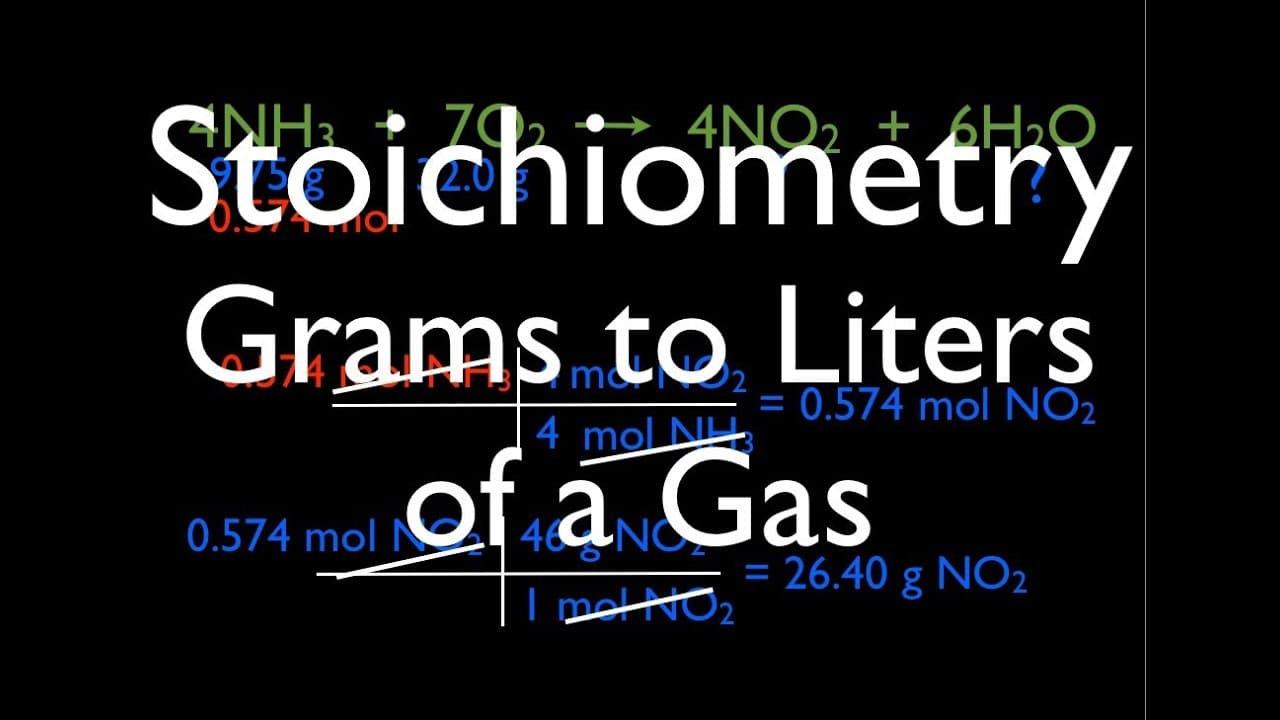
Chemical Reactions (11 of 11) Stoichiometry: Grams to Liters of a Gas
TL;DR
Learn how to convert grams to liters of gas using stoichiometry with a three-step process.
Transcript
okay in today's video we're going to go through another in our series of stoichiometry videos we're going to go and learn how to convert from grams to liters of a gas so we're going to start with a certain amount of grams of one of our reactants and we're going to produce a certain number or determine how many liters of gas we're gonna produce here... Read More
Key Insights
- 💆 Stoichiometry involves converting between mass and moles of substances in a chemical reaction.
- ❓ The balanced chemical equation provides the basis for molar relationships in stoichiometry calculations.
- 🥳 Molar ratios represent the proportion of reactants and products in a chemical reaction.
- 🫢 The molar volume of a gas at standard temperature and pressure is crucial for gas volume calculations.
- ❓ Converting grams to moles is the initial step in stoichiometry calculations.
- 💆 Utilizing the molar mass of substances allows for accurate conversion between mass and moles.
- 🫢 The three-step process in stoichiometry involves converting grams to moles, using molar ratios, and converting moles to volume (liters) of gas.
Install to Summarize YouTube Videos and Get Transcripts
Explore YouTube Video Summarizer or Get YouTube Transcript Extractor
Questions & Answers
Q: What is the first step in converting grams to liters of gas using stoichiometry?
The first step is to convert grams to moles using the molar mass of the substance provided in the balanced chemical equation.
Q: How do you determine the molar ratio in stoichiometry calculations?
The molar ratio is determined by the coefficients of the balanced chemical equation, representing the mole-to-mole relationship between reactants and products.
Q: Why is converting from moles to liters of gas important in stoichiometry?
Converting from moles to liters of gas allows us to understand the volume of gas produced or consumed in a chemical reaction, crucial for practical applications.
Q: How does the molar volume of a gas at standard temperature and pressure factor into stoichiometry calculations?
The molar volume (22.4 L/mol) helps convert moles of gas to liters, providing a standardized volume measurement for gases.
Summary & Key Takeaways
-
Video discusses converting grams to liters of gas using stoichiometry.
-
Three-step process involves converting grams to moles, using molar ratios, and converting moles to liters of gas.
-
Demonstrates converting 18.75 grams of phosphoric acid to 6.42 liters of hydrogen gas.
Read in Other Languages (beta)
Share This Summary 📚
Summarize YouTube Videos and Get Video Transcripts with 1-Click
Try YouTube Summary with ChatGPT & Claude or YouTube Transcript Generator
Explore More Summaries from Step by Step Science 📚


Summarize YouTube Videos and Get Video Transcripts with 1-Click
Try YouTube Summary with ChatGPT & Claude or YouTube Transcript Generator