Does Hot Water Really Freeze Faster Than Cold Water?
TL;DR
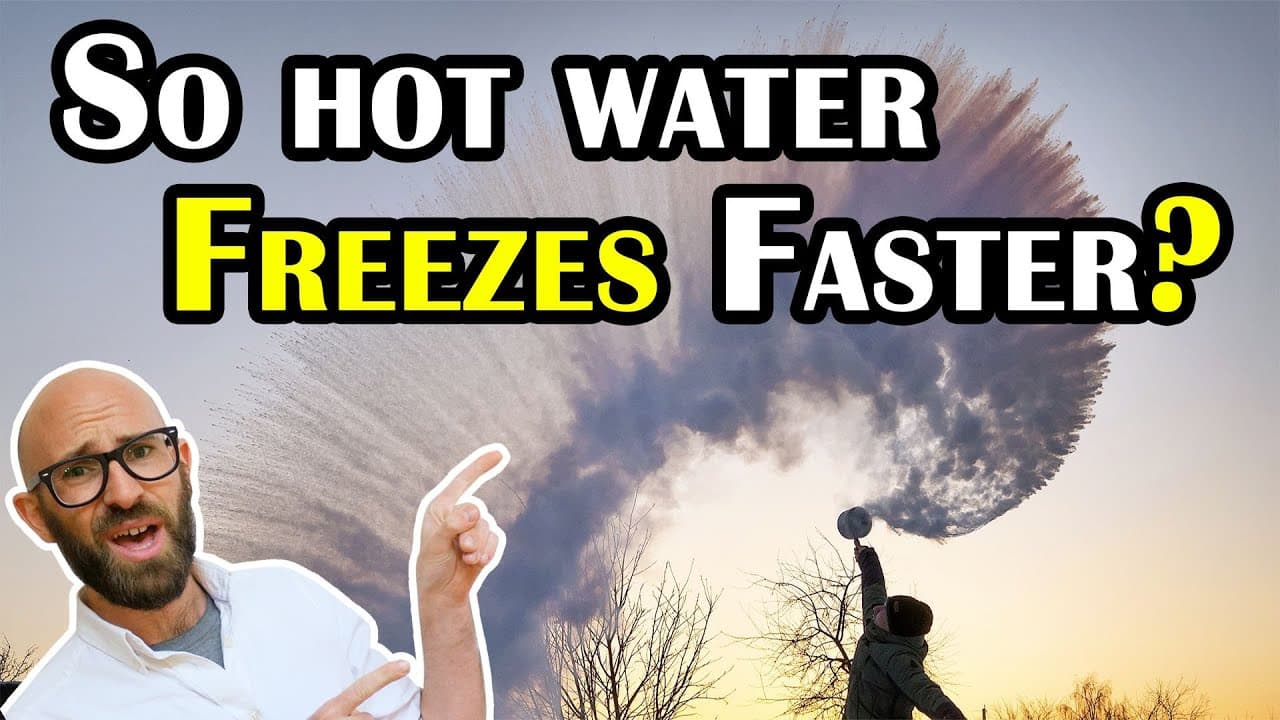
The phenomenon known as the Mpemba Effect suggests that hot water can freeze faster than cold water, but scientific consensus is lacking. While experiments by Erasto Mpemba and Dennis Osborne in 1969 proposed this effect, subsequent studies have failed to consistently replicate the results, leaving the phenomenon debated among scientists with various theories proposed to explain it.
Transcript
today's video the surprisingly heated debate on which type of water freezes faster but first there should be absolutely no debate on whether or not you use today's sponsor nordvpn to improve your internet experience the answer is yes look the internet's not like it used to be it's not 1994 these days you should be using the internet with some prote... Read More
Key Insights
- 💦 The Mapemba Effect refers to the hotly debated observation that hot water can freeze faster than cold water.
- 🧑🔬 Despite being named the Mapemba Effect after Erasto Mapemba's discovery, scientists have been unable to reproduce consistent results.
- ❓ Multiple theories, such as evaporation, dissolved substances, convection currents, and supercooling, have been proposed to explain the phenomenon.
Install to Summarize YouTube Videos and Get Transcripts
Explore YouTube Video Summarizer or Get YouTube Transcript Extractor
Questions & Answers
Q: What is the Mapemba Effect?
The Mapemba Effect refers to the controversial observation that hot water can freeze faster than cold water under certain conditions.
Q: How did scientists attempt to explain the Mapemba Effect?
Various theories suggest that the presence of dissolved salts and gases, convection currents, or supercooling may contribute to the Mapemba Effect. However, none of these theories have been conclusively confirmed by experiments.
Q: Why is the Mapemba Effect considered elusive and hotly contested?
Scientists have struggled to replicate the Mapemba Effect consistently, leading to debates and opposing viewpoints. The lack of consensus and ambiguous experimental parameters contribute to the controversy.
Q: What are some historical examples of observations similar to the Mapemba Effect?
Aristotle, Francis Bacon, and René Descartes made observations of hot water freezing faster than cold water, indicating that the phenomenon has been noticed throughout history.
Summary & Key Takeaways
-
In 1963, a Tanzanian student named Erasto Mpemba discovered that his hot ice cream mixture froze faster than his classmates' cold mixtures.
-
Mpemba conducted experiments with a visiting lecturer, Dennis Osborne, and published their results in 1969, dubbing it the Mapemba Effect.
-
Despite evidence supporting and refuting the phenomenon, no conclusive scientific study has been able to replicate the Mapemba Effect.
Read in Other Languages (beta)
Share This Summary 📚
Summarize YouTube Videos and Get Video Transcripts with 1-Click
Try YouTube Summary with ChatGPT & Claude or YouTube Transcript Generator
Explore More Summaries from Today I Found Out 📚






Summarize YouTube Videos and Get Video Transcripts with 1-Click
Try YouTube Summary with ChatGPT & Claude or YouTube Transcript Generator