What Made the Tiger 1 Tank Iconic in WWII?
TL;DR
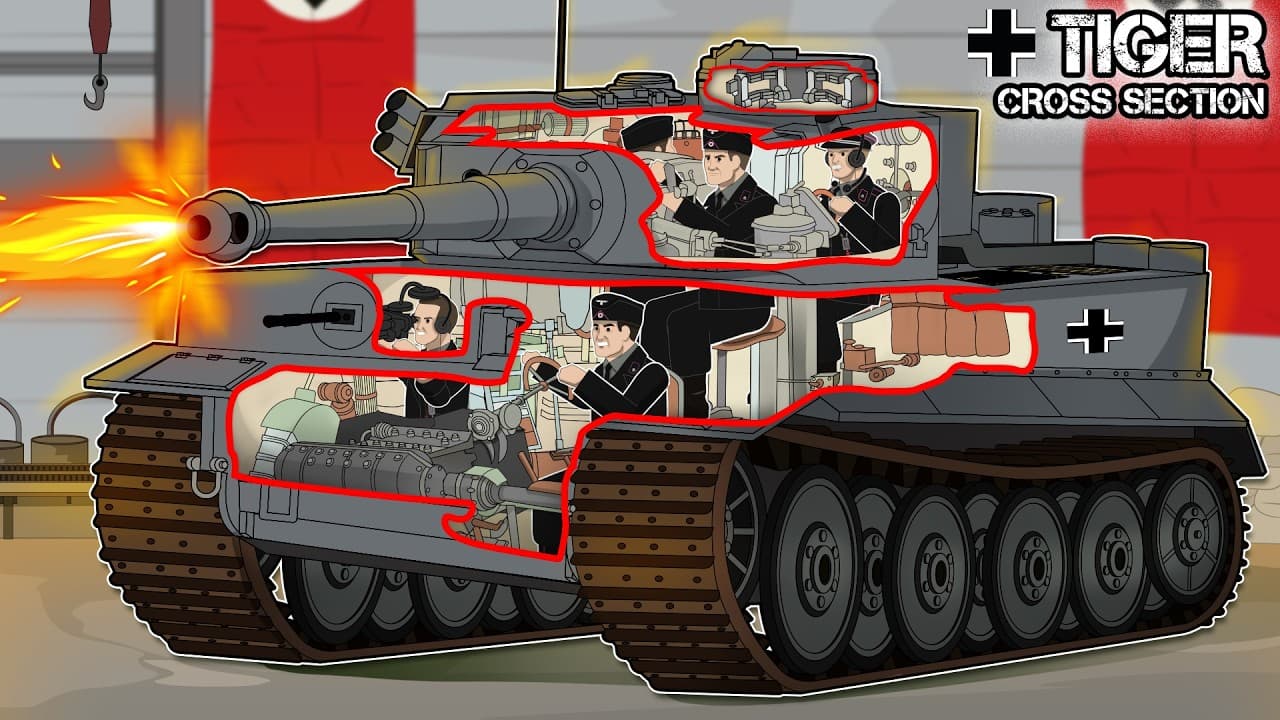
The Tiger 1 was a formidable WWII tank, featuring an 88mm gun and thick armour that made it a dominant force on the battlefield. Despite mechanical issues and high production costs, its psychological impact on Allied forces contributed to its enduring legacy as one of the war's most feared tanks.
Transcript
Thanks to Enlisted for sponsoring this video. Watch out, it's a tiger. That's not a tiger. It's a burned out truck. What about that halftrack and that? That looks like a tree. You got to stop being so paranoid. There aren't that many tigers to begin with. Our chances of running into one are told you so. The origin of the Tiger 1, arguably Germany's... Read More
Key Insights
- 🪡 The Tiger 1 tank was a result of evolving tank warfare demands, reflecting the need for superior firepower and protection.
- 😝 With a weight close to 57 tons, the Tiger 1 was classified as a heavy tank, significantly heavier than its main rivals like the T-34.
- 👻 The introduction of a powerful 88mm gun allowed the Tiger 1 to dominate the battlefield against other tanks and fortifications.
- 🧑🦼 The design included a complex system of interleaved wheels for weight distribution, enhancing mobility despite logistical challenges in repairs.
- 🪛 The Tiger 1's crew composition of five included specialized roles, ensuring effective operation and maintenance under combat conditions.
- ✋ Production challenges limited the Tiger 1’s numbers to only 1,354 units, emphasizing its high cost and complex manufacturing requirements.
- 🦾 Despite its initial battlefield successes, mechanical reliability issues often diminished the Tiger 1's effectiveness in prolonged engagements.
Install to Summarize YouTube Videos and Get Transcripts
Explore YouTube Video Summarizer or Get YouTube Transcript Extractor
Questions & Answers
Q: What was the main purpose behind the development of the Tiger 1 tank?
The Tiger 1 tank was developed in response to the need for a breakthrough heavy tank that could withstand and overpower enemy forces, particularly the formidable Soviet tanks like the KV-1 and T-34, which outmatched earlier German designs. As such, it combined heavy armor and powerful armament to ensure battlefield superiority.
Q: How did the Tiger 1's design evolve over its production run?
The design of the Tiger 1 evolved continuously during its production from April 1942 to August 1944. This was driven by operational experiences in the field, with modifications made to address mechanical issues, improve reliability, and enhance combat capabilities. Various upgrades were implemented nearly monthly based on feedback to optimize performance.
Q: What were the common mechanical flaws of the Tiger 1 tank?
The Tiger 1 tank was plagued by mechanical challenges, specifically related to its complex gearbox and engine. These issues often led to breakdowns in the field, forcing crews to abandon their vehicles during missions. Despite the tank's impressive firepower and armor, its reliability was a significant concern.
Q: How did the Tiger 1 tank impact the morale of enemy forces?
The Tiger 1 had a profound psychological impact on Allied forces, instilling immense fear due to its powerful 88mm gun and formidable armor. This fear was exacerbated by its reported battlefield performance, as tales of Tigers single-handedly destroying multiple tanks spread, reinforcing a narrative known as "Tiger phobia."
Q: What distinguished the Tiger 1 from its contemporaries?
The Tiger 1 distinguished itself mainly through its heavy armored design and powerful armament. Weighing around 57 metric tons and featuring an 88mm gun, it outclassed many contemporary tanks in both defense and attack capabilities, making it a feared opponent on the battlefield.
Q: How did the operational range and fuel consumption of the Tiger 1 affect its deployment?
The Tiger 1's operational range was limited to 45-75 miles depending on conditions, paired with a large fuel tank that resulted in high fuel consumption. These factors made logistical support crucial and often limited its sustainability in prolonged engagements, impacting its deployment during the war.
Summary & Key Takeaways
-
The Tiger 1 tank, developed during the 1930s, was a response to evolving battlefield conditions, leading to significant design changes and enhancements throughout its production.
-
Features of the Tiger 1 included an 88mm gun, thick armor, and a powerful engine, making it dominant but costly and complex with a high rate of mechanical failures.
-
Despite its battlefield effectiveness, the psychological impact and fear of encountering a Tiger tank among Allied forces contributed to its lasting legacy and mystique.
Read in Other Languages (beta)
Share This Summary 📚
Summarize YouTube Videos and Get Video Transcripts with 1-Click
Try YouTube Summary with ChatGPT & Claude or YouTube Transcript Generator
Explore More Summaries from Simple History 📚



Summarize YouTube Videos and Get Video Transcripts with 1-Click
Try YouTube Summary with ChatGPT & Claude or YouTube Transcript Generator